
[ad_1]
I’ve been trying to remember back to all the nonsense beliefs I once held, even if loosely.
Of course there was religion. I was brought up in a Jewish family and didn’t reject the whole business until I was eleven or twelve years old, when I unceremoniously declared that I was an atheist. My parents took it reasonably well and eventually would join me as atheists themselves. At the time, however, it was a lonely identity; I knew no other atheists, and of course there was no way at that tender age in the 1970s to find any others.
But even then, I felt the truth as I saw it was more important than sticking with a god-belief I simply could not wrap my head around as even remotely likely.
During preteen slumber parties, my friends and I would use a Ouija board to ask the universe questions. The planchette (I just looked up that word) would race around the board like it had a mind of its own. It didn’t. It was us. We all knew it but pretended not to. It was grand fun.
We would try to levitate one another but would never quite get our “floating” selves above the many fingertips holding us aloft. Still, some would swear that it happened.
I had a really strange exposure to Erhard Seminars Training (EST)—or some similar “mind control” or Zen Buddhism-lite program—at my public middle school. The episode is a vague memory of my entire grade spending multiple days in the school’s auditorium being guided by someone who wanted us to get in touch with our inner selves. It was a long time ago, and I don’t remember much except there was an uproar from parents, understandably. Apparently, the principal took it upon himself to foist this on the students. We were just happy to be out of our regular classes.
As a kid, I found astrology mildly intriguing. Maybe it was because my Taurus star sign seemed to so well describe my stubborn streak. Maybe it was because the newspaper always had a horoscope column and that gave it the veneer of credibility. Maybe it was the ubiquity of Zodiac charts and astrology tchotchkes alongside the tie-dyed t-shirts, peace buttons, and suede fringed vests in the coolest shops of the times.
In those days, “What sign are you?” seemed to be the universal ice breaker at parties, until it (thankfully) became hackneyed and mocked.
Yet even as it was an occasional diversion to “check” my horoscope in the newspaper, I never believed the basic premise that the movement of celestial bodies influenced human characteristics or divined the future.
Psychics were ridiculous, always. Who sits in a little room with a red neon “Psychic” sign glowing in the window if they could actually tell the future when the key to immense wealth is simply to buy low and sell high? But even as an adult, I had some very smart friends, women friends exclusively, who consulted psychics. These women were convinced that their psychic was the real deal. I was flummoxed by the gullibility. And when it was reported that Nancy Reagan relied upon astrologer/psychic Joan Quigley to guide her (and to some extent her president husband’s) life while in the White House, I started to realize that astrology was not a harmless trifle.
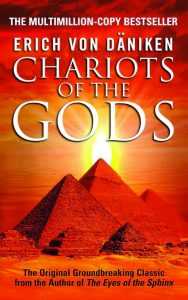 There was one charlatan who got me, though. I bought (literally and figuratively) everything he was selling. Can you guess who it was? It was the purveyor of ancient astronauts, Erich von Däniken. I read his book Chariots of the Gods probably at about twelve years old. The evidence that ancient peoples were visited by advanced aliens from space appeared strong to me. I went on to read his subsequent books, convinced that it explained a lot about the art, technology, and religious beliefs of various human civilizations.
Boy, was I wrong. Thank you, Carl Sagan! He and other scientists took on von Däniken’s claims, methodically documenting their inaccuracies. Von Däniken’s thesis, it turns out, was a cornucopia of logical fallacies, cherry-picked facts, and made-up storytelling. He didn’t bother to know much about the civilizations he was writing about before attributing some ancient artifact to an astronaut helmet or a giant geoglyph to an alien aircraft landing strip.
That was a lesson in credulity I wouldn’t forget.
 A book titled The Space-Gods Revealed—with a foreword by Sagan—came out in 1976, the same year that the Center for Inquiry’s originating organization, the Committee for the Scientific Investigation of Claims of the Paranormal (CSICOP), was founded. Just as I was hitting the Age of Reason, the skepticism movement was organizing itself into a fighting force, pushing back on the tsunami of woo nonsense that permeated the culture.
I could not have predicted then, nor could Joan Quigley have done so, that fifty years later I would have the honor to serve as a lieutenant in that army. An army made up of scientists, rationalists, logicians, magicians, technicians, critical thinkers, writers, researchers, activists, and a whole lot of smart, committed people. People who share one thing in common: they value an evidence-based worldview—in other words, the truth. Something that was back then, as it is today, worth fighting for.
[ad_2]
Source link
