
[ad_1]
A U.K. jury is mulling the case of four protesters who raided Wolverhampton arms factory said to produce “military aircraft parts for Israel,” John McEvoy reports.
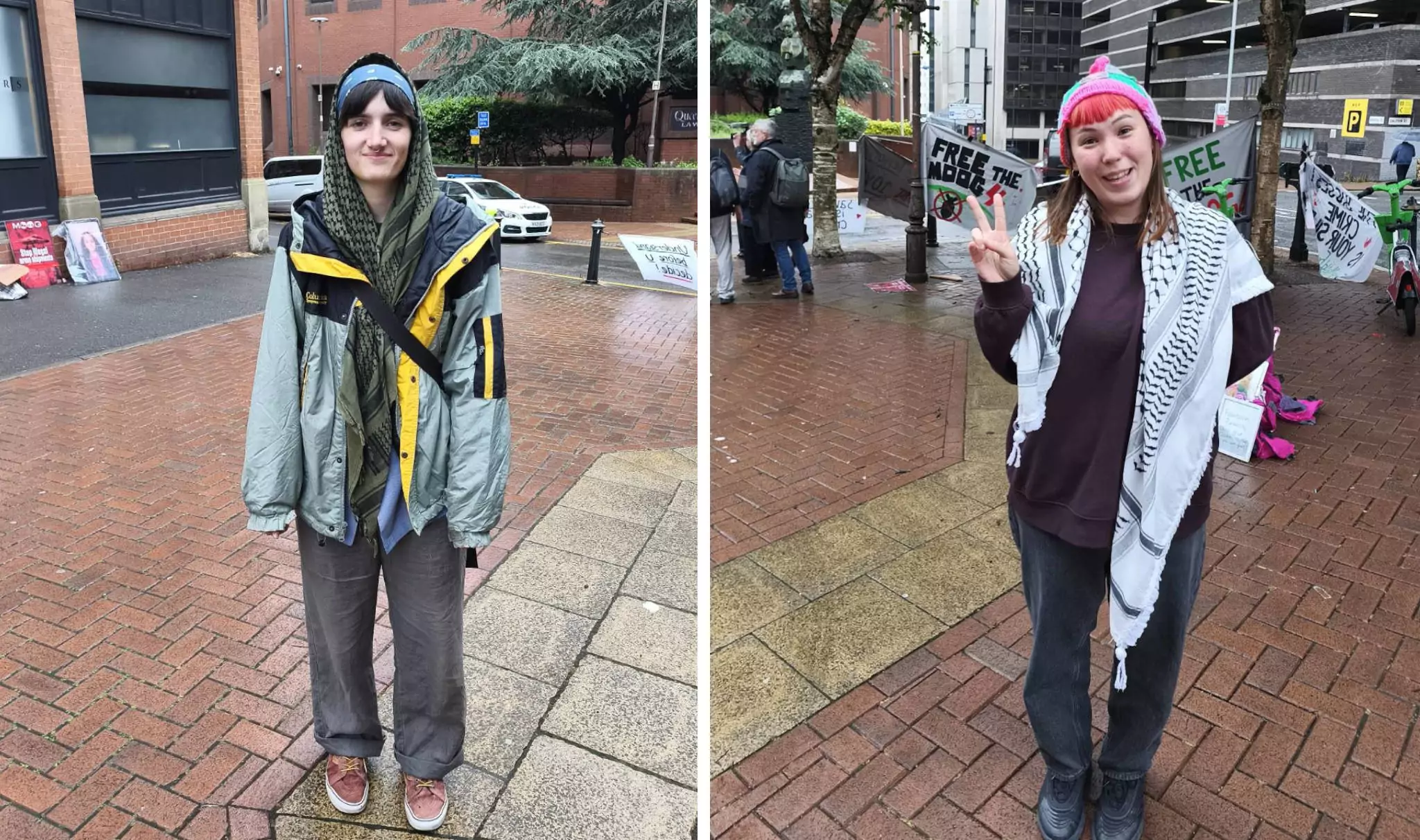
 A jury at Birmingham crown court is deliberating whether four pro-Palestine activists committed criminal damage at an arms factory in Wolverhampton.
Defendants Iain Evans, Hisham Alkhamesi, Frank Sherman and Hana Yun-Stevens believed the factory, used by arms firm Moog, supplied weaponry to Israel.
They climbed onto the roof in August 2025, smashed equipment and unveiled a banner saying “Free Palestine” while wearing T-shirts with the names of Palestinians killed in Israeli airstrikes.
Social media posts relating to the action and shown to the jury described Moog as a manufacturer of fighter jet components which are supplied to Israel.
During the five-day trial, the defendants told the court that they had been on protests but felt unable to effect change, leading to the decision to engage in direct action.
Jurors were unable to reach a verdict this week and have been discharged until Tuesday.
BREAKING: Four action takers crash through two gates and climb on top of a weapons factory called ‘Moog’.
The Wolverhampton firm supplies Elbit Systems Israel with military aircraft parts, used to train Israeli pilots to fly F-16 and F-35 fighter jets. pic.twitter.com/MXkJghyeVY
— The Aftershock (@The_Aftershock_) August 26, 2025
One of the defendants, Sherman, who identifies as they/them, chose to give their own closing statement Thursday rather than let a barrister advocate on their behalf.
Sherman, 23, told the jury they would always believe disrupting the factory was “not criminal” and that any repercussions they may face could not “compare to how I would feel if I had not taken action”.
Lawyers for the other defendants reminded the jury of its powers – referencing the Magna Carta and the Bushell case, a landmark ruling from 1670 which established the independence of juries.
They also mentioned how the suffragettes “did a bit of smashing themselves.”
The prosecution’s lawyer noted how “there is no dispute that these defendants… believed that the business they targeted was involved in the supply chain to Israel”.
But the trial, he said, “is not about Israel, it’s not about Palestine… It’s simply about whether they unlawfully damaged property.”
The four defendants have all pleaded not guilty to criminal damage.
‘The Lives We Would Save’

Queen Elizabeth Law Courts, the crown court venue in Birmingham, U.K. (David Stowell /Wikimedia Commons/ CC BY-SA 2.0)
During cross-examination on Tuesday, Yun-Stevens, 24, explained the concept of direct action as “going to the source of production and disrupting it, having an immediate impact.”
Yun-Stevens said the primary intention in scaling Moog’s roof was not to cause criminal damage but to “disrupt the factory’s operation which we deemed to be criminal.”
Solar panels and windows were smashed during the incident with the stated goal of slowing down the factory’s production line and exposing machinery to rain damage.
Alkhamesi, 23, told the court on Tuesday that the “main intention” of the action was “to occupy the roof” because the “factory can’t operate while we’re on the roof.”
He explained how his life had been shaped by his grandfather, Abdullah Alkhamesi, who founded the Yemeni Red Crescent in 1973.
Alkhamesi’s grandfather died in 2017 because he was unable to receive healthcare in Yemen amid a military blockade imposed by Saudi Arabia.
The court also heard how Alkhamesi contributed money left to him by his grandmother to fund the direct action campaign against Moog.
Evans, who previously worked in the aerospace sector, told the court: “We believed the longer we stayed up there, the more lives we would save. The idea was that the longer we stay on the roof, the longer the factory would be shut down.”
Each action taker from ‘Palestinian Martyrs for Justice’ is wearing a t-shirt in honour of four martyrs: Hossam Shabat, Refaat Alareer, Adnan Al-Bursh and Raghd Al-Jabri.
They’re calling for support as they shut down weapons factory Moog, Wolverhampton, WV9 5GB. pic.twitter.com/KtOEW1mXcE
— The Aftershock (@The_Aftershock_) August 26, 2025
He intimated at the importance of direct action with reference to the concept of “just in time” supply chains, wherein items are delivered right before they are needed in order to reduce stockpiling costs.
“Any delay in that process, if [a company] is late in delivery, that has knock-on impacts because obviously they’re not keeping a stockpile of parts in a warehouse,” Evans said. That means “immediate impacts on the supply chain.”
All of the defendants emphasised that they had been involved in Palestine marches over recent years and felt they were not making a significant enough impact on events.
Yun-Stevens noted in court how a full arms embargo has still not been imposed on Israel.
The defendants further explained how the action was taken in the early hours of a bank holiday Monday in order to prevent interaction and potential confrontation with Moog staff.
Closing Statements
During closing statements Thursday, Sherman explained that “the care that we as a group put into the direct action that we took can only be spoken of by one of us.”
Sherman, who previously volunteered in support of refugees in Athens and Calais, told the court that: “The reason we are here standing trial is because we took direct action.”
Direct action, said Sherman, is akin to seeing “a room is flooding because the tap is turned on and you spend time ringing people to try and get them to turn off the tap, but they are refusing to come even though you can see the damage it’s causing. Direct action is turning off the tap yourself.”
With reference to their co-defendants, Sherman continued: “As Iain told you, the longer we stayed up there, the more lives we could save; as Hisham told you, we intended to disrupt shipments, disrupt production; and as Hana told you, we disrupted only what we deemed to be criminal.”
Sherman declared: “I will always in my heart know that using care and intention to disarm the factory is not criminal.”
They closed their statement by reading the poem “If I Must Die,” by Palestinian author Refaat Alareer.
The other three defendants retained their legal representation for closing statements.
Representing Alkhamesi, defence counsel Mira Hammad told the court that her client was in some ways “the least likely person you could imagine to get on that roof.”
As a “shy straight-A student” who “sits in the corner of the room and likes to talk about books,” Alkhamesi was not the type of person who would be expected to “climb onto the roof of an arms company.”
Yet there was “no mystery about why the [four defendants] were there either,” said Hammad. “It wasn’t for personal gain, to get anything for themselves.”
The explanation, she said, “was on their T-Shirts. It’s right there in the prosecution case” and “the tweet” discussing “military aircraft parts to Israel.”
Defence counsel Tom Wainwright, representing Evans, emphasised the importance of jury trials and noted how they were coming under attack in the U.K.
“The history of trial by jury we are not taught about in school compared with other rights and liberties,” he said. “But it is marked by control being wrested away from those in power and back to the local community.”
John McEvoy is chief reporter for Declassified UK. John is an historian and filmmaker whose work focuses on British foreign policy and Latin America. His PhD was on Britain’s Secret Wars in Colombia between 1948 and 2009, and he is currently working on a documentary about Britain’s role in the rise of Augusto Pinochet.
This article is from Declassified UK.
Views expressed in this article may or may not reflect those of Consortium News.
Please Donate to the
Spring Fund Drive!


[ad_2]
Source link
