
[ad_1]
In Jessica Riskin’s beautifully written new book, The Power of Life, with the deliberately imitative eighteenth-century style subtitle, The Invention of Biology and the Revolutionary Science of Jean-Baptiste Lamarck, she makes a powerful heretical case, set in italics, that Lamarck was Right. To do justice to that sentence, which is indeed heretical, you need to read the entire book. It’s worth the effort, not least because Riskin writes with the vitality of a good novelist and the precision of a scientist; she is also committed to the idea along the way that the separation of science from other forms of knowledge has damaged both the sciences and the humanities. It’s a good read and full of details that only a very good scholar could unearth and from which we all might learn about the most famous and influential biologist before Darwin.
Lamarck, as virtually anyone who thinks about these subjects at all knows, is far more than out of fashion. Mainstream science and the popular imagination are in agreement that Lamarck was wrong about evolution. Lamarckian ideas have been officially and unofficially banished for more than a century. And “Lamarckian ideas” is widely accepted to imply that characteristics acquired during an organism’s lifetime can be transmitted to future generations, which we are told was refuted by Darwin. That Darwin did not even have the concept of genes, or that he did not believe that all inheritance is genetic, has not diminished at all the widely held sense that Lamarck got it wrong and Darwin got it right. Although Darwin denied learning anything from Lamarck, he conceded in a letter to Lyell that they came to similar conclusions.
As a passionate and long-time scholar of Darwin, as much of my earlier writing shows, I need to make it clear that I remain very much a Darwinian, but, largely through the efforts of Riskin and my astonished belated reading of Lamarck’s brilliantly original book, Zoological Philosophy, I have become a Lamarck fan as well.
Few major scientific figures have been so badly treated as Lamarck, and Riskin sets out to right some of the wrongs done to him. She certainly has more at stake than redeeming Lamarck’s long vilified name, but that is an important place to start. The vilification began early in, among other things, the humiliation to which Napoleon himself subjected Lamarck, and yet worse, in the “Eulogy” by his contemporary, the famous scientist Georges Cuvier. In his “eloge”—his memorial “praise”—Cuvier wrote that Lamarck had “constructed vast edifices on imaginary foundations, resembling the enchanted palaces of our old romances.”
Did you know that Lamarck was the first to use the word “biology” (in French, of course) and the first to conceive biology as a separate science?
But hang on for a second. Did you know that Lamarck was the first to use the word “biology” (in French, of course) and the first to conceive biology as a separate science? Did you know that Lamarck invented the category “vertebrates,” separating them off from “invertebrates” in scientific study? Did you know that fifty years before Darwin, he developed the first full theory of evolution and had no hesitation, unlike Darwin, in publishing it? You might “know,” also, that Lamarck was wrong and Darwin was right. But Lamarck wasn’t wrong about the fact that evolution happened. All good science since has demonstrated that as a fact. He was wrong about how evolution worked. But wasn’t Darwin also wrong about a great many things, such as completely misunderstanding (or not knowing about) the mechanics of inheritance?
What is at stake in the Darwin-Lamarck contest as it is popularly understood is the question of how these things happen. I am sure that they both got that “wrong,” in a certain sense, though both got it right on the initiating key matters: that organisms do “evolve,” and that they do so by way of interaction with the environment.
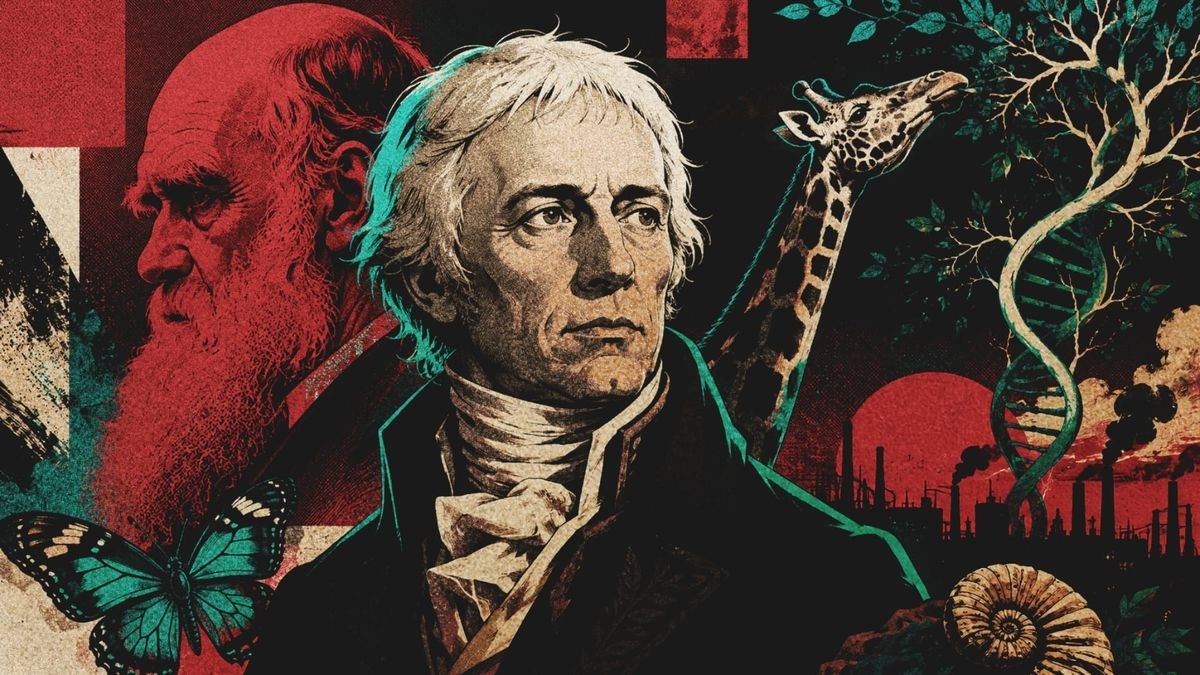
I’m sure you’ve heard and laughed at the Lamarckian idea that giraffes developed their long necks by stretching to reach the higher leaves in trees, so that the long neck evolved by virtue of their own efforts—by giraffian intention. Wanting to get at the leaves that others couldn’t reach, giraffes stretched their necks, and boffo, big necks they got. They have been hanging Lamarck on the giraffe’s neck for a long time. But did you know, as Riskin tells us, that the poor giraffe, invoked in almost every put-down of Lamarck, occupies but a single paragraph of Lamarck’s massive, encyclopedic, and ambitious works.
Alternatively, something I learned in my long readings of Darwin: when we now talk of “Darwinism,” in light of contemporary consensus we invariably mean not what Darwin wrote, but a modern variation on Darwin’s thought, produced in what is called the “modern synthesis,” which wasn’t fully formulated until the 1930s. This modern synthesis, called “Darwinism,” excludes the fact that Darwin too believed in use and disuse as important elements in evolution. The idea is worked out in at least one chapter in the Origin; and as Riskin points out, it is affirmed in almost every work of Darwin. I noticed this fact forty years ago, when I started reading Darwin seriously and quoting, as everyone does, that wonderful and moving last paragraph of On the Origin of Species. The idea is there too. In listing the “laws” that have produced the “entangled bank”—that evolutionary metaphor in which we live—Darwin includes, bold as brass, “use and disuse.” Here it is in all its literary glory:
It is interesting to contemplate a tangled bank, clothed with many plants of many kinds, with birds singing on the bushes, with various insects flitting about, and with worms crawling through the damp earth, and to reflect that these elaborately constructed forms, so different from each other, and dependent upon each other in so complex a manner, have all been produced by laws acting around us. These laws, taken in the largest sense, being Growth with reproduction; Inheritance which is almost implied by reproduction; Variability from the indirect and direct action of the conditions of life, and from use and disuse; a Ratio of Increase so high as to lead to a Struggle for Life, and as a consequence to Natural Selection, entailing Divergence of Character and the Extinction of less improved forms. Thus, from the war of nature, from famine and death, the most exalted object which we are capable of conceiving, namely, the production of the higher animals, directly follows. There is grandeur in this view of life, with its several powers, having been originally breathed by the Creator into a few forms or into one; and that, whilst this planet has gone circling on according to the fixed law of gravity, from so simple a beginning endless forms most beautiful and most wonderful have been, and are being evolved.
Unsatisfied even with his own explanations of how evolution happened, Darwin worked out a theory explaining the mechanism of use and disuse in his two-volume opus, Variation of Animals and Plants Under Domestication, the last part of which is devoted to his theory of “pangenesis.” Not genes but gemmules, developed in the course of the lives of the organisms, explain inheritance, including inheritance of characteristics acquired during an organism’s lifetime.
Historians of science have long noted that there is a remarkable overlap (which Darwin himself wanted to minimize) between his ideas and Lamarck’s
Of course, I’m not saying that because Darwin believed in “use and disuse” that the idea is true. Modern science so disbelieves it that it excludes it from its reading and understanding of Darwin. I am only pointing out what historians of science have long noted, namely that there is a remarkable overlap (which Darwin himself wanted to minimize) between his ideas and Lamarck’s, and that Lamarck, on the other hand, had many important and useful ideas about evolution and had the courage (and Riskin’s book makes clear how much courage it required) not only to formulate and state a theory of evolution, but to work it through systematically. Darwin, on the other hand, hung back more than twenty years from announcing his belief in evolution, wary precisely of the kind of fate that had befallen Lamarck.
The excitement of Riskin’s book is not only in its vivid biographical study of Lamarck, of the close and highly contextualized consideration of his ideas, and of the drama involved in their very formulation and development. The true center of the book’s argument is that in banishing Lamarck and Lamarckian ideas from mainstream science, science has in effect left the world barrenly inert, with no agency in anything but the living minds of “advanced” organisms, that is, human beings. Lamarck’s vision was of an interactive world, in which organisms above the level of single-celled amoebas are active in attempting to adapt to environments and thus also in helping shape their environments. In the modern synthesis, organisms are passive victims of genetic transformations and environmental changes with which they have nothing to do.
The late 19th century zoologist, August Weismann, successfully convinced the scientific community that such transmission was absolutely the only one: genetic variations, mutations, that give some organisms advantages in the struggle for life. The Weismann barrier was established. Riskin, capable of quiet biting ironies, has a wonderful chapter called, “He cut off their tails,” describing Weismann’s “decisive” experiment in which he cut off the tails of mice and saw that their offspring nevertheless had tails: ergo, acquired characteristics can’t be inherited.
With nothing but genetic transmission, if the environment were to change, then bad luck, unless, good luck—some genes mutate in the right direction! Any Lamarckian idea that the will of the organism had anything to do with evolution was, then, effectively banished. Lamarck was out on his tushy (or derriere, if you prefer) and forever. Within orthodox science for well over a century, organisms remained entirely passive creatures, subject to the vagaries of genes and chance. But for Riskin, life makes the world. Neither the organisms, nor the world, are dead.
A Darwinian lesson that I learned long before I came to Lamarck is that the world is in constant motion, constantly changes, and the changes can be the result of things that life does. In one wonderful chapter, Darwin shows how enclosure laws, which kept grazing animals out of certain areas, absolutely changed the landscape, and the creatures that thrived there. On a larger scale, as Lamarck well knew, activities of living beings—intentional human beings—change the landscape, which forces changes in what is entailed in “adaptation,” which leads to evolutionary change, or can, in the long run. This is something of which Lamarck was well aware.
Natural selection and Lamarckian evolution are not necessarily incompatible theories. Riskin points out that in 1896, James Mark Baldwin published a paper called “Organic Selection,” which, after first being contested ferociously “had recently achieved widespread acceptance among biologists.” “Organic Selection means selection that an organism enacts upon itself by behaving in certain ways.” For example, once humans found that opposable thumbs could help in survival, natural selection did its work and those born with opposable thumbs had a greater chance to survive. In this case, natural selection and something like Lamarckian intention co-exist. In fact, they depend upon each other. Human desire and intention change what it is to adapt. So, as Riskin puts it, “organisms aren’t just the passive objects of natural selection but its active conductors.” Hey, that might be a way to make Lamarck’s poor abused giraffes respectable.
For Lamarck, via Riskin, organisms are active in their own adaptiveness. They are capable of changing the environment to make it compatible with their needs. And here Riskin introduced me to a powerful and crucial element of Lamarckism that we have all ignored to our peril: Organisms are capable of changing their own environments. Usually, they do it in what they take to be their own interest. As we have all too slowly become aware, we have been working toward a new era: after the Pleistocene has come the Holocene and now (though still disputed) the Anthropocene—the era “defined by significant human impact on Earth’s geology, climate, and ecosystems.”
Whether we accept the term or not, it has been hard to ignore that we organisms are changing our own environments. We have been doing it in what are our immediate interests without recognizing all the consequences of our self-interest. And, despite Lamarck, we can fail to see that in part because we have consistently treated the world as our great passive coal mine, an object not alive, but there for us to use and exploit. One depressing and horrifying fact of which Riskin has made me aware is that just about every major figure in the development of the “modern synthesis” was a eugenicist. Clearly, this is no accident. Humans, from the perspective behind the Weismann barrier, are objects to be manipulated, coal mines to be dug out. Bad gene clusters to be eliminated. It is partly as a polemic against this view of the absence of agency in this world that Riskin devotes the later part of her book. But it never takes the shape of polemic.
As with everything else in the book, it is argued with substantial scholarship. It has at least changed my view of the “modern synthesis,” most of whose theorists I had previously tended to celebrate as intellectual heroes. But as the final chapter of Riskin’s book puts it, this world is a “Life Made World,” and recognizing the implications of this is crucial to our mutual adaptations and to our ultimate survival. What Riskin shows is that for Lamarck the kind of thinking implicit in the modern synthesis was and remains a moral and physical disaster. Riskin calls to our attention a stunning footnote from Lamarck’s last book that is well worth repeating:
Man, belying his own interests by his shortsighted selfishness, and by his inclination to enjoy all that is at his disposal, in a word, by his carelessness for the future and for his fellows, seems to work toward the annihilation of his own means of conservation and the very destruction of his own species. By destroying everywhere the large plants which protect the soil to satisfy his impetuous greed, he quickly renders sterile the soil on which he subsists, causes the springs to dry up, repels the animals who found their subsistence there, and causes large portions of the globe, once very fertile and highly populated, to become bare, barren, uninhabitable, and deserted. Impervious to the counsel of experience, abandoning himself to his passions, he is perpetually at war with his fellows, destroying them on all sides and under all pretexts, so that we see populations that were formerly considerable becoming increasingly impoverished. It seems that man is destined to exterminate himself after making the globe uninhabitable.
An astonishing vision in 1821, a remarkably accurate vision for 2026. Could it be that Riskin is right in saying that Lamarck was right? He was certainly right on this last matter.
[ad_2]
Source link
