
[ad_1]
On Wednesday afternoon, senior U.S. administration officials finally read the text of a memorandum of understanding with Iran, days after it was digitally signed. The 14-point plan gives the United States and Iran a 60-day runway to figure out a long-term deal to end the ongoing military conflict. On a call with reporters, officials described the MOU as an important step but not a bailout.
“It commits us to quite literally nothing,” one official said. “But of course, if the Iranians do a lot of good, then we want to reward that good behavior and transform their relationship with the Middle East and the world.”
Both President Donald Trump and Vice President JD Vance signed the MOU digitally on Sunday, but delayed publishing the text at the request of the Iranians. Another U.S. official said they agreed to abide by Iran’s timeline to begin to build trust. Trump signed a physical version Wednesday evening in France, but he’s sending Vance to a formal signing ceremony in Geneva, Switzerland, on Friday.
At a press conference in France at the G7 Summit, the president tempered expectations, saying he would resume bombing if the 60-day agreement did not result in a peace deal. He both acknowledged and warned his vice president.
“If it works out, I’ll take the credit. If it doesn’t work out, I’m blaming JD. You better be careful, JD,” Trump laughed.
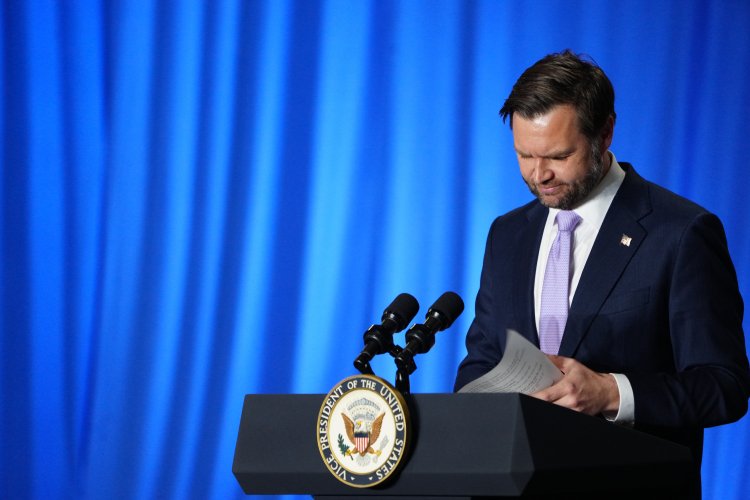
Vance has adopted the role of top public spokesman to herald the plan and convince the American people that it is not simply a repeat of the Obama administration’s Joint Comprehensive Plan of Action. The timing coincides with the release of Vance’s faith-based memoir, Communion. His everywhere-at-once media availability could represent a pivot not only for a future 2028 campaign but also for the office of the vice presidency.
“It’s very high risk and potentially very high reward, but there’s certainly a lot of risk involved in what Vance is doing,” attorney and presidency scholar Roy Brownell told RealClearPolitics. “I think it’s fair to say that conservatives who are hawkish probably are not going to be for Vance anyway. That said, it’s a little bit surprising that the administration has pushed Vance out forward to push what could be seen as a dovish sort of policy, which is ending the conflict.”
Vance came into the vice presidency with less than a U.S. Senate term under his belt, a memoir about his upbringing in Appalachia, and a juris doctor from Yale. He had neither the foreign policy experience nor the congressional relationships that Secretary of State Marco Rubio had amassed, and Trump has enjoyed pitting the two against each other in recent weeks. At political rallies and in interviews, he’s asked whether voters prefer Rubio or Vance, making clear that he has not chosen a successor to vie for the office in 2028. This week, Vance appears to be on the rise.
“Up until this week with the agreement, I think that Vance’s vice presidency has been largely comparable to the [Mike] Pence and [Kamala] Harris vice presidencies,” Brownell said.
Vance is not the first vice president to be so involved in foreign policy. Vice President Dick Cheney was known for leading negotiations with other countries to join the Iraq War. Al Gore negotiated with the former Soviet Union to work out post-Cold War nuclear issues. But the American vice presidency’s influence on the world stage has waned in recent administrations.
“The vice presidency, since the first Cheney term, has been in general decline, and I would say in unhealthy decline since Biden left the vice presidency in 2017,” Brownell said. “It may be this may be a turning point, maybe demonstrating that Vance’s views are sort of the present sort of starting to come around to them, at least maybe with their perspective on foreign engagement.”
Vance might be the face of the administration’s position, but no one doubts that Trump holds all the levers. During his first term, Trump gave then-Vice President Mike Pence leadership of the coronavirus task force and then publicly contradicted Pence on several occasions. Even in the past few months, Vance has said Iran and the U.S. were close to a deal, and then Trump resumed bombings. But Christopher Devine, a professor at the University of Dayton and author of books on the vice presidency, noted that this is part of what he signed up for.
“This is quite typical for vice presidents. They are, by definition, in a subordinate role to the president,” he said. “These are very valuable, significant roles, but it’s distinct from actual leadership in the sense of exercising power, making decisions.”
There are political benefits for both the White House and Vance if they can wrap up the war quickly. Since the first joint strikes on Feb. 28, Trump’s approval ratings have sunk from 43.5% to an all-time low of 39.6% in May, according to the RCP average. His numbers are ticking up slightly, but still underwater. Traditionally, the president’s political party fares poorly in midterm elections, particularly when the president is unpopular. With gas prices beginning to ease with the announcement of the MOU, the GOP could right the ship before campaign crunch time.
Vance appears to be on a portfolio expansion spree, taking on roles not only in the Iran negotiations but also with the anti-fraud task force. Devine said it all matters for 2028.
“It looks pretty good for him as someone who can engage at a high level and be trusted by the president on two very different types of issues,” he said. “It speaks to some versatility, if he is effective, to show competence and expertise.”
The results will inform Vance’s political future. Pence’s legacy in the job has not been any particular policy but rather his refusal to block the presidential election certification in 2021. Former Vice President Kamala Harris’s failure to visit the southern border until she was campaigning cast a shadow over her bid for the presidency, despite her nickname “border czar” and her responsibility to research the root causes of migration.
“The reality is that rarely have vice presidents actually exercised influence in either foreign or domestic issues. So if it’s true that Vance is doing so, that would be pretty significant and a testament to his role in the administration.”
On the flip side, Vance could still shoulder the burden if the war with Iran progresses into the fall. The MOU would expire in early August, less than three months before the midterm elections. And beyond that, there is no guarantee that U.S. ally Israel will comply with the ceasefire and loosening of sanctions.
“There’s a lot that’s beyond Vance’s control here about this agreement potentially unraveling,” Brownell said. “If it goes south, it’s going to be hard for him to position himself as an excellent and attractive candidate. This could be the defining matter of his term in office. This isn’t like fumbling the OSU national title trophy [referring to Vance dropping the base of the trophy while greeting the Ohio State team at the White House]. This could be fumbling the nation’s national security.”
Early reaction from members of Congress has not been entirely favorable. Sen. Lindsey Graham, a Republican from South Carolina, initially cautioned that Vance, as the architect of the MOU, needs to brief Congress on the details. He then came out in support of it on Wednesday. Sen. Bill Cassidy, a fellow Republican from Louisiana, called it the worst policy blunder in decades. Sen. Ted Cruz, a Texas Republican, told reporters that he believes the president has been receiving bad advice if it results in any release of money to Iran.
A U.S. official read the 14-point memorandum to reporters on a call on Wednesday. But foreign policy analysts aren’t popping champagne and celebrating peace just yet.
“It’s really a 60-day interim period of opening the Strait [of Hormuz],” Brookings Institution senior fellow Michael O’Hanlon told RCP. He said that open questions about Iran’s nuclear and missile programs, frozen assets, and support for proxy terrorist groups will be difficult to solve in that period. “It’s more than a ceasefire but way less than a peace deal or formal agreement. The idea of having a signing ceremony is oxymoronic, because it implies that what you’ve got is some kind of lasting document when you don’t.”
In a nod to the MOU’s precarious position, Trump told reporters on Wednesday that he does not consider the 60-day period a firm deadline.
“Just as long as they’re behaving, I don’t care,” he said of Iran.
On a call with reporters, a U.S. official said the Switzerland signing ceremony is more than just pomp and circumstance, but diplomatic relations are still uneasy.
“Meeting this weekend in Switzerland will be quite critical to really see how we get to the next phase, and I think this document basically has continuations of what all the different parties want to do,” the official said. “If one party is obviously not meeting the expectations of the other party, we’ll hopefully know within days or weeks, not months. And… obviously, President Trump maintains a ton of optionality on what he’ll do.”
Carolina Lumetta is White House correspondent for RealClearPolitics. Follow her on X @CarolinaLumetta.
[ad_2]
Source link
