
[ad_1]
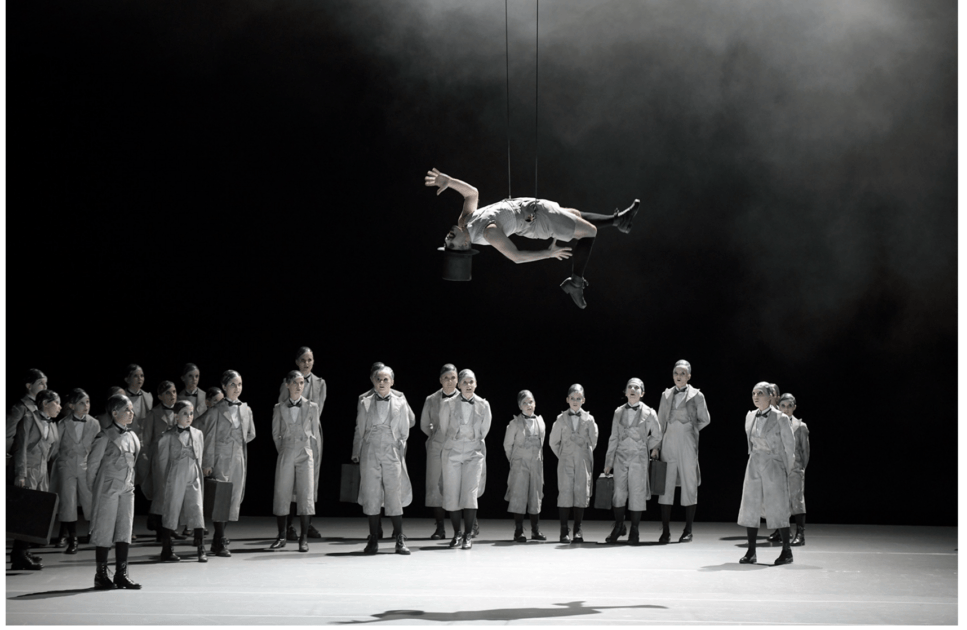
Benjamin Britten’s Midsummer Night’s Dream with members the Children’s Choirs of the Deutsche Oper and Jami Reid-Quarrell as Puck (photo: Deutsche Oper).
As my sojourn in Berlin tips towards its conclusion and the return to Fortress America looms, I’m going to concerts: I’ve included one opera over the four days of the long weekend that ran from Ascension Day (Himmelfahrt)—always a Thursday—and ended last Sunday evening.
Jesus’ trajectory forty days after Easter Sunday was vertical—straight up toward Heaven. His reunion with his Father—none other than himself in a different form, a family dynamic that makes any Oedipal complex exponentially harder to work through—perhaps explains why Ascension is also celebrated as Father’s Day (Vatertag) in Germany.
Berlin, by contrast, is horizontal. The slight and gentle inclines in the topography are almost imperceptible, though they become more apparent when riding a bike through the city. Any hill you see or climb is manmade: heaped up war rubble or a picturesque folly of a more distant past.
My pieced-together musical festival began on Ascension Thursday, when I cycled through the flat city to the Deutsche Oper for a farrago performance of Benjamin Britten’s A Midsummer Night’s Dream.
The Shakespeare play on which the opera is based had a father, a mean-spirited one named Egeus, who forbids his daughter Hermia to marry her beloved Lysander. Meanwhile, custody of one orphaned—i.e., fatherless—“Indian” boy is battled over by the Fairy King and Queen, Oberon and Titania. For reasons of economy, Egeus was cut from the opera cast along with the rest of Act I by the librettists—Britten working together with his partner, the tenor Peter Pears. Pears appeared in the original 1960 production in the role of Flute, a bellows mender, who then takes the part of Thisbe in the bungled on-stage play that closes the opera. Singing something generally takes longer than speaking it. The patter-song pace of Gilbert-and-Sullivan is not Britten’s.
Britten was one of the most committed and creative of twentieth-century composers for children’s choir, and in this work, the host of fairies is made up by kids. In A Midsummer Night’s Dream, Britten gave accessible but alluringly off-kilter harmonies and crossed melodies that seem both familiar and strange. The children’s choirs of the Deutsche Oper sang his uncanny music with a kind of eerie clairvoyance, as if intoning the fears, desires, and follies of the humans who could not see or hear them. Because of the secular/sacred national holiday, many family members and friends of the choir members were in the audience. Among them were many fathers. The hometown crowd’s enthusiasm filled the auditorium not just in the final applause and volleys of bravos.
High spirits reigned, even if the look of the production was dour. Costumed by Annemarie Woods, the fairies (both big and small) were clad in tarnished white frock-coat tuxedos with flared shorts. The ghostly hue of these clothes was offset by black boots below and black bow ties, blackened eyes, and slicked-down black hair above. The only silent character was the “Indian” boy, and he was dressed in bright blue. This ashen, post-Chernobyl aspect contrasted weakly with the pastels of the adult humans who stray into the fairies’ wood, a place devoid of color and props except for a stepladder—first a short one, then a long one—that led up to a rusty toxic cloud and after that to a golden lunar crescent. The two sets of lovers were moon- (not star-) crossed. Puck (a speaking, and occasionally singing, part with lots of dancing and trapeze acrobatics performed with muscular grace by Jami Reid-Quarrell) did what he could to sow discord and delight. He flew in from above, tiptoed across the dark floorboards, pirouetted in the emptiness, and reminded us what fools we be, especially when in the maniac throes of opera. Whether stage director Ted Huffman’s particular brand of muted madness had him grasping for the merely drab or the enviro-apocalyptic—or both—was impossible to say.
The music lifted the afternoon toward salvation, bringing color and comedy to the grimness. The dreamlike shimmers and unsettling surges of the opening instrumental sonorities played at the edges of the unconscious, as if both orchestra and listeners were simultaneously awakening from a dream and falling into one. The afternoon ranged from post-Romantic lushness to modernist cool to neo-baroque coyness. Harpsichord-laced retro style played with convention and history. Impudent trumpets mocked both. The individual voices of the large and excellent cast were fabulously varied, bracingly characterful, and always convincing.
Conductor Dalia Stasevska’s brightly patterned maestra’s coat was the most colorful thing in the pit or on the stage above. From musicians in both places, she drew sounds even more vibrant than her sleeves, which intermittently came into view above the partition at her back. Under her direction, the orchestra played with precision and panache, by turns comic, astringent, flighty, petulant, and besotted.
The fantastical melodies and pronouncements of fairy king Oberon were sung with clarion surety and the right touch of willful wackiness by the celebrated British countertenor Iestyn Davies, who had busted out of his usual bailiwick in the baroque to take Berlin by pre-summery storm.
Davies and the pagan spirits had risen to the occasion. The opera ended at 7:30 in the long light of a northern European evening. I got on my bike and chased my shadow east for an 8:00 program at Philharmonie concert hall on the edge of the Tiergarten, Berlin’s vast central park—a thick and verdant wood possibly teeming with faeries, though I didn’t see any. In that world-famous venue on Ascension, a shooting-star conductor, the thirty-year-old Finn Klaus Mäkelä took the podium. His name must fill at least a few Germans with umlaut envy. Next year, Mäkelä takes over as director of two of the world’s leading symphony orchestras—at Amsterdam’s Royal Concertgebouw and in Chicago. His big, amiable frame loped onstage in a gray double-breasted suit, his manner suddenly transforming when he started the music: while conducting, he is all tensile strength and kinetic energy, sparking and coaxing and soothing and electrifying the orchestra in this program of two major symphonic works: the German premiere of composer Andrew Norman’s Play was followed after the intermission by Igor Stravinsky’s The Firebird Suite.
Play has the rapid-fire riffs and blindside collisions that capture ways of being in this Age of quickly shortening attention spans. Yet its 45-minute arc bridges these purposeful ruptures and juxtapositions. The organized chaos is continually overtaken, almost unawares, by stillness and fragmentary melodies whose individual tones are passed between instruments, suddenly alone among the hundreds in the ensemble: intense personal reflections achieve a profound collectivity. Norman’s assemblage of accelerating, then arresting, motives ended not with a big bang but with a whisper, the notes wafting through the conductor’s feathering fingers. Play was both a moving prelude and an autonomous pendant to Stravinsky’s revolutionary rhythms and avant-garde archetypes of a century before. Mäkelä ruffled the Firebird then roused the mythic bird into glorious flight.
That both concertmasters of the Philharmonic were playing—Noah Bendix-Balgley and Daishin Kashimoto, who normally alternate their duties—testified to the admiration the orchestra has for this young shooting star.
Next stop on the weekend’s itinerary was the Pierre Boulez Saal for the world’s most compelling and captivating viol consort, Phantasm. Theirs was an intimate pageant of pavans, galliards, and other dances from across the English seventeenth century that revolved around four pieces by the famed lutenist and tunesmith John Dowland, who died four hundred years ago. Enclosed by consort music from predecessors and successors—Holborne, Jenkins, and Lawes—the center of the evening’s mournful, mysterious universe became Lachrimæ or seaven teares figured in seaven passionate pavans, published in 1604, the year after Queen Elizabeth’s death. In the Boulez, Dowland brought forth passion, contemplation, joy, and melancholy, and maybe even a few tears for those so temperamentally attuned. The five viol players, led by Laurence Dreyfus, were joined by lutenist Elizabeth Kenny, arrayed in a circle beneath the hovering ovals of the Frank Gehry-designed auditorium. Kepler met Copernicus in the warped post-Newtonian space that wedded geometry and music, truth and emotion.
If the architecture, acoustics, and aesthetics worked in concert for Phantasm on Friday, they occasionally bickered over Bach at the Boulez on Saturday and Sunday for a pair of programs from Isabelle Faust on baroque violin and wide-ranging keyboard virtuoso Kristian Bezuidenhout. This pair of recitals presented Johann Sebastian Bach’s six sonatas for violin and harpsichord intermixed with works for both instruments as well as solos by each from Froberger, Matteis, Biber, and Handel (he ditched his umlaut when he moved to London, but the Germans always reclaim him by putting the two dots back over that “a”), and Carl Philipp Emanuel Bach. A viol consort is right for music in the round. A harpsichord (with or without violin) is full frontal. Sometimes richly painted with pastoral scenes or decorated with uplifting Latin mottoes, the harpsichord lid protects the instrument when closed but projects the sound when open. C. P. E. Bach, second son of Johann Sebastian, called his father’s pieces “clavier trios,” though they are usually referred to nowadays as violin sonatas. In order to distribute the sound equally and clear up the sightlines in the vertically stacked ovals of the Boulez Hall, the lid was taken off its hinges and removed from the blue-and-gilded harpsichord.
C. P. E. Bach, whose ripping G minor sonata held its own on Sunday night against his father’s genre-defining efforts, seems to suggest that the harpsichord is the first among these two equals in this genre. But the weekend’s physical arrangement upended this relationship. The violin cut through the often indistinct harpsichord clatter. Still, the individual brilliance and mutual sympathy between the two musicians transcended these logistical challenges. Bezuidenhout was ever tasteful, whether striving for full-on flash or ruminating in the musical shadows. Unerring even when approaching escape velocity, he achieved a near-absolute accuracy unattainable by other mortals on these finicky keyboards. Faust proved herself a champion of collaboration and adventure, dialogue and daring. Together, they elevated Bach to a plane just beyond his musical satellites. Somewhere far above Berlin, the distinct, complementary sonorities of harpsichord and violin found each other again. Halfway to heaven, they orbit each other now in perfect, everlasting balance.
[ad_2]
Source link
