
[ad_1]
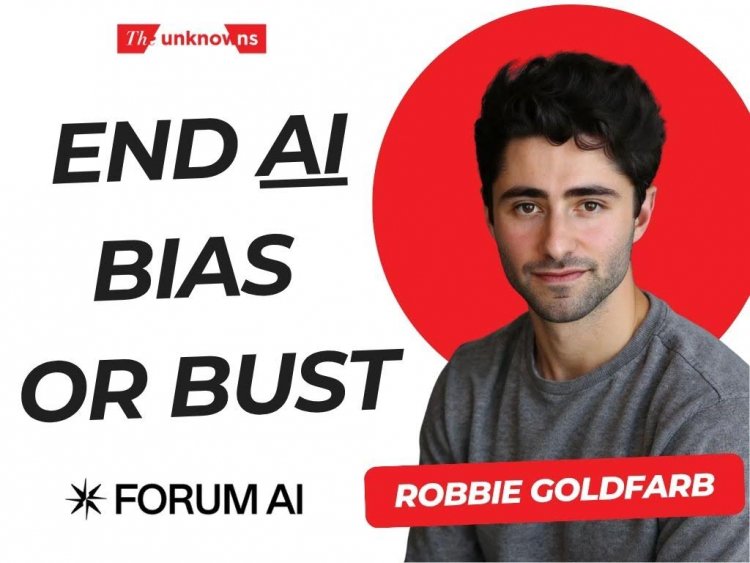
A former Meta executive who worked on trust and safety at Facebook and Instagram, Goldfarb explores key challenges facing artificial intelligence today. Specifcally, how to minimize bias and build greater reliability into systems that increasingly influence how people understand the world. Goldfarb shares a central realization from his time at Meta. He explains that sheer computing power and enormous datasets fall short when it comes to delivering dependable answers in complex areas like politics, foreign affairs, mental health, and breaking news.
“What A.I. is lacking is sound judgment,” he told Stone, “grounded in input from a diverse group of leading experts.” This insight led Goldfarb and Campbell Brown, a former CNN anchor and Meta executive, to launch Forum AI in late 2025. The New York-based company works to incorporate structured expert human insight into large language models. It functions as an external evaluation layer, assessing how models perform on intricate subjects and helping to screen out skewed or questionable results.
Forum AI’s Method: Leveraging Expert Insight to Tackle Bias
Traditional approaches to labeling training data often miss subtleties around tone, fairness, context, and balancing different priorities. Forum AI takes a different route by convening a network of respected voices—including Fareed Zakaria, Niall Ferguson, Scott Jennings, Salena Zito, former House Speaker Kevin McCarthy, and economist Larry Summers—while collaborating with organizations such as the Stanford Institute for Human-Centered AI and the Manhattan Institute. The goal is to build a living, expert-guided resource that can guide AI development.
The company tests major models against questions that require careful discernment and feeds in refined expert perspectives to enhance overall reliability. Goldfarb emphasizes drawing from a broad range of viewpoints to prevent the kind of insular thinking or conformity that can undermine even careful human review.
Drawing from his Meta experience, he discussed both the strengths and shortcomings of earlier human oversight efforts, highlighting why scalable, top-tier expert input is essential for AI. The company has already formed partnerships, including with Perplexity, and is establishing itself as an impartial assessor that developers cannot easily ignore. This effort aligns with a growing recognition across the industry that raw technical progress needs to be matched with stronger safeguards against bias, fabrications, and ideological tilt.
Public Concerns Highlight the Urgency
These issues echo broad public unease. A 2025 Pew Research Center survey found that 55 percent of both the American public and AI experts voiced strong worries about bias in AI decision-making.
Trust in AI companies’ capacity to safeguard data and produce balanced systems is also trending downward, per the Stanford HAI 2025 AI Index.
Goldfarb observes that while many in the AI field agree on the need to address bias, turning that agreement into effective practices remains difficult. Forum AI aims to close this divide by converting expert insight into tangible enhancements for current large language models.
As Stone and Goldfarb note, the implications are significant amid AI’s fast pace of change. The company’s wager is that independent groups of credible specialists can provide what’s missing: not merely information, but well-calibrated discernment spanning different ideological and professional backgrounds. Time will tell whether this model sees wide uptake and whether AI can evolve from impressive technical performance to something genuinely dependable.
[ad_2]
Source link
