
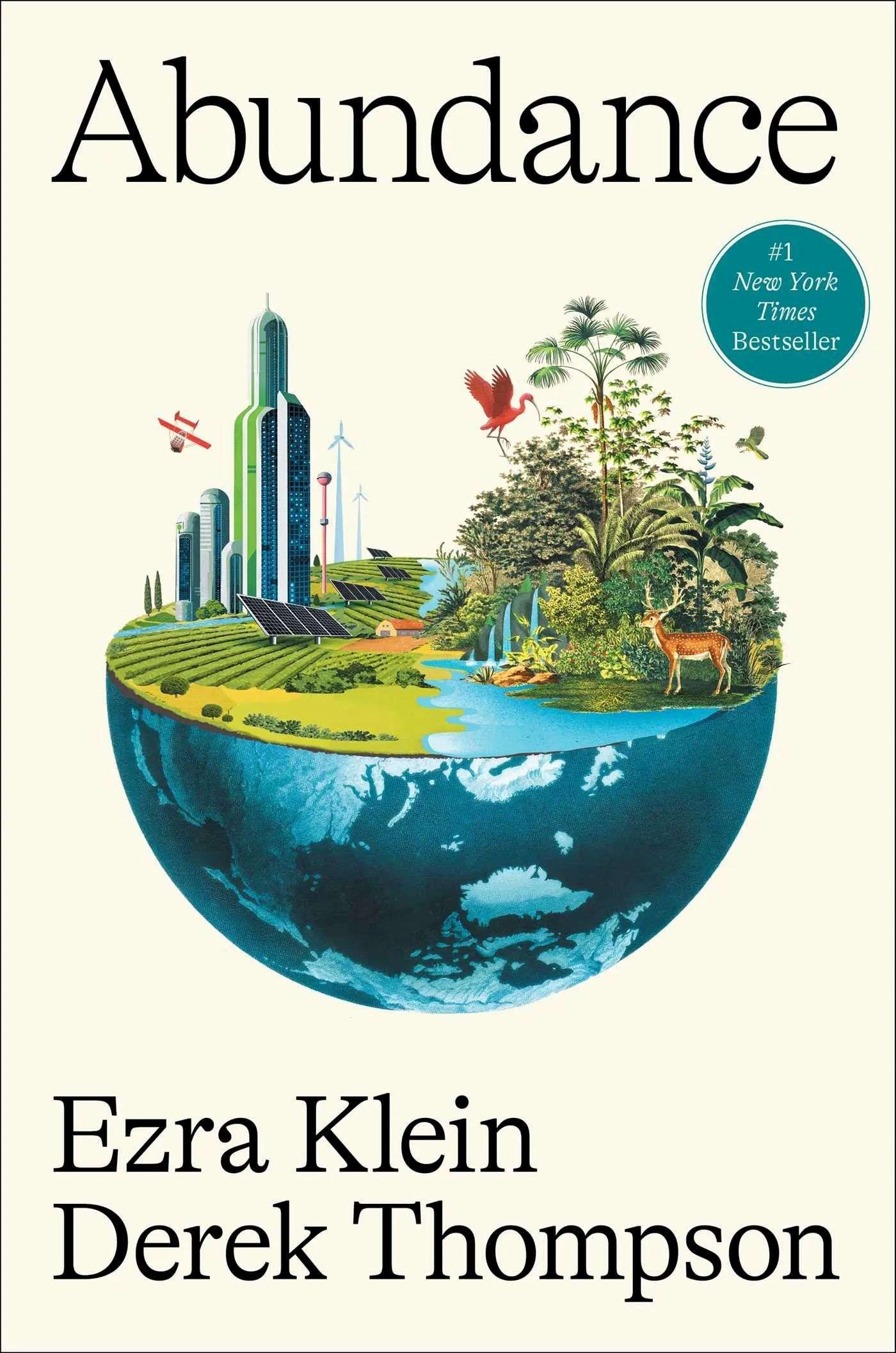

The rise of “abundance liberalism” is one of the few good political developments of the last few years. Abundance liberals and related thinkers like Ezra Klein and Derek Thompson (authors of the best-known book promoting the movement), Matt Yglesias, Catherine Rampell, Kelsey Piper, Noah Smith, Jerusalem Demsas, and others are left-liberals who advocate market-based approaches to a variety of important issues. Smith and famous law professor Cass Sunstein have even written recent articles expression new-found appreciation for libertarianism.
I think the growth of this movement is extremely promising, even though it has some flaws and internal contradictions. And it’s a source of potentially valuable allies for libertarians and other free market advocates, at a time when we badly need them.
Despite my general enthusiasm for the abundance movement, I actually agree with many of the criticisms and reservations expressed by libertarians like and free market conservatives, like Bryan Caplan, Samuel Gregg, and Richard Reinsch. In particular, the critics are right to highlight how many abundance liberals embrace market approaches on some issues (most notably trade and housing), but reject them on others (e.g. – health care and education), without recognizing that most of the reasons for curbing government intervention in the former areas also apply to the latter. In addition, Bryan is right to urge the abundance advocates to push their case further in those areas where they do embrace markets, particularly when it comes to immigration.
That said, we should never let the best become of the enemy of the extremely good. And abundance liberalism is indeed extremely good! The issues where they support major movement towards freer markets – most notably housing, trade, immigration, and nuclear power – are extremely important ones. They have enormous effects on the life, liberty, and happiness of tens of millions of people. A coalition focused on these big issues could have great value, even in spite of differences on other matters.
Back in 2024, I wrote a piece on setting issue priorities, where I urged prioritization of issues based on three criteria:
1. Magnitude of effects on human freedom and happiness. Big effects deserve priority over small ones.
2. Easy to implement solutions. Problems with simple, quick fixes deserve priority over ones where the solution is difficult and/or requires a massive increase in competence and capacity.
3. The possibility of incremental progress. Issues where incremental progress is possible deserve priority over “all or nothing” issues, except in unusual revolutionary situations.
The issues on which abundance liberals are good all check every one of these boxes. Indeed, I highlighted two of them (housing and immigration restrictions) in my original 2024 post. All these issue have huge effects on human freedom and welfare, and solutions are relatively easy to implement (in most cases just ending or cutting back on harmful government intervention; though nuclear power is somewhat more difficult). And incremental progress on all of them is feasible. Even if we cannot abolish all exclusionary zoning, we can make progress by getting rid of some. Even if we cannot abolish all immigration restrictions, we can greatly improve the world by abolishing some. And so on.
In addition to these important areas of agreement on specific issues, abundance liberals and libertarians also have significant (though, far from total) agreement on some important general principles. Both groups tend to support liberal individualism over various types of collectivism, whether those of the left or the nationalist right. Many of the abundance liberals dislike conventional left-wing identity politics, even if not as much as most libertarians do.
Kelsey Piper even wrote a recent article critiquing affirmative action. Part of her objection is that racial preferences are extremely unpopular (which is true) and thus a drag on the electoral fortunes of the Democratic Party. But she also objects to these kinds of policies on principle:
Our foundational commitment is that every person is an individual, created equal, and deserving of equal treatment under the law and equal opportunity. That means you shouldn’t get judged by the average qualities of your group. You shouldn’t be judged as less impressive because other East Asians have, on average, higher test scores, and you shouldn’t be judged as more impressive because other Hispanics have, on average, lower test scores.
Preach it, sister!
Abundance liberals and libertarians also have in common an appreciation for basic Econ 101. For example, both groups recognize that when government restricts supply (as with exclusionary zoning in the case of housing), that increases prices and creates shortages. Similarly, tariffs are harmful because they prevent mutually beneficial trade, thereby making us poorer and the economy less efficient. Abundance liberals recognize more exceptions to these general principles than libertarians do, and tend to believe that market failures are more common than is actually the case. But the initial acceptance of basic Econ 101 is still extremely important.
And abundance liberals are not afraid to criticize left-wing policies when the latter deviate from Econ 101 without a compelling reason. For example, almost all abundance liberals reject rent control, and many were highly critical of Biden’s student loan forgiveness program., because it created a variety of perverse incentives and helped the relatively affluent at the expense of the needy, instead of vice versa.
In addition to agreement on some key issues and principles, abundance liberals and libertarians also have important common enemies in the form of the national right and the “democratic socialist” left. Sometimes, common enemies bind people together more than anything else.
Abundance liberals are also potentially valuable allies because they seem to have some real influence in Democratic Party politics, and on the political left generally. A variety of Democratic governors – including Gavin Newsom (California), Jared Polis (Colorado), and Kathy Hochul (New York) have embraced various abundance liberal “YIMBY” housing deregulations. Massachusetts Governor Maura Healy has even coupled that with forcefully opposing rent control, which I never thought I would see a prominent liberal Democratic politician do. It is even possible – though far from certain – that an abundance-oriented candidate might win the 2028 Democratic presidential nomination.
By contrast, libertarians and other free market advocates are clearly losing ground on the political right and the Republican Party, which are increasingly dominated by New Right “national conservatives” who have made hostility to both personal and economic liberty central to their agenda. Thus, the Trump Administration has given us government stakes in many major busineses (further exacerbated by the planned takeover of Spirit Airlines), mass deportations that gravely threaten the liberty and welfare of native-born citizens as well as immigrants, FCC bullying to suppress free speech, and the biggest trade war and highest tariff schedule since the great Depression.
The old “fusionist” alliance with the conservative right is dead, and we need new allies, as libertarians are pretty obviously not strong enough to achieve a lot on our own. Abundance liberals are by far the best available alternative coalition partners.
Abundance liberals might ask: what good are libertarians to us? It’s not as if libertarianism is vastly popular. In answer, I would note that libertarian intellectuals and policy experts have long batted above their weight and wielded important influence, including on issues central to the abundance agenda, such as housing, immigration, and trade. In addition, depending on how you define them, libertarian-leaning voters are some 7-20% of the population (I think the lower-bound figures are more plausible than the higher ones). And many of them tend not to have strong party loyalties, and therefore can be swing voters. That’s nowhere near enough to win elections by themselves. But it could be a valuable voting bloc in close elections.
In this post, I do not try to outline in any detail how such an alliance might work. That remains to be seen, and is probably best worked out by people with better connections and greater political skill than I have. But I do want to suggest the general idea, thereby hopefully giving a nudge to those who do have the requisite skills. I would add that an effective coalition should have both an elite/intellectual element and a more popular one focused on moving public opinion and influencing electoral results.
There is the important caveat that political developments are often hard to predict. Perhaps in five to ten years, the Democratic Party will be dominated by socialists, while the MAGA nationalist movement will have collapsed, allowing more market-oriented conservatives to regain control over the GOP. Other types of unexpected developments might also happen, that make an abundance liberal/libertarian alliance ineffective or unnecessary.
But, for the moment, this is a potential coalition that makes good sense. And it is likely to continue to do so as long as the issues that unite the two groups remain extremely important. I suspect most of them won’t go away anytime soon.
