
[ad_1]
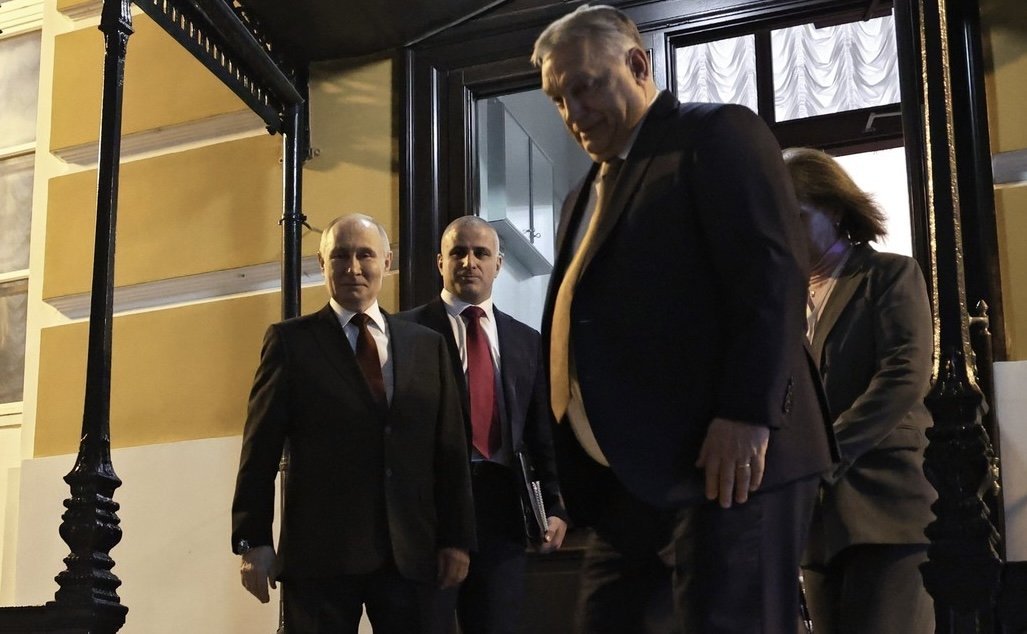
Photograph Source: kremlin.ru – CC BY 4.0
“You should write about Viktor Orbán,” a close English friend told me before heading back to the Himalayas.
Orbán? I wondered. As leader, he has “ceased to be,” “expired,” and is “no more,” to borrow from Monty Python.
Then I saw his point. Orbán is not yesterday’s story so much as a figure already ripe for perspective. A proper valediction might do more than mark the end of one career. It could help frame the twilight of a political generation.
For Orbán belongs, perhaps, with Vladimir Putin, Donald Trump, and even JD Vance—leaders whose instincts were formed in the late twentieth century, though they believe themselves to be the exact opposite and are now straining against the realities of the twenty-first.
The late E. J. Thribb, that indefatigable fictitious house elegist of Private Eye, would have marked the moment in his own way:
So, farewell then, Viktor Orbán
Many people said you were off
And now that you really are off
Only Keith’s Mum really likes you.
For such is the fate of strongmen once the spell breaks. When Viktor Orbán is no longer the victor, even old friends grow forgetful.
The Kremlin, with trained nonchalance, insisted it was never especially close to him—while expressing polite interest in engaging his successor, Péter Magyar.
There would, of course, be more talk of dialogue, of pragmatism, of water under both the Bolshoy Moskvoretsky and Széchenyi Chain bridges.
To Orbán’s credit, he took defeat far more gracefully than Donald Trump ever managed.
And if Orbán and Trump were tub-thumpingly close, Orbán’s deeper affinity lay eastwards. Besides, Trump is presently too busy contributing to global shortages in the coming weeks to be relevant here.
Orbán’s government cultivated an unusually easy intimacy with Vladimir Putin and the Russian state—political, economic, and diplomatic—each strand reinforcing the others. It was just a pity it was never a much larger bridge of peace.
This closeness was no accident of temperament but policy: the so-called “Eastern Opening,” a deliberate tilt towards Moscow, expressed most neatly in projects like the Russian-financed expansion of Hungary’s Paks nuclear plant.
Orbán also maintained a close and pragmatic partnership with China, promoting investment, trade, and political cooperation while often aligning Hungary more closely with Beijing than do other EU nations. Such arrangements always promised energy and investment—but at the price, critics argued, of a long, quiet dependency.
Was Orbán hooked?
Now, everyone wants to know what happens to Hungary’s relationship with a Vučić-led Serbia and with Slovakia’s Robert Fico, now that Orbán is no longer calling the shots.
The relationship with Moscow and Moscow-friendly states used to mean not only seeking to dilute EU sanctions on Russia—even after the invasion of Ukraine—but maintaining deep energy ties. As many people know, Russia supplied much of Hungary’s gas, oil, and nuclear fuel, sustained by a steady rhythm of high-level contact.
Orbán met frequently with Putin, travelling to Moscow in ways that diverged sharply from the wider EU consensus, whose commonly used labels for him included: Putin’s Trojan Horse, the EU’s enfant terrible, illiberal democrat, and mini-Putin. My favourite was probably Black Sheep of the EU.
This pro-Russian alignment inevitably extended into politics: resisting EU aid to Ukraine, calling for negotiation over military support, and echoing positions handy to Moscow.
In consequence, analysts and EU officials came to portray Hungary under Orbán as over-amplifying Russian influence within the EU—though such judgments reflected opinion more than evidence.
There were also unproven allegations of information-sharing or influence operations; these were persistent but never substantiated.
Orbán out—Trump next—then Putin: it has become a popular refrain, at least for the moment.
And this despite the occasional flicker of Orbánite sympathies even in the British press. Writing in the Telegraph before the recent election, novelist Tibor Fischer observed that ‘the word “authoritarian” is applied to Orbán frequently—chiefly by pundits who know little about Hungary or the meaning of the term.’
I met Fischer once, briefly, at the Union Club in London’s Soho. He struck me as perfectly pleasant. Still, his support for Orbán surprised me—though what do I really know about defeated right-wing autocrats other than the fact that they are defeated? “Success is precisely why Orbán’s so hated by the international Left,” he wrote.
The truth, however, is now simpler: Orbán was not successful in the end.
Even Trump, already on fresh manoeuvres, reportedly told Jonathan Karl that he reckoned Péter Magyar will be good.
Another factor in Orbán’s fall that should not be forgotten was JD Vance’s possibly ill-judged visit. He arrived in Budapest to “help” him win—praising his nationalism while attacking the EU for interference.
The intervention drew a noisy backlash across Europe, widely seen at the time as clumsy and counterproductive—even before Orbán lost.
While there, Vance pressed on regardless, even accusing Ukraine of attempting to influence Hungary’s election, though there was no widely accepted evidence for such claims. Most observers saw the tensions as those of diplomatic conflict rather than covert interference.
Orbán’s defeat is still positive for Ukraine. As Hungary’s longtime leader, Orbán had been one of Kyiv’s most vexing partners within the EU and NATO—slowing sanctions, opposing military aid, and maintaining that conspicuously pro-Russian stance.
A new Hungarian government is likely to be far less obstructive. It will not transform the war overnight, but it removes a persistent political roadblock within Europe.
Even Trump’s Project 2025 was said to have echoed Orbán’s model: expanding executive control, weakening institutional checks, reshaping the state in the image of the leader.
Well, it doesn’t now.
And perhaps that is the point.
For Orbán, like Trump, Putin, and Vance, belongs to a political ecology that is thinning out. Their instincts—centralised power, nationalist theatre, transactional alliances—were forged in a different age. They are not quite extinct. But they are starting to look like it. This is such breaking news that even they don’t realise it.
They are not predators of the present—but relics of a world that no longer quite exists.
Dinosaurs, blinking in the suddenly changed light. I wonder whether my friend can see them from the Himalayas.
[ad_2]
Source link
