
[ad_1]
“I don’t think we live in a functioning democracy—and that has been true for some time.” Hedges
Joshua Scheer
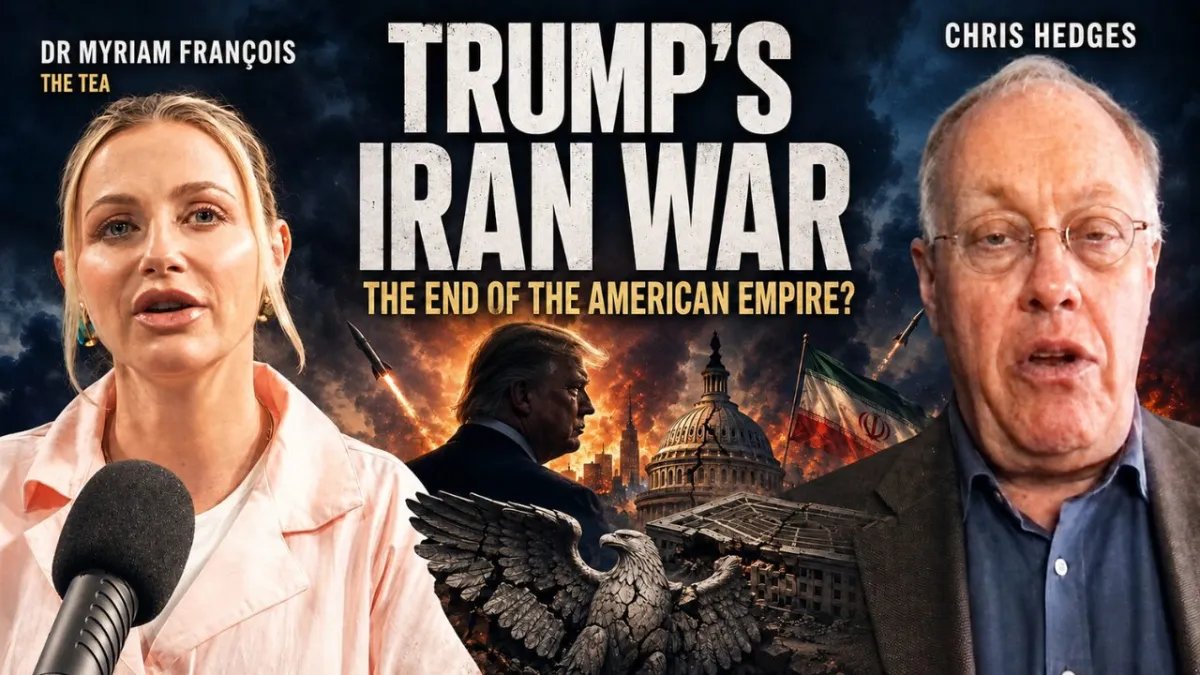
Six months into the disastrous U.S.-Israeli war on Iran, the fantasy of a quick and decisive victory has collapsed. American weapons stockpiles are dwindling, energy and food prices are soaring, Washington’s Gulf alliances are fracturing and the balance of power in the Middle East is shifting beneath the empire’s feet. In a sweeping interview with Dr. Myriam François, Pulitzer Prize-winning journalist Chris Hedges argues that the war has exposed more than a catastrophic military miscalculation: It has revealed an American empire hollowed out by corruption, war profiteering and democratic decay. As political institutions fail and elites continue to enrich themselves from the destruction, Hedges warns that organized direct action may be the only force still capable of confronting the machinery of permanent war.Six months into the disastrous U.S.-Israeli war on Iran, the fantasy of a quick and decisive victory has collapsed. American weapons stockpiles are dwindling, energy and food prices are soaring, Washington’s Gulf alliances are fracturing and the balance of power in the Middle East is shifting beneath the empire’s feet. In a sweeping interview with Dr. Myriam François, Pulitzer Prize-winning journalist Chris Hedges argues that the war has exposed more than a catastrophic military miscalculation: It has revealed an American empire hollowed out by corruption, war profiteering and democratic decay. As political institutions fail and elites continue to enrich themselves from the destruction, Hedges warns that organized direct action may be the only force still capable of confronting the machinery of permanent war.
Hedges examines Washington’s fatal miscalculation in Iran, the growing rift between President Donald Trump and Israeli Prime Minister Benjamin Netanyahu, and the possibility that the war has strengthened Iran while destabilizing America’s position across the Middle East. He also follows the money, detailing how weapons manufacturers and political elites profit as ordinary people absorb the costs through inflation, austerity and mounting insecurity. The conversation moves beyond the battlefield to confront the erosion of American democracy, the failure of the press to hold power accountable and the rise of inexpensive drone warfare capable of challenging vastly larger military powers. With traditional political institutions increasingly captured or paralyzed, Hedges concludes that organized resistance—from dockworkers refusing to ship weapons to mass movements disrupting the machinery of war—may be the only remaining way to impose consequences on those in power.
“Well, the United States blundered into yet another catastrophic fiasco in the Middle East. I worked in Iran, by the way, and I’m no friend of the Iranian regime. I was thrown in jail by the regime, and on another occasion I was deported in handcuffs. But there was a complete misconception of how Iran would react and a fundamental misunderstanding of the internal power dynamics within the country.
“The United States has lost the war. There’s no other way to put it. Iran has waged highly effective asymmetric warfare. It has been preparing for a conflict with the United States since the 1979 revolution—nearly 50 years. Iranians are not as Trump and much of the West portray them. Iran is a highly educated country with a rich and deep Persian culture.
“Iran controls the Strait of Hormuz, while the United States has exhausted significant portions of its weapons stockpiles. Iran—probably with the assistance of Chinese and Russian intelligence—has also become quite adept at striking vulnerable and strategically important targets, particularly radar stations. At this point, there is very little the United States can do to stop it.
“Interceptors, THAAD missiles and Patriot systems take a long time to produce. Once you run down those stockpiles, it’s not as if you can replace them the following week. We have also deeply alienated our Gulf allies. They were not consulted before Trump launched this war. Neither were our other allies, including the United Kingdom. The war was launched on the fantasy that assassinating Iran’s supreme leader would bring about a swift victory.” Chris Hedges
Hedges ultimately returns to his understanding of journalism as a moral obligation: “Journalism should be used to hold the powerful to account and to lift up the voices of those who would not be heard without us. That is the role of a journalist.” However he chides the media saying “The media have become completely siloed. They cater to particular political demographics and become echo chambers. That destroys any meaningful form of communication.”
His indictment extends from the profiteers who turn destruction into wealth—“I’ve covered many wars. War is a very good business”—to the political and media institutions that enable them. While Iran has emerged as “the dominant power in the region,” the opposite of what Israel and the United States intended, Hedges argues that the Democratic Party remains “hostage to corporate and oligarchic forces” and its leaders would sooner “keep their seats in the first-class cabin and watch the ship go down” than pursue meaningful reform. Meanwhile, a siloed corporate press traps audiences inside partisan echo chambers, destroying the shared reality needed to challenge those in power.
With electoral politics, institutional safeguards and the media all failing to restrain an increasingly lawless system, Hedges reaches his conclusion: “The only mechanism left is direct action. If our governments will not uphold international law and refuse to supply weapons for a genocide, then we have to do it.”
The warning is unmistakable: Empires do not collapse only when they lose wars abroad. They collapse when truth becomes inconvenient, profit replaces principle and those entrusted with the future choose comfort as the ship goes down. If power will not restrain itself, then the burden falls to ordinary people—to refuse, to resist and to remind the powerful that history is not written only by those who command armies, but also by those who finally decide they will no longer obey. Of course guides are needed and should be welcomed.
Editor’s Note: At a moment when the once vaunted model of responsible journalism is overwhelmingly the play thing of self-serving billionaires and their corporate scribes, alternatives of integrity are desperately needed, and ScheerPost is one of them. Please support our independent journalism by contributing to our online donation platform, Network for Good, or send a check to our new PO Box. We can’t thank you enough, and promise to keep bringing you this kind of vital news.
You can also make a donation to our PayPal or subscribe to our Patreon.
Please share this story and help us grow our network!
[ad_2]
Source link
