
[ad_1]
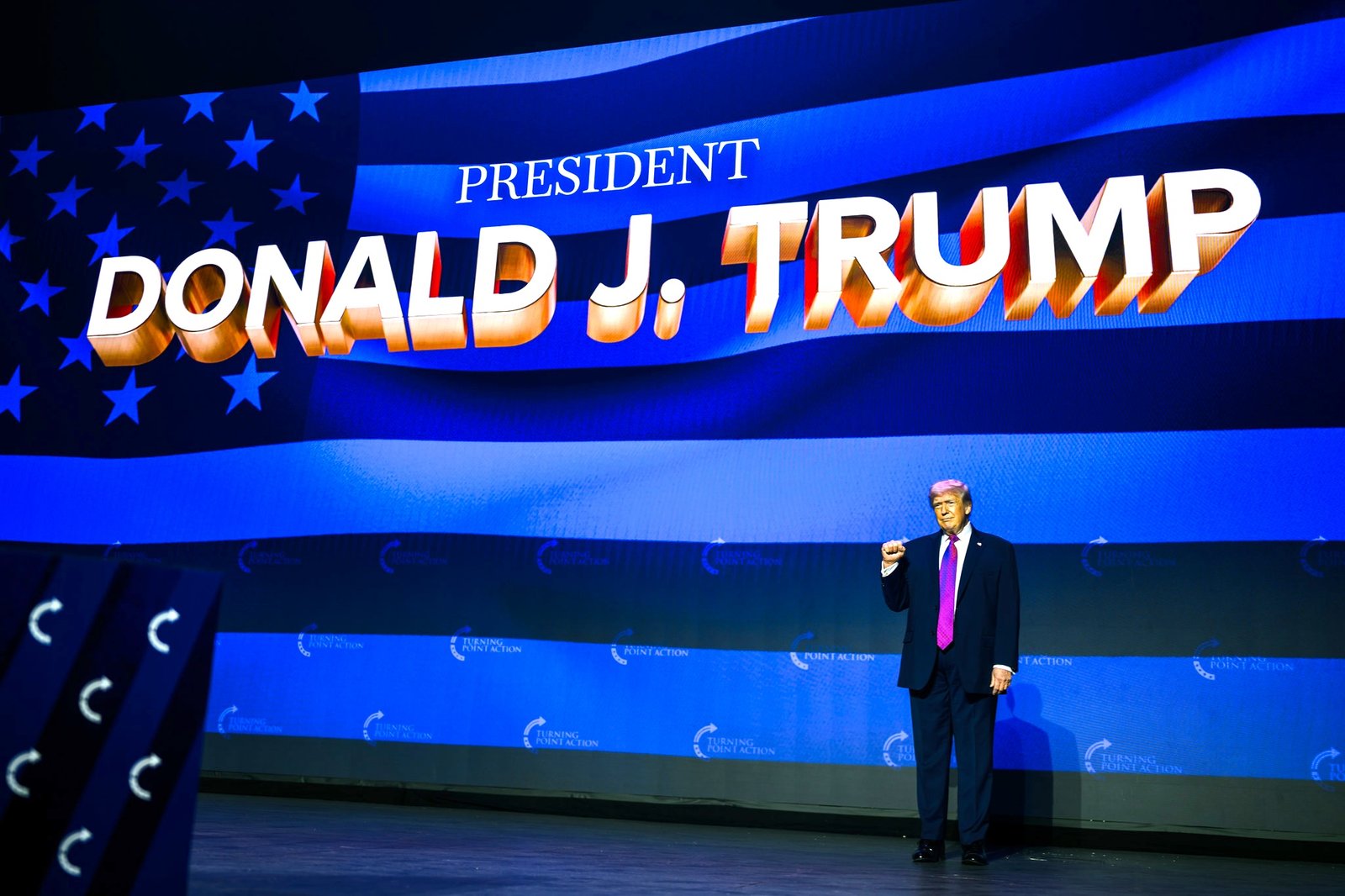
The U.S. president has lost the war he started with Iran — or at the very least he has no chance of winning it — but accepting defeat and repairing the damage of the error is simply beyond his reach.
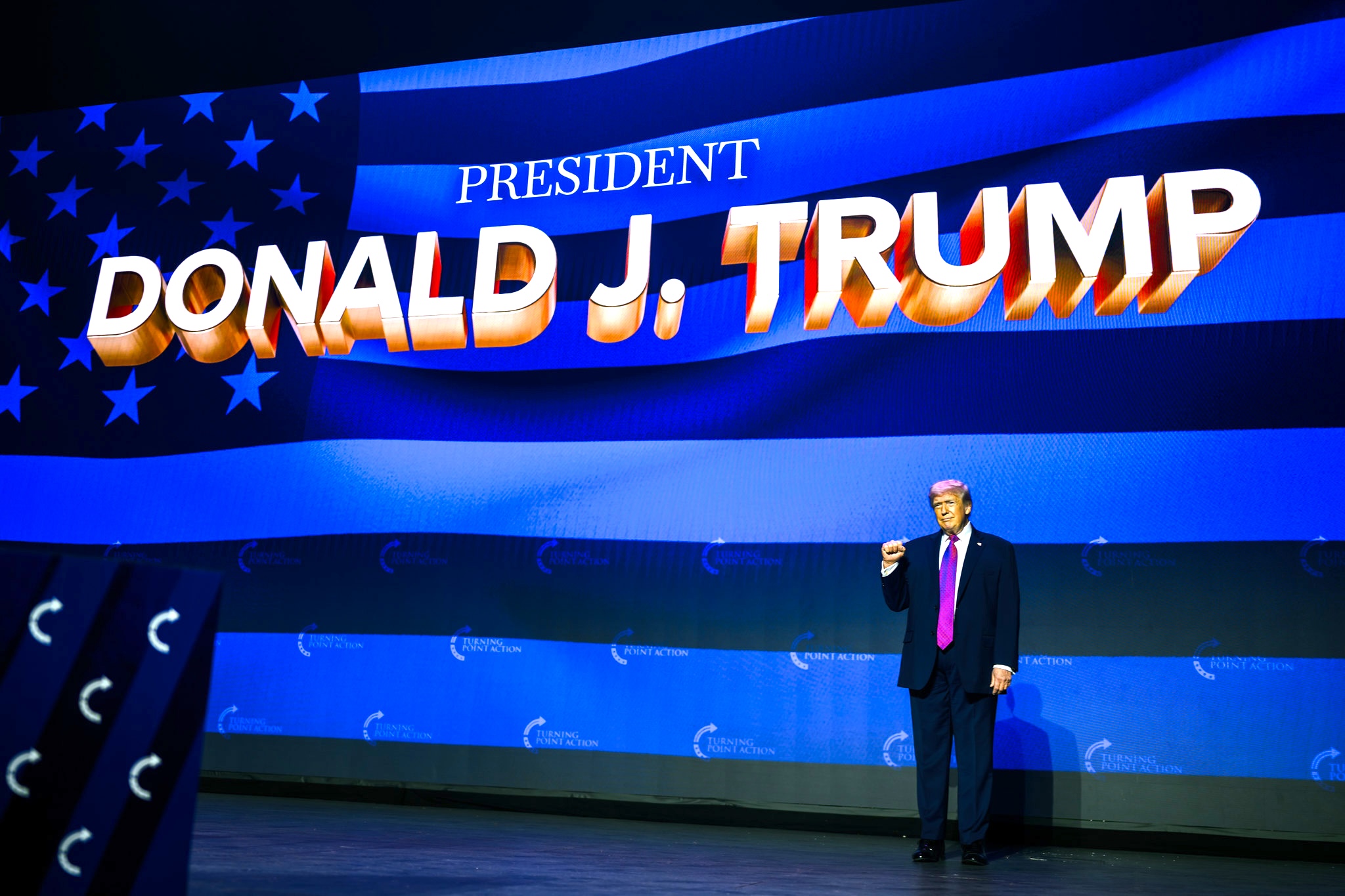
President Donald Trump at a Turning Point USA event at Dream City Church in Phoenix in April. (White House/Daniel Torok)
By Patrick Lawrence
Special to Consortium News
 You have to hand it to Sara Jacobs, the California Democrat and the youngest member of the Golden State’s House delegation.
She has an O.K.–plus voting record — at least by Capitol Hill standards — as a member of the Armed Services and Foreign Affairs Committees, but this is not why you have to hand it to Sara Jacobs.
You have to hand it to Sara Jacobs because she has just forced the question of Donald Trump’s lapsing sanity into an open debate in the U.S. Congress.
Jacobs accomplished this during the very heated grilling of Pete Hegseth during his testimony in Armed Services hearings on Wednesday.
The defense secretary was a belligerently incoherent mess, but we already knew he was a hopeless Dummkopf, and his appearance on the Hill — his first since the U.S.–Israeli attacks on Iran began Feb. 28 — is merely par for his course.
Jacobs stole the show with her opening question when her time came. Here is a video of her five minutes with the microphone, and here is the query that may find some small place in the annals of the Trump II regime when they are written:
“Mr. Secretary, you are with the president a lot, and it pains me even to have to ask this about our president, but my constituents’ lives are at stake: Do you believe the president is mentally stable enough to be the commander-in-chief?”
Sara Jacobs, you go girl.
I asked Secretary Hegseth a straightforward, yes or no question today: Is Donald Trump mentally stable enough to be Commander in Chief?
He didn’t say yes. And that speaks volumes. pic.twitter.com/ncWhEBAX9r
— Congresswoman Sara Jacobs (@RepSaraJacobs) April 29, 2026
The Trumpster’s mental instability — indeed, his relationship with reality — is much remarked upon these days.
Threatening to destroy one of humanity’s oldest civilizations, blowing his cool so badly his adjutants recently locked him out of the Situation Room so they could coherently discuss… the situation; “Open the Fuckin’ Strait, you crazy bastards,” and so on: It reaches the point where there is a better-than-even chance America’s rotund leader will not make it to the end of his term.
I see little chance of it, honestly.
And Sara Jacobs just pushed open the door, slightly ajar at this early moment, to 25th Amendment proceedings. O.K., she’s a Democrat in a GOP–controlled House, but there are now Republicans sporting beads of sweat over Trump’s failing sanity, and, in any case, they may not have a House majority come the midterm elections.
And here’s the thing. Donald J. Trump — setting aside clinical symptoms unrelated to the global calamity he has set in motion — has very good reasons, two of them, to lose his mind.
One has to do with American ideology and the other with Israel. It is important to know this because whoever succeeds Trump will be similarly taxed to stay compos mentis.
Trump is trapped. And whoever follows him will be trapped, too.
The Imperium’s Sunset Phase
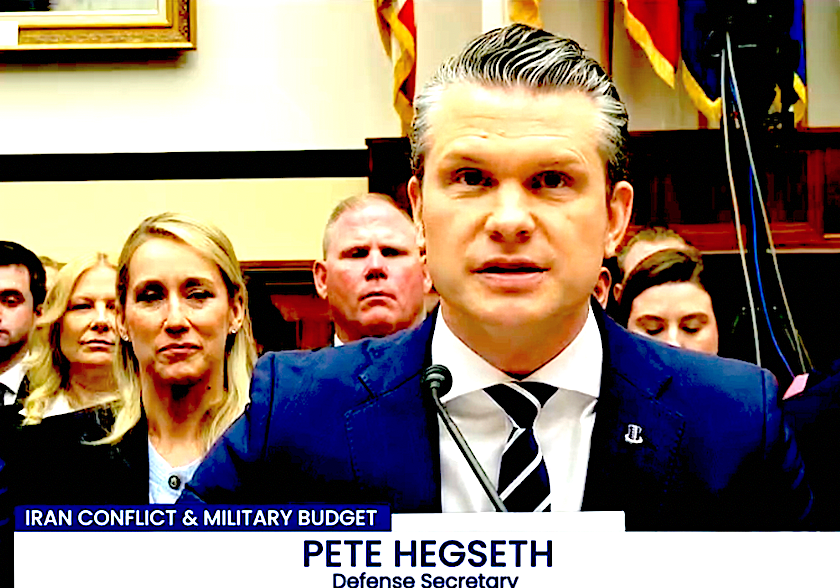
Hegseth before the House Armed Services Committee on Wednesday. (C-Span)
It is not a good time, to put this point differently, to be president of these United States.
This was bound to be the case, I should add, once the imperium entered its sunset phase — which began, as I have argued severally in this space, on Sept. 11, 2001. And as many have remarked, if the Iran crisis forces one truth on Americans above all others, it is that the sun is going down even more swiftly than anyone could have anticipated.
Of the two reasons the Trumpster is discernibly slipping his grip, the first has to do with America’s exceptionalist ideology. America cannot lose in its confrontation with Iran for the simple reason America cannot lose anything. Defeats, reversals, failures — history altogether — are what befall other nations, never the United States.
This imperative, a function of a collective neurosis now four centuries old, cancels all possibility of a leader or leaders setting a wise, imaginative, even modestly courageous new course into the 21st century. Join me in counting this the essential tragedy of our fading republic.
Think of it. Fifty-one years after the rise of Saigon (as I insist we consider it), the United States has yet officially to acknowledge it lost the Vietnam war to the Vietnamese people. Officially, Washington still nurses the “peace with honor” delusion.
This is what I mean by Trump’s trap. He has lost the war he started with Iran — or at the very least he has no chance of winning it — but accepting defeat and repairing the damage of the error is simply beyond his reach. It is irrational, an ideological blocage, but the “American experiment” (curious phrase) has never been a rational proposition.
At the moment, DJT must listen to various military options to continue the Iran campaign, one more cockeyed than the next, while squirming in desperation to get out of it.
So does he descend into fabrications, fantasies and, let’s just say it, other symptoms of clinical psychosis — taking Hegseth and the rest of his cabinet with him as he watches the war he cannot win — but cannot lose — disrupt the global economy to the point that it drifts toward a depression which could match or exceed 1929.
Conversations & Questions

The New York Times building. (Ermell, CC BY-SA 4.0, Wikimedia Commons)
I have to note some interesting conversations bearing on the trap wherein Trump finds himself.
“The United States can accept some degree of geopolitical embarrassment as the price of ending our war with Iran, without that embarrassment being an era-defining debacle or inflection point.” This is Ross Douthat, the thinking man’s conservative, making his case for a rational way forward in an April 21 column in The New York Times.
A couple of questions arise. Ross, do you honestly think the Trump regime can accept the humiliation and loss of credibility attaching to any retreat from the Iran debacle? I don’t.
It would be a fine thing for America to accept that it has embarrassed itself before the world — a big step toward becoming “a normal nation” — but history is persuasive on this point. There is also America’s “civil religion” to think about. It remains far too strong to permit of any such acceptance.
Second question, in two parts. Were the United States wise and brave enough to accept some “geopolitical embarrassment,” how could it be other than “era-defining?”
And what under the sun is wrong with defining an era in this way? If America and the rest of the world need one thing more than any other, it is a humbler, post-hubristic, post-hegemonic American republic.
I need to hear why Ross Douthat proposes the embarrassment but wants the present “era” to remain intact.
Ben Rhodes is a curious figure. He served in the Obama administration as a consent-manufacturing propagandist but seemed aware his work was as insidious as it gets even as he got it done. Rhodes now writes opinion at the Times and has recently published an interesting piece on Graham Platner after traveling through Maine with the Down East oysterman running for a Senate seat as a left Democrat.
This is an important piece. (And I accept Rhodes’s apology for his errant past). His conversations with Platner, an Iraq and Afghanistan veteran, ranged widely as they drove along in Platner’s pickup truck, but Rhodes, at heart a foreign policy man, is interested primarily in Platner’s “radical honesty” as to the imperium’s incessant violence in the post–Sept. 11 years and mainstream Democrats’ abject refusal to stand against it.
On the past 25 years of the Pentagon’s invasions and interventions:
“The core of his message [Platner’s] is an unflinching disgust for the forever war we have waged since 9/11. ‘Nobody is going to be able to convince me that what I did in Iraq and Afghanistan did anything for the people of Sullivan, Maine,’ he told me, punctuating his point with an obscenity. ‘I don’t want other young Americans to go through what I’ve been through. And I don’t want to send other young Americans to inflict the horror that I had to inflict on people.’”
On the Democrats’ limp-wristed objections as Iran joins the list of forever wars while they vote consistently for bloated defense budgets and implicitly reaffirm the late-phase imperium’s reigning ideology:
“All this undercuts Democrats’ ability to credibly argue for a fundamental shift in the nation’s priorities. … The absurdity of these priorities makes Washington feel distant and obtuse, an imperial capital cloistered from its subjects with National Guard troops patrolling the city.
‘Here in the real world, most people get it,’ Mr. Platner says of his campaign events. ‘Do you think this country should spend more on schools and hospitals and less on bombs? A lot of people are like, yeah, that’s pretty obvious.’”
On the current impasse in Washington:
“’If the Democratic Party is to flourish in the future,’ Mr. Platner told me, ‘it needs to be an antiwar party.’ As talks to end the latest disastrous war focus on reopening a narrow strait of water that was open before the war began, this seems like an obvious conclusion. And yet many Democratic politicians would most likely be wary of embracing it.”
In effect, Rhodes via Platner makes the case for a fundamental renovation of American foreign policy — a turn toward 21st century realities, chief among these the end of U.S. preeminence and the arrival of a multipolar order. Platner’s voice is to be altogether welcomed for this.
Is such a turn possible — and possible via the Democratic Party, as both Rhodes and Platner implicitly propose? This is our question.
And I simply don’t see it. The trap that springs on Donald Trump as we speak will spring again and again until the trap itself is destroyed.
Despite a 40-point lead, Maine Senate candidate @grahamformaine says he hasn’t heard from DNC leadership. #theweeklyshow #jonstewart #politics pic.twitter.com/VzZPAVbmMc
— The Weekly Show with Jon Stewart (@weeklyshowpod) April 29, 2026
After Gov. Janet Mills’ withdrawal from the primary race, Platner, now the Democratic Party presumptive nominee, is looking ahead to the general election.
Drop Site News, in an excellent piece published April 28, reports that billionaire donors — all of them from out of state — are spending multiple millions of dollars via a super PAC in support of Susan Collins, the doddering Republican incumbent Platner is at the moment projected to unseat.
This is how the trap often springs.
Zionist Billionaire Influence
During their apparently extended road trip neither Rhodes nor Platner seems to have mentioned the Israel lobbies and the political power exerted by wealthy American Zionists. They should have.
Stephen Schwarzman (Blackstone), Paul Singer (Elliott Management), Alex Karp (Palantir): These are the billionaires now spending big to destroy Platner’s bid for a seat in the Senate. They are militant Zionists to a one.
A new true thing: It no longer makes any sense to discuss American politics without reference to the pernicious influence of Zionists over policy and the political process policy is supposed to reflect. New and true, in any case, since the Israelis’ post–Oct. 7 terror has brought “the Jewish state” in for near-universal condemnation.
There is no saying how Graham Platner will fare against the Zionist donors now ganging up against him. But it is perfectly plain that the trap Israel and its many American allies set for Donald Trump is the second reason he seems to be losing his mind at an accelerated pace since Bibi Netanyahu railroaded him into the war against the Islamic Republic.
Ross Douthat, in the aforementioned Times opinion piece, makes this observation in his second paragraph:
“A different question, though, is whether this war will be remembered as an inflection point for Israel in its relationship with the United States.”
Douthat, while professing mild reservations about the Israelis’ various terror campaigns, does not think the Iran mess will go down at all in this way. He does not, in any case want to see any such “inflection point” in the U.S.–Israel relationship.
It is dreadful to think Ross Douthat will get his way on this point, but the Trumpster’s predicament suggests he will.
The Israelis face DJT with the worst possible choice so long as he remains within the reigning orthodoxy, as certainly he will: He can either turn against the Israelis and risk the damage, almost certainly fatal, the Zionists will wreak on his regime (and him personally, given what is almost certainly in the Epstein files), or he can continue to oblige these vicious people as they keep the war going — wars at this point — and the global economy descends into havoc.
I have long wondered — in my mind, not in print — whether the truth of any given age is radical. It certainly is so in ours. The only way out for whomever leads our crumbling republic is a radical, “era-defining” admission of defeat in the Iran war and a radical, “era-defining” rejection of the Zionist regime.
These would be excellent prospects ware either even remotely possible. The sun would shine at the end of both these roads. But America no longer avails of excellent prospects. The sun must first set on the imperium if it is ever to rise again.
Patrick Lawrence, a correspondent abroad for many years, chiefly for the International Herald Tribune, is a columnist, essayist, lecturer and author, most recently of Journalists and Their Shadows, available from Clarity Press or via Amazon. Other books include Time No Longer: Americans After the American Century. His Twitter account, @thefloutist, has been restored after years of being censored.
TO MY READERS. Independent publications and those who write for them reach a moment that is difficult and full of promise all at once. On one hand, we assume ever greater responsibilities in the face of mainstream media’s mounting derelictions. On the other, we have found no sustaining revenue model and so must turn directly to our readers for support. I am committed to independent journalism for the duration: I see no other future for American media. But the path grows steeper, and as it does I need your help. This grows urgent now. In recognition of the commitment to independent journalism, please subscribe to The Floutist, or via my Patreon account.
The views expressed are solely those of the author and may or may not reflect those of Consortium News.
[ad_2]
Source link
