
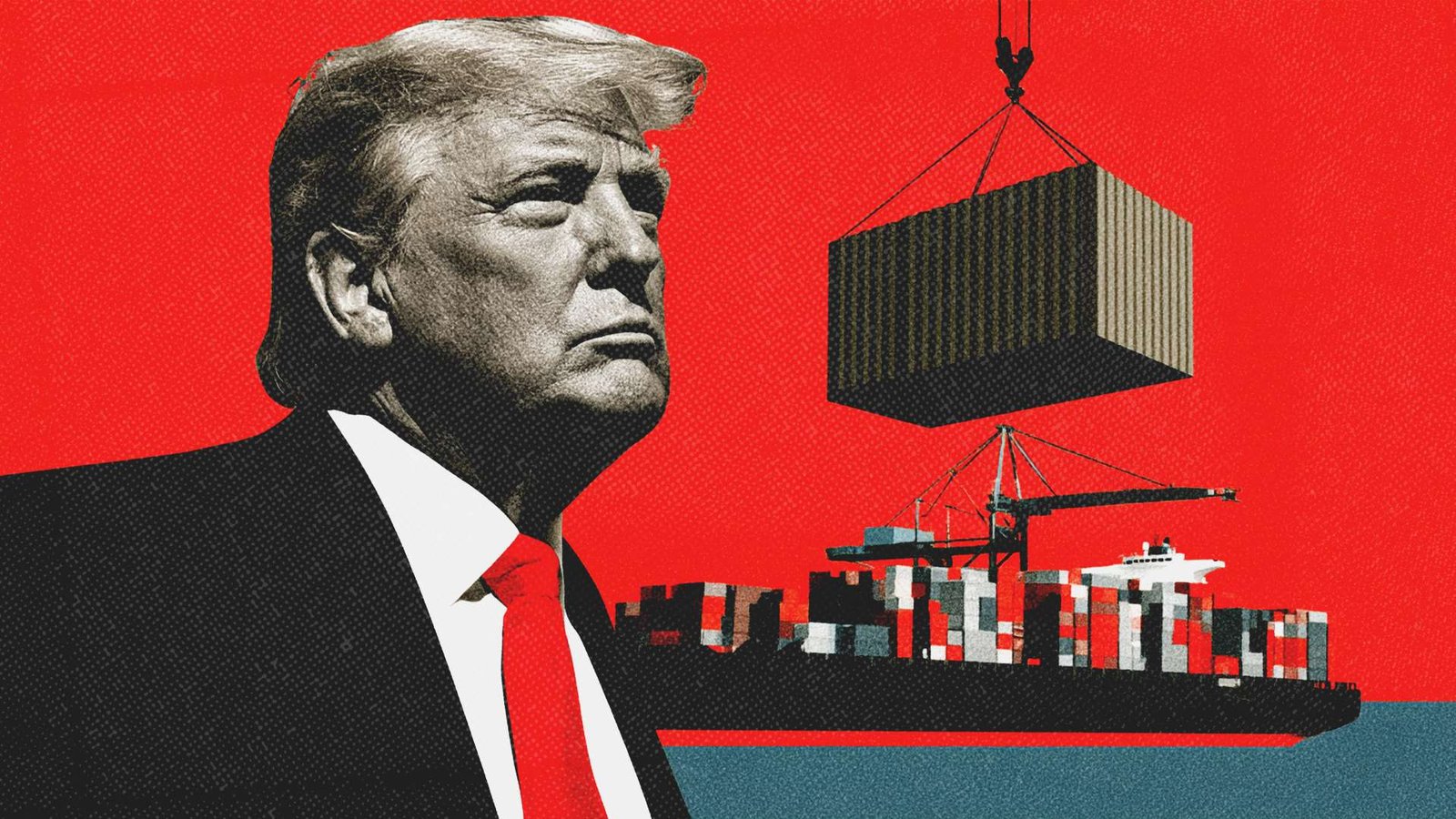
Despite slapdowns by the courts, President Donald Trump’s love affair with protectionism continues. In recent weeks, he’s authorized additional tariffs against countries supposedly using “forced labor,” slapped 50-percent duties on some imports from Canada, and may soon receive a bipartisan grant of enhanced trade powers from lawmakers seeking to punish nations that trade with Russia. That’s all unfortunate, because barriers to the free exchange of goods have already imposed high costs on Americans.
You are reading The Rattler from J.D. Tuccille and Reason. Get more of J.D.’s commentary on government overreach and threats to everyday liberty.
“In 2025, the Trump tariffs amounted to an average tax increase of $1,000 per US household,” write Erica York and Alex Durante of the Tax Foundation. “We estimate that the tariffs both announced and imposed, including the Section 122 tariff, Section 232 tariffs, Section 301 tariffs, and Section 338 tariff on Canada, will increase taxes per US household by $900 in 2026.”
The somewhat lower additional cost of trade protectionism on Americans projected for 2026 relative to last year comes courtesy of the changing legal landscape, not because of any loss of resolve on the part of the Trump administration. The sweeping tariffs imposed last year under the alleged authority of the International Emergency Economic Powers Act (IEEPA) were voided in February when the Supreme Court flatly ruled that “IEEPA does not authorize the President to impose tariffs.” Since then, the president and his partisans have scrambled to exploit any possible means to burden imports with high duties and to punish foreign sellers for daring to export goods to the U.S. at competitive prices.
The laws that the administration has invoked for new tariffs are limited in scope or can only be invoked under specific circumstances. Section 122 tariffs, for example, may only be put in place for 150 days. Imposed after the IEEPA ruling, they expired on July 24 and were themselves overruled in May by the U.S. Court of International Trade since there was no balance of payments deficit as required by the law.
Conveniently, the White House announced Section 301 tariffs, which offer “Relief from Unfair Trade Practices,” on July 23. According to the administration, the new tariffs involved “Investigations under Section 301 of the Trade Act of 1974 of the Acts, Policies, and Practices of 60 Economies Related to the Failure of Each Economy to Impose and Effectively Enforce a Prohibition on the Importation of Goods Produced with Forced Labor.” We’re supposed to believe that the timing is just coincidental, which is a hard sell. So is the idea that Section 301 tariffs will survive legal challenges.
“Unlike IEEPA, which does not include words such as ‘tariff’ or ‘duty,’ Section 301 clearly authorizes the Executive Branch to impose tariffs in specific circumstances and Presidents have repeatedly used it as a trade policy tool since the 1970s,” explained Georgetown University legal scholar Peter E. Harrell in June. “But Trump’s use of the statute to impose tariffs on countries—86 of them, counting the member states of the European Union individually—that make up more than 99% of U.S. imports is novel and far exceeds any prior use. Section 301’s text and history, as well as broader legal and constitutional considerations, all make clear that USTR’s planned tariffs exceed what Section 301 authorizes and should be circumscribed by the courts.”
Of course, proving that point will require litigation and court proceedings, which take time. Until the courts render a binding decision on the administration’s misuse of Section 301, Americans will bear the costs of duties imposed on imported goods.
“The Trump administration’s tariff policies have resulted in substantial increases in effective tariff rates,” according to the Penn Wharton Budget Model in an analysis published July 13. “In January 2025, the average effective tariff rate was 2.3 percent. As of May 2026, it stood at 7.2 percent” after having hit a peak of 11.38 percent in October 2025. “The decline in recent months follows the Supreme Court’s February 20, 2026 declaration that the IEEPA tariffs were unconstitutional.”
The effective tariff rate would have been even higher—15.52 percent last October—except that people change their behavior when costs rise and substitute cheaper purchases for expensive ones. But changing behavior doesn’t completely offset the burdens borne by businesses and consumers. Americans are aware that tariffs are hitting them in the wallet.
In March, a Harris/Guardian poll found that 64 percent of Republicans, 77 percent of Democrats, and 67 percent of independents believed that tariffs have raised the prices of goods they buy. “60% of Republicans also said that tariffs had had more of a negative impact on consumers than a positive one, compared with 81% of Democrats and 75% of independents,” per the Guardian.
Last week, YouGov pollsters reported that 46 percent of respondents said the Trump administration’s tariffs increased prices “a lot.” Another 26 percent perceived “a little” increase in prices.
“Small businesses were particularly challenged by higher tariffs in 2025 to which they mostly responded by passing on higher tariff costs to their customers,” found Federal Reserve Bank of New York analysts.
“Nearly six-in-ten adults (58%) are not too or not at all confident that Trump can make good decisions about U.S. trade policy, and 63% express little or no confidence in his handling of tariff policy,” according to an April Pew Research Center survey. Forty-one percent had confidence in his trade policies.
Aside from the costs to businesses and consumers, the Trump administration’s continuing legal duels with the judicial branch over the limits of the president’s trade authority have created significant uncertainty over the costs of goods crossing borders. “Since the beginning of President Trump’s second term, US tariff policy has changed more than 50 times,” note the Tax Foundation’s York and Durante.
They add that the administration’s protectionist policies, which constitute “the largest tax hike since 1993,” and constant courtroom battles have produced rising and falling rates that make planning difficult. As things stand with the president’s trade policies, “we estimate the average effective tariff rate for 2026 will be 6.6 percent—the highest since 1969.”
Another effect of higher tariffs, beyond the higher prices of goods purchased by American consumers and businesses, will be to reduce long-run U.S. GDP by 0.4 percent, say York and Durante. That’s before taking into account the damage done by foreign retaliatory trade barriers which could reduce long-run GDP by another 0.2 percent.
After all is said and done, it’s obvious that tariffs are expensive, and Americans are paying the price.
