
[ad_1]
As Elon Musk defends nude deepfakes, the FTC is moving to censor AI models trained to recognize historical injustices.
By Mike Ludwig
This article was originally published by Truthout
As Elon Musk defends nude deepfakes, the FTC is moving to censor AI models trained to recognize historical injustices.
To understand the stakes of the debate over AI regulation, look no further than Minnesota, where tech oligarch Elon Musk is once again generating embarrassing headlines.
Last week, a federal judge denied a request from Musk’s artificial intelligence company xAI to block a Minnesota law banning nude deepfakes used to sexually harass women and girls from taking effect. Musk faced widespread backlash after Grok, one of xAI’s signature products, introduced an AI feature that allowed users to digitally undress people in images circulating online. In March, three young girls sued xAI, alleging Grok was used to create child sexual abuse material. Minnesota Gov. Tim Walz called Musk a “creep.”
It’s a bad look for Musk, but the lawsuit wasn’t filed for applause. Musk and competing tech titans are currently spending immense political capital molding to their advantage the regulatory environment that AI companies are stepping into as the technology rapidly advances. The xAI lawsuit against Minnesota’s ban on nude deepfakes is part of Musk’s broader campaign against state regulation and so-called “woke AI.”
Musk has worked closely with President Donald Trump, who has issued multiple executive orders attempting to shape AI development and discourage regulation by individual states. In response to Trump’s orders, the Federal Trade Commission (FTC) proposed a new policy in July that critics say would undermine the First Amendment and civil rights laws while potentially coercing companies into promoting white nationalist narratives with AI models that millions of people increasingly rely on for information.
“This tech-Trump alliance — far from bringing expertise to responsibly guide policy on tech and AI — has only furthered the administration’s corruption and enabled its campaign to censor and control our information ecosystem,” said Shilpa Jindia, policy counsel at the digital rights group Free Press, in a statement on August 3.
Free Press is one of several digital rights groups that recently submitted comments opposing a policy statement on “AI accuracy” proposed by the FTC, which is tasked with protecting consumers from deceptive advertising. Echoing comments by Musk and others on the right about “woke AI,” the FTC statement claims AI companies may be required by state laws or simply “tempted” to train large language models (LLMs) such as Claude and ChatGPT to deliver “ideologically motivated distortions” to consumers expecting objective answers to their questions.
AI companies market their products as problem-solving tools that “distill all of human knowledge,” so allowing such ideological “distortions” may violate the federal law that created the FTC to protect consumers from deceptive advertising, according to the policy proposal. Using LLMs as a primary source of information is “becoming part and parcel of daily life,” and the FTC could take legal action against companies that do not provide clear disclaimers about ideological “distortions” in the answers AI models provide.
“An adequate disclaimer could not be buried in terms of service, for instance,” the FTC wrote.
In an interview, Jindia said that behind the FTC’s threat of legal action against AI companies lies the far right’s obsession with diversity, equity, and inclusion (DEI). A broad pool of ideas originally developed by educators for addressing discrimination in schools and the workplace, DEI is now used as a smear by Republicans and fascist trolls to discredit any policy viewed as remotely anti-racist, pro-LGBTQ, pro-women, or progressive.
“This began with Trump’s executive order signed on day one against DEI, and it’s under that guise they are going after AI outputs, or basically the content of AI,” Jindia told Truthout.
In March 2025, Trump controversially fired both Democratic members of the FTC, leaving two Republicans on what is supposed to be a bipartisan, five-member commission. Concerned that AI may suppress “accuracy” in the name of “so-called equity,” Trump’s FTC warns that AI engineers may train their models on “ideologically motivated distortions” to correct “what the developer believes are ‘historical injustices’ in the facts.”
This recent policy statement is a dog whistle for culture warriors, insisting that all U.S. consumers must “feel their values are being respected” by AI.
Jindia said that language is a thinly veiled reference to the Black and Indigenous history the Trump administration has worked to systematically erase across all levels of the federal government. Trump’s MAGA movement has censored books on racial justice and queer people in public school libraries while denying the reality of such historical injustices as slavery, segregation, and the mass displacement and slaughter of Native Americans — topics men such as Musk and Trump dismiss as “woke.”
“It’s really a way for them to try to pressure private companies to suppress certain viewpoints, the viewpoints the Trump administration disagrees with, which is anything about diversity, equity, inclusion — and truth it wants to deny,” Jindia said.
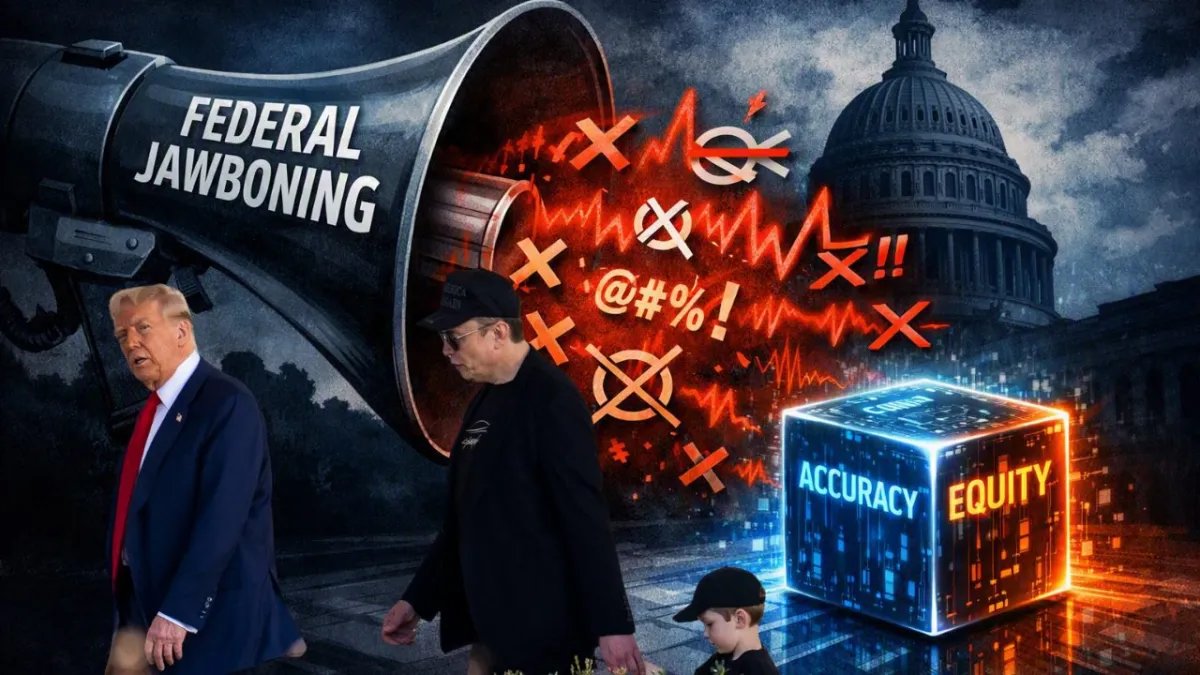
Jindia is describing “jawboning,” or the use of public appeals or informal pressure by government officials to persuade private companies to take certain actions — often censoring or regulating speech. Republicans accused the Biden administration of free-speech violations after officials encouraged social media companies to enforce their own content moderation rules against disinformation about the COVID pandemic — a form of jawboning in service of public health — but now the Trump administration appears to be writing jawboning into official policy.
John Coleman, the legislative counsel at the Foundation for Individual Rights and Expression (FIRE), a free-speech group to the right of Free Press, said the FTC’s proposal risks giving the government power to control AI-generated expression in violation of the First Amendment.
“AI developers shape their systems through choices about training data, system prompts, alignment, and other design decisions — editorial judgments protected by the First Amendment,” Coleman said in a July 31 statement. “The FTC’s proposal assumes there is one ‘best output’ and one set of user expectations.”
The FTC claims authority to take legal action against AI companies that “deceive” consumers with chatbots or LLMs under Section 5 of the FTC Act, which created the agency in 1914. However, FIRE’s comment to the FTC points out that values and expectations held by individual consumers are not uniform, and people will likely choose AI models as they do news outlets. Besides, FIRE argues, the right to make editorial decisions when training AI models is clearly protected by the First Amendment:
Again, the First Amendment protects from government encroachment that freedom to choose where to share and receive information, and the Commission has no authority to recharacterize protected editorial decisions as “deceptive” based on a declaration that AI users monolithically desire to, as the Statement suggests, ‘feel that their values are being respected.’ The Commission has no authority to define Americans’ values.
The FTC’s proposed policy is also an attempt to preempt and undermine state regulation of AI, according to the Electronic Privacy Information Center (EPIC), a digital rights group focused on algorithmic discrimination. While the vast majority won’t become law, in 2026 alone, lawmakers in states across the country have introduced roughly 1,500 bills to protect consumers in the age of AI, including legislation criminalizing digital impersonation with AI deepfakes and addressing the mental health risks associated with chatbots, especially for children.
Big Tech has fought state regulations at every turn and has a stalwart ally in the Trump administration. According to the FTC’s proposed policy statement, if AI engineers are not tempted to train AI models on their own ideological biases, state laws may require them to do so in the name of “so-called equity.” However, the federal government is falling behind on regulating AI, and states continue to be at the forefront of creating online privacy and safety, according to EPIC and Free Press.
For years, researchers have recognized that the nation’s legacy of racism is reflected in data — including the data hoovered up by AI. In Colorado, a new law cited by the FTC statement requires companies to be transparent about the data their AIs use to make decisions about online financial services, health care, education, housing, and hiring, in order to provide consumers with some level of protection against algorithmic discrimination. Under the FTC’s proposal, companies that meet the law’s requirements could be targeted for deceptive advertising.
“They are also trying to tell the states: Don’t pass laws that attempt to address racist algorithmic bias, even though everybody understands that it’s been a documented problem in the rise of machine learning,” Jindia said. “This is part of the same censorship campaign that has been in place since day one of the Trump administration, and just expanding it to AI.”
This article was originally published by Truthout and is licensed under Creative Commons (CC BY-NC-ND 4.0). Please maintain all links and credits in accordance with our republishing guidelines.
Editor’s Note: At a moment when the once vaunted model of responsible journalism is overwhelmingly the play thing of self-serving billionaires and their corporate scribes, alternatives of integrity are desperately needed, and ScheerPost is one of them. Please support our independent journalism by contributing to our online donation platform, Network for Good, or send a check to our new PO Box. We can’t thank you enough, and promise to keep bringing you this kind of vital news.
You can also make a donation to our PayPal or subscribe to our Patreon.
Please share this story and help us grow our network!
[ad_2]
Source link
