
[ad_1]
The ceasefire was supposed to mark the beginning of the end of a crisis. Instead, it quickly became a symbol of strategic failure. With renewed clashes in the Strait of Hormuz, fresh U.S. strikes on Iranian military targets, and Tehran’s retaliation, the last hopes that the Donald Trump administration could manage the Iran crisis through negotiations have collapsed. What remains today is not a clear path toward an agreement, but a return to the familiar instruments that have defined U.S. policy for years: economic pressure, military threats, and the use of hard power.
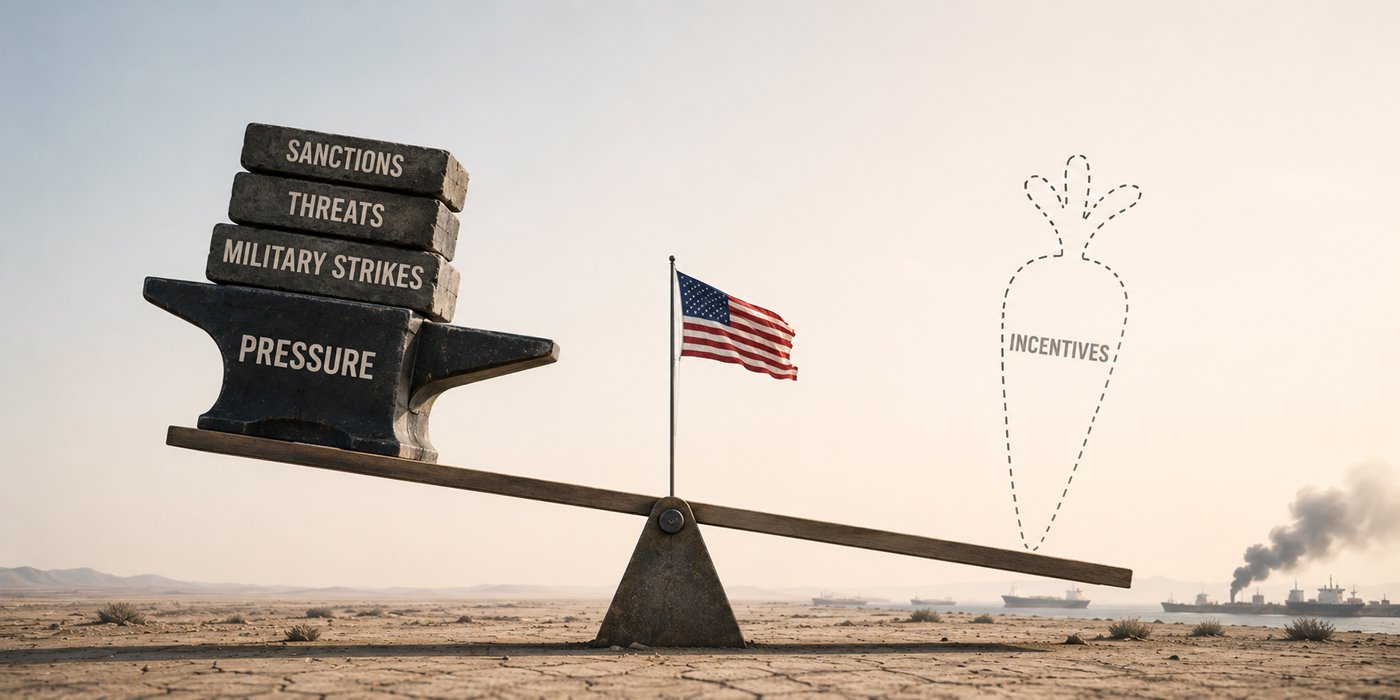
This time, however, there is one crucial difference. The Trump administration is no longer simply pursuing a policy of maximum pressure; it has entered a phase that can best be described as “all stick, no carrot.” The problem is not that Washington lacks coercive tools. The problem is that the incentives meant to transform pressure into a political settlement have lost their credibility.
Before the ceasefire collapsed, Trump’s strategy rested on a dual equation: raising the cost of Iranian resistance while simultaneously offering the prospect of economic benefits in exchange for an agreement. The White House hoped that a combination of military pressure, sanctions, promises of easing economic restrictions, higher Iranian oil exports, and renewed investment would convince Tehran that a deal was preferable to continued confrontation. In other words, the stick was supposed to bring Iran to the negotiating table, while the carrot was supposed to keep it there.
The collapse of the ceasefire, however, weakened the second half of that equation. When a process intended to reduce tensions once again ends in military exchanges, the credibility of any future political promise inevitably declines. From Tehran’s perspective, the central question is no longer simply how much pressure Washington can exert, but whether any future agreement can be trusted. If a diplomatic process cannot prevent a rapid return to confrontation, why should the next agreement be any different?
As a result, what remains available to the Trump administration today is largely the punitive side of the equation: sanctions, threats, and military strikes. But this raises a fundamental question: why does the White House believe that instruments which previously failed to compel Iran to accept American demands will now produce a different outcome?
This is precisely where Trump’s policy encounters its central contradiction. Pressure is effective only when it not only raises costs but also offers a viable exit. The history of diplomacy shows that even the harshest pressure campaigns have succeeded only when the targeted state believed that changing its behavior would bring tangible benefits. Threats without the possibility of compromise gradually cease to be instruments of negotiation and become instruments of punishment.
The Trump administration now finds itself trapped by this missing link. The greater the pressure, the more difficult it becomes to create the political space necessary for an agreement. And as the prospects for an agreement diminish, the White House feels compelled to intensify pressure further in order to demonstrate the success of its policy. The result is a cycle in which every new step demands another, without necessarily bringing Washington any closer to its stated objectives.
This is the “all stick, no carrot” trap. The problem is not a shortage of power, but an inability to convert power into a durable political outcome. The United States still possesses the capacity to impose economic and military pressure, but possessing tools is not the same as possessing a strategy. Bombing can send signals, sanctions can impose costs, and military threats can create temporary deterrence, but none of them alone can resolve a complex political crisis.
Supporters of this approach may argue that greater pressure will eventually force Iran to retreat. Yet this argument faces an uncomfortable question: what has changed this time? If economic pressure, political isolation, and military threats failed to produce Washington’s desired agreement in previous rounds, why should the same instruments succeed now without a credible political offer?
This is precisely where the Trump administration lacks a convincing answer. If the objective is an agreement, agreements do not emerge without incentives. If the objective is to change Iran’s behavior, Washington must explain what new factor has altered the equation. And if the objective is merely to increase costs, then this is no longer a strategy for ending the crisis, but one for managing it indefinitely.
The consequences extend far beyond Iran and the United States. Continued cycles of attack and retaliation increase the risk of a wider conflict in the Persian Gulf, threaten global energy security, and leave Washington’s allies more concerned with crisis management than with building a sustainable regional order. Each new round of escalation consumes additional political capital and resources without providing any guarantee of a lasting outcome.
The paradox of Trump’s policy is that, in seeking to demonstrate strength, it may ultimately leave him with fewer options than before. Retreating from pressure can easily be portrayed as political defeat, yet continuing along the same path offers no assurance of success. The longer the crisis persists, the more obvious the gap becomes between America’s instruments and its declared objectives.
Ultimately, the central weakness of Trump’s Iran policy is not that its stick is too small. It is that it assumes the stick alone can accomplish what only a combination of pressure and diplomacy can achieve. The Trump administration promised to secure a better agreement through American power, yet with the collapse of the ceasefire, the bargaining element has disappeared from the equation, leaving only pressure behind.
Successful foreign policy is measured not only by its ability to inflict costs, but also by its ability to end crises. Trump may impose additional sanctions, strike more targets, and raise the costs for Tehran, but until he can answer a simple question — what comes after more pressure? — his Iran policy will remain little more than a strategy of attrition.
The return to an “all stick, no carrot” approach is not evidence of a new strategy. It is evidence of a strategic deadlock in which Washington can still apply pressure, but no longer possesses a credible path for turning pressure into political success.
Greg Pence is an international studies graduate of University of San Francisco and my articles have been published on websites like Middle East Monitor.
[ad_2]
Source link
