
[ad_1]
President Donald Trump has decided not to renew the United States–Mexico–Canada Agreement (USMCA), which was up for review this year. The agreement will remain in force until 2036, at which point it will expire unless all three signatory countries have agreed to renew it for another 16 years.
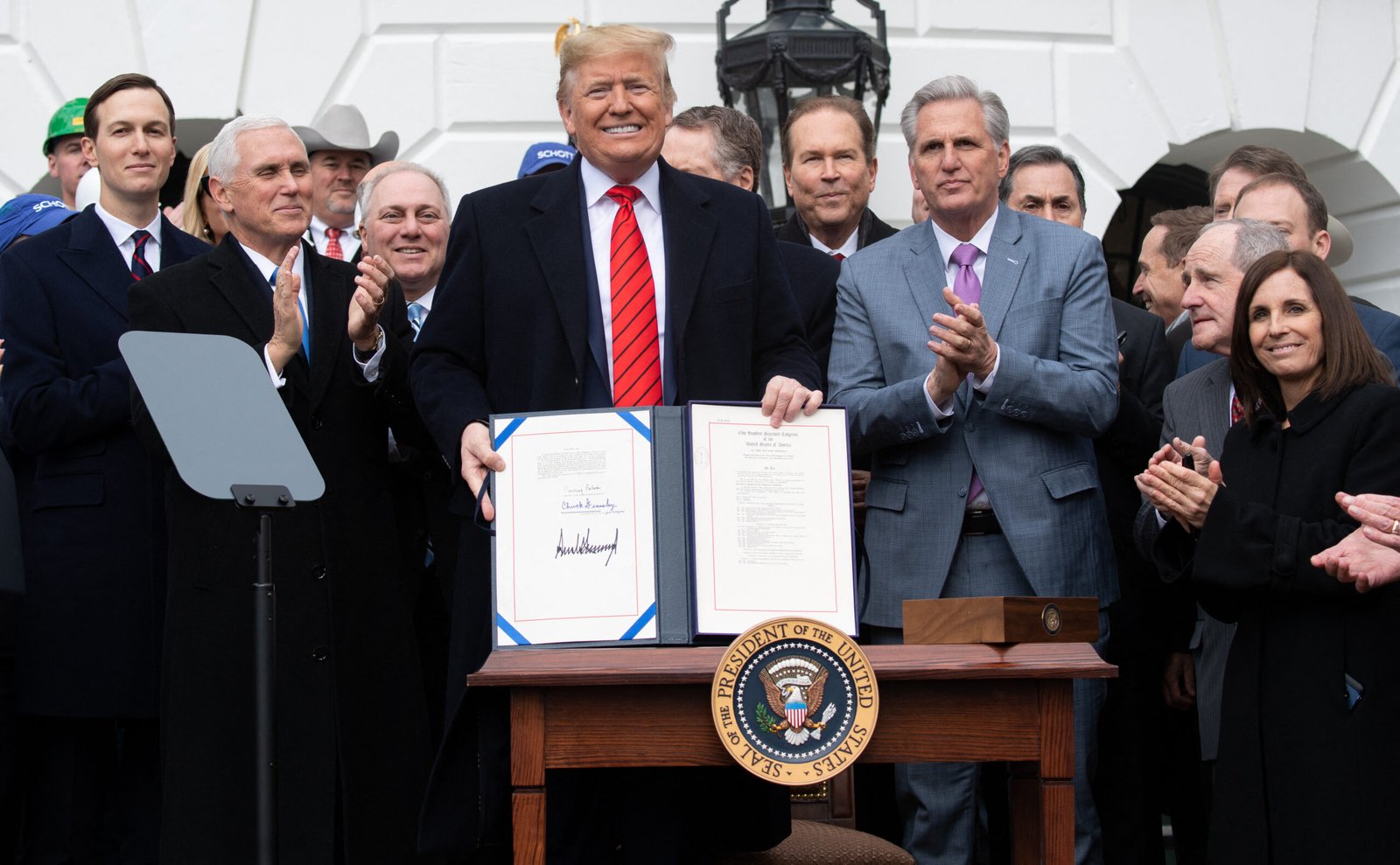
The country’s largest trade agreement, the USMCA was originally negotiated and signed by Trump himself during his first term. It replaced the much-reviled North American Free Trade Agreement (NAFTA), which Trump called “the worst trade deal in history” and a “job-killing failure” responsible for the loss of American industrial capacity.
Although the USMCA was negotiated under the first Trump administration and touted as a major achievement (the president called it “the largest, fairest, most balanced, and modern trade agreement ever achieved”), Trump has since been relatively ambivalent on the value of the deal, noting, for example, that the U.S. still runs a major trade deficit with Canada and Mexico.
“It was sort of a good deal, but it was a great deal for one reason,” Trump told reporters in June. “It gave the right to terminate.”
That right to terminate (or rather, to not renew) is what the president is exercising now, as he feels the agreement has not done all he had hoped it would. The economic trends that the USMCA was supposed to arrest—growing trade deficits with Mexico and Canada and American deindustrialization—have continued. Indeed, since the USMCA came into force in 2020, the U.S. trade deficit with its North American partners has exploded. In the past six years the U.S.–Mexico trade deficit for goods has almost doubled, going from $111 billion in 2020 to $197 billion in 2025. The U.S.–Canada trade deficit for goods grew from $14 billion to $48 billion over the same time period, an increase of nearly 250 percent.
American manufacturing is not much healthier for the change, either. While the U.S. manufacturing industry has grown in dollar terms since 2020, the sector has declined in proportion to the rest of the economy. When USMCA entered into force, manufacturing contributed just over 10 percent of the total U.S. GDP. Today, it represents only 9.4 percent. That decline is particularly painful as the U.S. attempts to keep pace with China’s massive manufacturing sector, an effort that looks more doomed with each passing year. The USMCA also failed to bring any revival in manufacturing employment: There are fewer Americans working in manufacturing today than in January 2020.
The lackluster results delivered by the USMCA are hardly surprising. The agreement, though touted as a repudiation of NAFTA, was essentially the same framework with a few modifications and a new coat of paint. It maintained essentially intact the North American free-trade zone, NAFTA’s signal accomplishment, but tightened rules of origin for automotives and automotive parts, strengthened labor standards, and beefed up the enforcement mechanisms for violations of the agreement. It also, of course, added the sunset clause that ends the agreement unless it is renewed by 2036.
The U.S. will continue to negotiate with Mexico and Canada over the terms of the USMCA during its remaining decade, however. The Trump administration is pushing to strengthen the automotive rules of origin even further, among other changes. But drawing up a replacement framework does not seem to be on the president’s agenda, at least for now.
Materially altering the USMCA framework will be difficult. North American trade is deeply integrated, and is becoming more so as the U.S. seeks to decouple supply chains from China. Much of that manufacturing has moved to Mexico, which under President Claudia Sheinbaum has placed steep tariffs on Chinese goods in an attempt to tighten its economic alignment with the U.S. Ending the North American free-trade zone would be a major disruption to the American economy and highly unpopular with U.S. businesses and consumers.
It’s also uncertain how effective doing so would be for American reindustrialization. American manufacturing has trouble competing with China’s cheap labor costs; sourcing parts from lower-cost countries like Mexico allows American companies to reduce the price of their products at the cost of shifting some of the supply chain abroad. Cutting off the possibility of cheaper inputs may stem the flow of offshoring but make American goods too expensive for the market, harming manufacturers.
Still, the Trump administration already began to move beyond the free-trade framework established by NAFTA and only partially preserved by the USMCA. During Trump’s 2025 “Liberation Day” tariff campaign, Canada and Mexico were not treated like free-trade partners: The administration imposed duties on some Canadian and Mexican goods under border-emergency authorities, though USMCA-qualifying products retained their preferential treatment.
These measures marked an important departure from NAFTA’s animating premise: that tariff-free trade among the three countries should be the default. The Trump administration’s position is that access to the U.S. market must be subordinate to American industrial and economic policy priorities. It will continue to push that line in the ongoing USMCA talks this summer.
Subscribe Today
Get daily emails in your inbox
What will replace the USMCA when it expires in 2036 remains an open question, however, and will probably depend heavily on the results of the 2028 presidential election. Trump himself seems inclined to leave it to his successor, and it is not certain how the party will settle on economic policy as he exits the stage.
Vice President J.D. Vance, the heir apparent, has been one of the most prominent champions of the second Trump administration’s protectionist policies, while Secretary of State Marco Rubio, likely to be the establishment darling in a primary contest, is a proponent of something closer to the pre-Trump Republican consensus on free trade. Either could move the party in his own direction.
Democrats, on the other hand, have been fiercely critical of the Trump administration’s tariff policy, and are likely to seek a return to the days of NAFTA, a position that meshes well with the party’s increasing suspicion of borders generally.
[ad_2]
Source link
