
[ad_1]
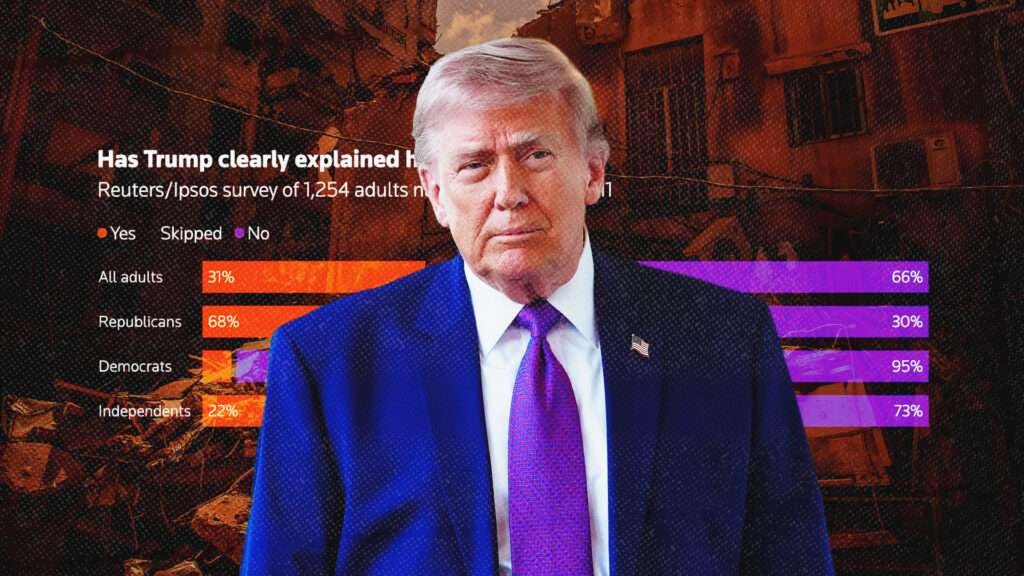
Two-thirds of Americans believe that President Donald Trump did not clearly explain his goals in the war with Iran, a poll released by Reuters and Ipsos on Monday shows. Reuters and Ipsos also found that two-thirds of Americans blame an increase in gas prices—caused by fighting in the oil-rich Persian Gulf—on the Republican Party.
The poll is only the latest in a long line of polls showing that the American public did not want the war to start and did not like the way it unfolded. And the Trump administration clearly knows it. Trump started the war by surprise on a Friday night. After the U.S. and Iran agreed to a ceasefire in mid-April, the administration claimed that Congress no longer gets a say under the War Powers Act, because the clock has reset on the war.
Buoyed by the quick success of Venezuela’s diet regime change, Trump publicly and privately said that the war was only supposed to last the weekend. Why bother making the case to the public if the war would be over before they had a chance to weigh in? Since then, Trump has argued that the public still needs to wait and see before passing judgment.
Instead of ending with the ceasefire, the war seems to have settled into a lower-grade but ongoing conflict. While both sides negotiate on the terms of their future negotiations, they continue to shoot at each other across the Strait of Hormuz.
“Don’t rush me,” Trump told reporters last month, shortly after the ceasefire began. “We were in Vietnam for 18 years. We were in Iraq for many, many years. I don’t like to say World War II, because that was a biggie. But we were four-and-a-half, almost five years in World War II. We were in the Korean War for seven years. I’ve been doing this for six weeks.”
Liberal supporters of the war have also expressed similar frustrations. A few weeks into the war, The Atlantic called it “a war between a democracy’s impatience and a theocracy’s ruthless endurance.” Rather than blaming the U.S. government for failing to win support for the war, author Karim Sadjadpour seemed to blame Americans for failing to line up behind their leaders.
For decades, there was an unwritten arrangement between war hawks and the American public: Hawks get to wage the wars they wanted without public input, as long as they didn’t demand much of the public. The Iran War broke this social contract. The hawks drove the country into a much bigger and more demanding war while expecting the same passive public consent.
Not even dictators fight wars this way. One-man and one-party regimes put quite a bit of effort into war propaganda to rile up the population. Their subjects may not be able to vote them out of office, but these governments still can’t demand sacrifices without any explanation. Eventually, they run into serious consequences for pushing the public too hard.
After all, the U.S. war effort was based on the idea that Iranian public opinion does matter, despite Iran’s domestic repression. Trump began his military buildup after the Iranian government violently put down an uprising, and Israeli Prime Minister Benjamin Netanyahu promised Trump that it would only take a little bit of pressure to finally overthrow the Islamic Republic. That didn’t happen, and the U.S. instead found itself in a drawn-out war.
Just before the ceasefire was announced, Trump threatened to blow up all the modern infrastructure in Iran, and just afterwards, he imposed a blockade on Iranian ports. The goal of both measures was to make the Iranian people poorer and more miserable. (Indeed, the combination of war damage and the blockade has caused double-digit inflation and dire unemployment in Iran.) Again, the theory behind this strategy is that public anger will either collapse the government or force it to surrender.
But the American hawks who chose this path seem to believe that the opinions of their own countrymen—who are blessed with the right to vote and to protest—should be a non-factor in the government’s decision-making process. The administration has scorned the idea that it needs any kind of public approval.
“They don’t like the word ‘war,’ because you’re supposed to get approval, so I’ll use the word ‘military operation,’ which is really what it is,” Trump said at a Republican fundraiser in March. He called it “treasonous” to question whether the U.S. is winning the war in a speech earlier this month.
The Pentagon, meanwhile, has worked to censor any kind of bad news coming from the Middle East. After Sen. Mark Kelly (D–Ariz.) warned about U.S. munitions running low in a Monday interview, Secretary of War Pete Hegseth threatened to prosecute Kelly for “blabbing” about “classified” information. The ammunition shortage is no secret; there has been plenty of news coverage, with far more specific numbers than Kelly gave.
The point is not just that the president has the power to start the war without asking the public. He and his advisors also believe that they shouldn’t have to explain themselves or answer criticism once it’s started. Americans have gotten the message—and they’re not happy with it at all.
[ad_2]
Source link
