
[ad_1]
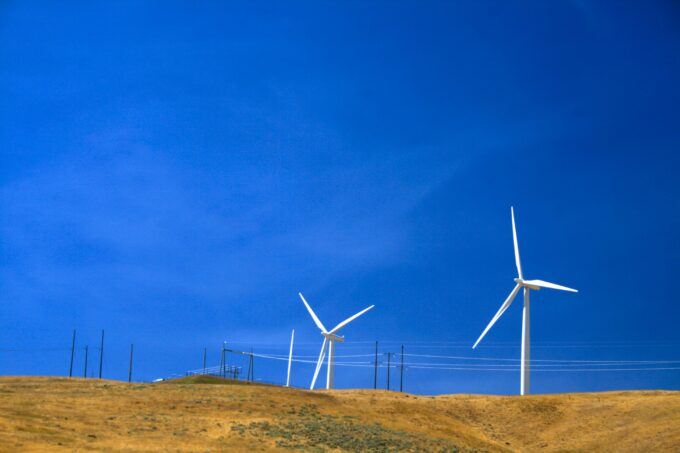
Wind turbines near Goldendale, Washington. Photo: Jeffrey St. Clair.
While we wait to see whether Trump will restart his war in Iran, we can take a moment to look at the positive side. Trump has done more with this half-baked war to spur the transition to a green economy than anything Kamala Harris could have realistically hoped to accomplish if she had been elected.
Trump’s war has sent oil and gas prices soaring. Even if he gets an agreement soon, which will be difficult now, since he has shown he is not a trustworthy leader, and the Strait is reopened, countries around the world will still look to hypercharge their transition to EVs and clean energy.
They don’t want to be dependent on an energy source that a petulant 8-year-old in the White House can shut down any time he has a bad day. And even if Trump leaves the scene in two-and-a-half years, or sooner, they now recognize that the United States is the sort of country that can elect a petulant 8-year-old and give them unchecked power. Responsible leaders don’t want their countries exposed to this risk.
We’ve already seen the response from countries and consumers around the world. Chinese EV manufacturers report their sales for March were up more than 50 percent from year-ago levels. There are similar increases in demand for batteries and solar panels. The Chinese government had been worried about excess supply in its clean energy sector.
It had been encouraging companies to reduce capacity and consolidate. Thanks to Trump’s war, the concern for overcapacity is likely to have disappeared. The world will buy as many EV cars and solar panels as China can produce.
It’s hard to imagine anything a Harris administration could have done to spark world demand for EVs and clean energy as much as Trump’s war. The United States would have been better positioned to play a role in the transition and would be doing more itself with Harris in the White House, but the rest of the world matters much more than the United States. And we will eventually catch up as consumers here get tired of paying twice as much to buy a car and keep it running than everyone else in the world.
I remember around a decade ago having a discussion with a reporter from a Norwegian newspaper. We both agreed that China’s economy was passing the US economy to become the largest in the world. He made the point that whenever a country passed the prior hegemon in size and power, it had always been accompanied by war.
The simple story is that the US gained clear dominance over the UK as a result of the First and Second World Wars. The UK became the world’s leading power following the Napoleonic Wars.
I was more sanguine. This sort of changing of the guard is a rare event. The most recent one was more than 80 years ago, and the world has changed. It seemed foolhardy to extrapolate from the past instances.
But here we are. Trump has managed to make the United States seem reckless and unpredictable. By comparison, China is an ocean of stability. It is also by far the leading manufacturer of the items needed for the green transition. It shouldn’t be hard for most countries to decide who they would rather do business with.
The United States has built up a massive structure of international institutions, most notably the I.M.F., which it largely controls; these will not go away overnight. But either the role of China in the I.M.F. and other international institutions will increase, or it will look to create competitors.
In any case, Trump is putting an end to the era of US hegemony, and it is happening much faster than anyone could have expected. We can argue whether this handing off of the baton is a good thing or not, but it is what it is — and thanks to Trump, the US is no longer #1.
This first appeared on Dean Baker’s Beat the Press blog.
[ad_2]
Source link
