
[ad_1]
President Donald Trump and other administration officials are claiming credit for a recent drop in prescription drug prices, citing deals they’ve struck with drugmakers and the launch of the online direct-to-consumer platform TrumpRx. But experts are skeptical those measures have had much impact on prices overall, and they say other factors likely explain most of the decline.
Trump and his allies were quick to celebrate when the latest consumer price data from the Bureau of Labor Statistics, released in mid-August, showed prescription drug prices falling 3.1% over the past year. The data measure prices paid by consumers and insurers at retail, internet or mail-order pharmacies.
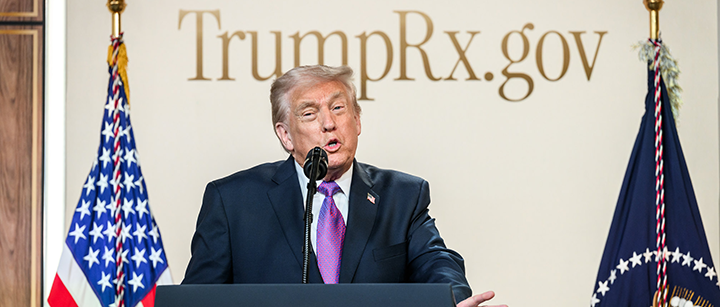
“Under my most-favored-nation policy on drug prices, we are delivering the largest prescription drug price cuts in the history of our country,” Trump said during an Aug. 14 speech on Long Island, referring to agreements with companies to offer certain drugs at prices comparable to those in other countries.
He repeated the claim during an Aug. 31 event at the White House at which he announced deals with additional companies.
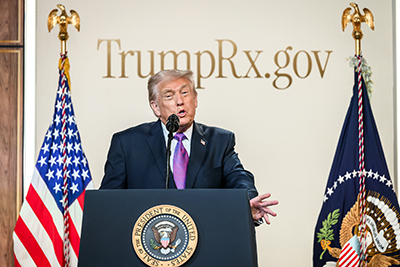
Similarly, in an interview with CBS News’ “Face the Nation” on Aug. 23, Centers for Medicare & Medicaid Services Administrator Mehmet Oz attributed the drop to the administration’s dealmaking and the launch of TrumpRx, which lists discounts on certain drugs for consumers paying cash prices.
“This increasing savings that we’re seeing, the additional amount of savings we’re getting — primarily driven not just by having the medications at most-favored-nation pricing, but available to the American people on TrumpRx.gov — is seismic in its nature,” Oz said.
Oz put it more succinctly in an X post two days earlier: “Why did drug prices DROP? The answer: President Donald J. Trump fulfilling his promises to the American people.”
But several drug pricing experts told us the reasons for that decline are a lot more complicated than the administration is letting on — and neither TrumpRx nor the agreements with drug companies are likely to have been major drivers.
They cited other factors they see as likely having a bigger impact, including market pressures driving down the cost of GLP-1 weight-loss drugs, more generics entering the market and a Biden-era policy that allows Medicare to negotiate drug prices.
“I think it’s totally possible that there are both some Republican policies — or, you know, Trump policies — as well as Biden policies that are at play here,” Cynthia Cox, a senior vice president at the nonpartisan health policy research organization KFF, told us. “But I think there’s also just market forces at play, in particular around GLP-1 drugs, that are really hard to ignore.”
Asked about the basis for the president’s claims that his policies are driving a major reduction in drug prices, White House spokesman Kush Desai rejected the idea that Medicare price negotiations implemented during the Biden administration, which apply to 10 drugs so far, made a big difference.
“President Trump’s Most-Favored-Nations deals, on the other hand, cover hundreds of drugs, including GLP-1s and fertility drugs that are enormously popular and not typically covered by insurance,” he said in a statement. “TrumpRx.gov has already saved real patients over $700 million, and the President’s MFN policies are set to save America over $500 billion in the next 10 years.”
We’ve previously written about the shaky assumptions behind that $500 billion number. The Centers for Medicare & Medicaid Services referred questions to the White House.
Effects of Drug Pricing Deals, TrumpRx ‘Murky’
It’s true that prescription drugs have just seen the largest one-year price decline in decades, as measured by the Bureau of Labor Statistics’ Consumer Price Index. The CPI tracks prescription drug prices based on what individuals and insurers, including Medicare drug plans, pay to pharmacies.
Those prices are down 3.1% since last July, the largest one-year decrease since 1963. Prices didn’t change much in the second half of 2025, but have dropped 3.3% since the start of this year — the steepest six-month drop since the BLS started tracking prescription drug costs in 1947.
Trump and other administration officials say the drop is due to deals they’ve struck with major pharmaceutical companies to offer certain drugs at so-called “most favored nation” prices, or prices that are comparable to those in other developed countries. The U.S. tends to pay significantly more than other wealthy nations for brand-name drugs.
Since November, the Trump administration has announced agreements with 17 large drug companies, including Pfizer, Merck and Johnson & Johnson, to implement MFN pricing for certain drugs in exchange for three years of tariff relief. (The administration announced similar deals with nine midsize biotech companies Aug. 31.) Trump has sometimes described those deals in sweeping terms.
“For decades, Americans paid the highest prices for prescription drugs,” Trump said in his Aug. 14 speech. “We paid more for prescription drugs than anywhere in the world. And now we pay the lowest price anywhere in the world for prescription drugs.”
But as we’ve explained before, the agreements are much narrower than Trump’s description suggests.
Companies did pledge to release at least some new drugs at prices comparable to those in other wealthy nations. But for existing drugs, MFN prices apply in only limited circumstances — drugs sold to state Medicaid programs, direct-to-consumer sales through TrumpRx and certain GLP-1 weight loss and diabetes drugs sold to Medicare or Medicaid. The agreements do not affect the prices of drugs already on the market for the majority of Americans who use private insurance.
“Right now, the only places where those MFN prices would show up in the CPI would be through TrumpRx,” said Jeromie Ballreich, a health economist at Johns Hopkins University who studies pharmaceutical economics and policy. (As a measure of consumer prices, the CPI doesn’t factor in what Medicaid pays because it’s fully taxpayer-funded.) And he said TrumpRx is unlikely to have had major effects on the overall prescription-drug market because it serves a relatively small subset of patients. “It’s not a big factor in the market.”
TrumpRx, which the federal government launched in February, features discounts on a selection of brand-name drugs for self-pay consumers, i.e., those not using insurance. As we’ve written before, the site may offer savings for some patients buying certain drugs, such as those without insurance or those who need expensive medications their insurance won’t cover, including GLP-1 drugs for weight loss. But most people will get a better deal going through their insurance, and some drugs featured on the platform also have cheaper generic versions available elsewhere.
The White House says TrumpRx has already saved Americans more than $700 million, though it hasn’t released the details of how it calculated that figure. A spokesperson said it’s based on comparing what people paid when buying medications through the site to what the prior net prices would have been. Seven hundred million dollars would represent less than 0.2% of the $467 billion that was spent on prescription drugs in the U.S. in 2024, according to the government’s national health expenditure data.
Additionally, Ballreich said drug companies and the White House have been relatively vague about the details of the MFN deals in their public statements, so it’s unclear exactly how far-reaching they are. Some companies’ Securities and Exchange Commission filings suggest that only some of their products are subject to the agreements.
“They didn’t have enough detail about, is it all new drugs?” Ballreich said. “Only some new drugs?”
Similarly, Richard Frank, a senior fellow at the Brookings Institution and director of the think tank’s Center on Health Policy, said the limited scope and lack of detail make it hard to assess the impact of these deals.
“There are an unknown, but probably small, number of drugs where there have been any negotiations with the Trump people, and it’s not even obvious that those have been implemented yet,” he said. “So all of this is kind of murky. It’s not that it’s implausible that they have some effect. But it’s really unlikely that they are the major drivers here.”
As for TrumpRx, Frank said there are still questions around its uptake and the extent of savings it actually offers.
“That’s an area where there could be a contribution,” he said. “But again, I would be surprised if it was very large.”
Cox, with KFF, said it’s possible that a newly launched pilot program to make reduced-price GLP-1 drugs available to certain Medicare beneficiaries factored into the most recent CPI prescription drug data, which registered a 0.8% drop in July.
The administration says Novo Nordisk and Eli Lilly — the makers of Ozempic/Wegovy and Mounjaro/Zepbound, respectively — have agreed to provide the drugs to Medicare for $245 per month, and certain Medicare beneficiaries became eligible to access the drugs for weight loss for the first time at a $50 monthly copay, starting July 1.
“That would correspond with the timing of this particular [month’s] drop in the CPI,” Cox said, but not the declines that happened earlier this year.
Other Reasons for the Drop in Prices
Experts told us they see other factors as more likely explanations for the year-to-year drop in drug prices, though they cautioned that they don’t yet have clear empirical data on exactly what’s going on.
For one, Cox said, GLP-1 prices have been coming down for reasons other than the administration’s dealmaking, including heightened competition between drugmakers as new GLP-1s enter the market.
“There’s competition within the class, there’s competition from compound pharmacies, there’s the fact that a lot of people don’t have insurance coverage for these drugs but really want them, and so they’re paying out of pocket and price-sensitive,” she said. “And there’s this kind of pressure from insurers and employers to bring down the prices, because they might want to offer that coverage but not at the current price.”
Frank likewise pointed to competition in the GLP-1 market lowering prices for those drugs. “Since their sales have been so high, they would get quite a bit of weight in the CPI,” he said.
Another likely factor is that a number of bestselling brand-name drugs recently lost patent protection, Ballreich said. “So we had generics and biosimilars come on the market at cheaper prices.”
Ballreich also credits a policy signed into law by President Joe Biden as part of the 2022 Inflation Reduction Act, which gave Medicare the authority to negotiate prices for certain expensive drugs. The negotiated prices for the first 10 of those drugs — which were dispensed to nearly 9 million beneficiaries in 2023 and accounted for about 20% of Medicare prescription drug spending that year — took effect in January.
The Centers for Medicare & Medicaid Services estimated in 2024 that the negotiated prices would have saved the program $6 billion had they been in effect for the prior year. It also projected that beneficiaries would save around $1.5 billion in out-of-pocket costs on those drugs in 2026 because of the lower prices.
“For Trump to take credit in drug pricing, I do think one of the biggest things he did was he did not dismantle Medicare price negotiations,” Ballreich said.
Frank is less confident that the initial batch of Medicare price negotiations was a major driver of the decline in overall prescription drug costs. He views it as possible but unlikely, given the negotiations involved a relatively small, if costly, set of medications. Some of the impact would depend on how much those particular drugs are weighted in the CPI index, he said.
“On the Medicare side, there are 10 drugs. They were generally relatively big sellers,” he said. But as with Trump’s MFN deals, “we don’t know how quickly they’ve all worked their way through the supply chain.”
Frank said other possible factors could be in the mix as well. Pharmacy benefit managers — the third-party companies that manage prescription drug benefits for insurers — have been under pressure to pass on more of the savings from rebates they negotiate with drug companies. He also said that we don’t know how a separate provision of the IRA — the Inflation Rebate Program, which aims to discourage drugmakers from raising their prices too fast — may have affected prices.
“There are a lot of moving parts here,” he said. “It would be surprising to me if the administration’s MFN negotiations played a big part of it, just like I wouldn’t have guessed that the IRA negotiations played a huge part of it.”
In his statement, Desai, the White House spokesman, called the idea that the Medicare price negotiations had made a big difference in the CPI “absolutely idiotic and unfounded.”
“The so-called Inflation ‘Reduction’ Act negotiated prices just on Medicare for a whopping 10 drugs, and failed to deliver any meaningful price reductions beyond discounts that private insurers had already negotiated,” he said. “These discounts came into effect in January 2026 without making a dent in the prescription drug CPI for February 2026.”
The CPI’s prescription drug index dropped about 0.2% in February before registering a bigger decline of 1.5% in March.
Whether people notice a difference in what they’re actually paying at the pharmacy, of course, generally has more to do with the specific features of their insurance plan, Ballreich said. “That will have a much more influential effect on them as patients, rather than general drug pricing trends.”
Editor’s note: FactCheck.org does not accept advertising. We rely on grants and individual donations from people like you. Please consider a donation. Credit card donations may be made through our “Donate” page. If you prefer to give by check, send to: FactCheck.org, Annenberg Public Policy Center, P.O. Box 58100, Philadelphia, PA 19102.
[ad_2]
Source link
