
[ad_1]

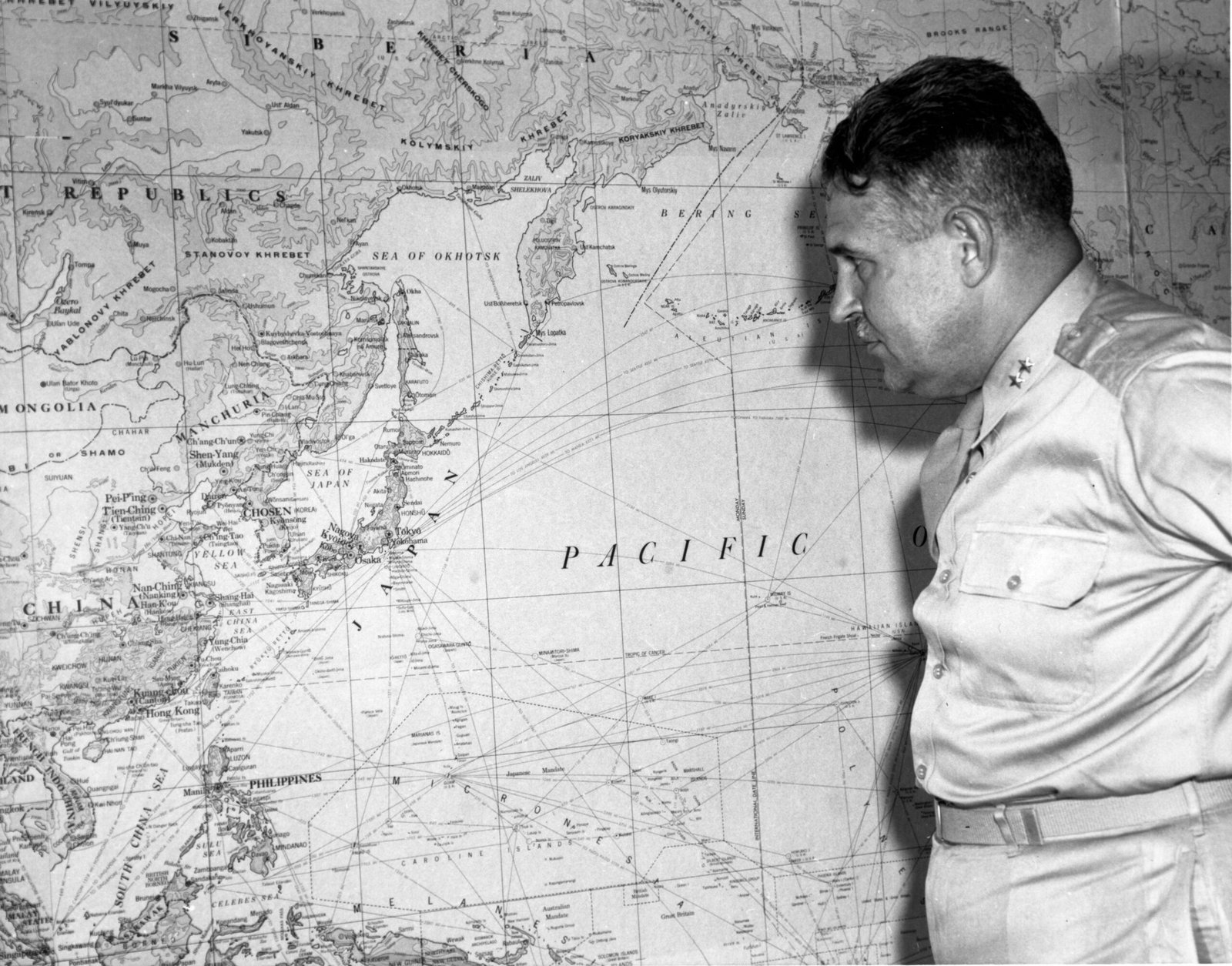
Leslie Groves, Manhattan Project director, with a map of the Far East – Public Domain
In quick succession, three things happened in early August 81 years ago that fundamentally changed the world and the course of human history:
We start with 8:00 a.m. on August 6, 1945, when three gleaming, silvery four-engine B-29 Superfortress bombers, larger than any other flying machine in the world, soared at 31,000 feet over Hiroshima, just shiny specks in a clear blue sky, high enough that their four throbbing engines were scarcely audible from the ground.
Many of the city’s residents, as WWII ground towards its violent inexorable end, had become inured to seeing waves of such American bombers pass overhead and for some reason, never targeting their city. So if they noticed the three planes at all, they might have assumed they were spotter or damage assessment aircraft and not what they really were: a single bomber, an observer plane to take photographs of what would be a dreadful historical event, and a weather monitoring plane. Few probably even noticed when one of the lead planes in the formation released a huge 10-foot bomb from its specially-enlarged bomb-bay doors and then veered sharply into a rapid dive to create as much distance as possible from the shockwave to come.
Sending a message to Moscow
The US plan for this and another atomic bombing to come soon was to maximize the damage done and the human death tolls. Accordingly, they gave no warning to residents of either targeted city to evacuate. The plan was also to strike each city around 8:00 in the morning to maximize the number of people out on the street without shelter.
The plan worked. The throngs of Japanese workers in Hiroshima heading to their job sites, the little chattering children in their “sailor suit” uniforms on the way to school, mothers and grandparents worrying about what they’d find to buy for the evening meal at the city’s war-strapped street markets and fretting about loved ones fighting a losing battle in foreign lands—all were too preoccupied that morning to watch the bomb’s 44.4-second plunge to the designated detonation altitude of 2000 feet above the city.
In a way, they were the lucky ones. The bomb’s silent flash instantly melted the eyes as well as the cerebral neurons of those who were watching and instantly killed those not looking too, vaporizing their bodies or turning them to ash. Some 80,000 Japanese, mostly civilians, women, children, and elders, died instantly. Or if they were among the 100,000 located farther away from Grand Zero, soon after the 15-16 kiloton air burst. Another 100,000 would die more painfully and slowly later over days, weeks, months and years from radiation or physical injuries from the blast. The world’s first nuclear bombing had also instantly leveled the city of 350,000.
Up above that nightmare holocaust, Captain Robert A. Lewis, co-pilot of the Enola Gay, the plane that dropped the uranium bomb dubbed “Little Boy,” after witnessing its catastrophic results: an angry, searing, roiling mushroom cloud rising 45,000 feet into the sky above an entirely flattened city- penned in his combat notebook, “My God, what have we done?”
Another A-Bomb, another message
Three days later, on the morning of August 9, the Japanese government, still reeling from the epic incendiary-bombing destruction of 17 square miles of the capital city of Tokyo in March 1945 (still the largest aerial mass destruction of a city in human history), and with communications and transport still not functioning well, was still trying to ascertain what had happened to Hiroshima. They didn’t know US Commander-in-Chief Harry Truman had days earlier already ordered the use of a second B-29, this time carrying the “Fat Man,” a second type of atomic bomb based upon plutonium.
The target selected for obliteration was Kokura, a city of 130,000. But heavy cloud cover spared it. Instead, Maj. Charles Sweeny, pilot of Bockscar, the B-29 carrying the “Fat Man,” opted, literally on the fly, to continue on for 100 miles to the alternate target of Nagasaki, a larger city of 263,000.
Arriving there and finding that alternate target to also be cloud-shrouded, and with his fuel getting low, thanks to the nearly five-ton “Fat Man” bomb he was carrying, Sweeny decided to fly to Okinawa, dropping the unused weapon in the ocean en route if necessary.
Then a break in the cloud over Nagasaki opened, and he changed his mind and headed back to the city, dropping the bomb at 11:02 a.m. in what to this day remains the last wartime use of an atomic bomb.
Because the plane had at first started to leave, relieved Nagasaki residents who had been huddling in bomb shelters because of the earlier air-raid sirens, had already heard the all-clear signal and had been emerging in relief, just as the bomber returned to drop its payload of death. An estimated 40,000 people—nearly all civilians—died instantly from the 21-kiloton blast, with another 100,000 dying over the next year. Mountains outside the city limited the area of total destruction to a single square mile, but also focused the blast’s power and searing 7000-degree heat within that constricted space.
A high school friend of mine, Public Health professional Charles Vidich, told me his late father, Arthur, a noted sociologist, had been an officer in the Marines in the Pacific during the war. A few weeks after Emperor Hirohito broadcast his stand-down order to the Japanese military and told the Japanese people that the war was lost and he was ending it by surrendering, Vidich and a detachment of Marine enlisted men were sent to land at the destroyed port city of Nagasaki to check for any defenders or caches of weapons. What Vidich discovered was a totally flattened city still in shock. He managed to locate a Japanese military pilot with access to a small spotter plane, which he commandeered to take him up over the city so he could take photos of the epic destruction. These images he kept as his personal property—a trove which his son discovered after his death and posted on a special website (see below image), the first unadulterated or uncensored aerial evidence of the nuclear war crime the US had committed.
The nuclear lying starts early
President Truman took to the airwaves the day of the leveling of the first city, Hiroshima, lying that it was “a military base.” But while there was indeed an Imperial Army base on the outskirts of the city (basically an administrative center), the target of the bomb was the city’s center, the goal being to cause the maximum number of deaths and the maximum physical destruction. In any case, most of the Japanese military was marooned in China, Manchuria, Korea, and Southeast Asia or stranded on islands spread across the Pacific with no way of returning to Japan to defend their country. That said, of the 80,000 people initially killed by the Hiroshima bomb, only 10,000 were in uniform. In the case of Nagasaki, of the 40,000 killed immediately by the plutonium bomb, only 150 were soldiers.
Before Japan even knew about the new US super weapon, and that the first of those two bombs was already en route from Tinian Island, with plans for using them both in quick succession on two Japanese cities, the country was already desperately suing for peace and was getting a deaf ear from Washington. As I report in my book Spy for No Country: The Story of Ted Hall, the Teenage Atomic Spy Who May Have Saved the World (Prometheus Books, 2024), Dwight D. Eisenhower, at the time Supreme Allied Commander of the Allied Amies in Europe, was briefed on the plan to use the two bombs on Japan by Secretary of War Henry Stimson, who was visiting the five-star general at his headquarters in occupied Germany. Eisenhower writes that he tried unsuccessfully to dissuade Truman’s top military advisor against that course of action.
As he recalls in his memoir written in 1963:
I was one of those who felt that there were a number of cogent reasons to question the wisdom of such an act…During his recitation of the relevant facts, I had been conscious of a feeling of depression and so I voiced grave misgivings, first on the basis of my belief that Japan was already defeated and that dropping the bomb was completely unnecessary and second, I thought that our country should avoid shocking world opinion by the use of a weapon whose employment was, I thought, no longer mandatory as a measure to save American lives. It was my belief that Japan was, at that very moment, seeking some way to surrender with a minimum loss of “face.” The Secretary was deeply perturbed by my attitude, almost angrily refuting the reasons I gave for my quick conclusions.
Gen. Eisenhower, who had ordered the criminal incendiary bombing of German cities without compunction, certainly cannot be accused of being squeamish about what, since WWII, has been referred to euphemistically by the US military as “collateral damage.” But he was right about Japan. As a military leader, he knew that for Japan the war was over. As I wrote in my recent book on Ted Hall:
Japan was portrayed and is still said by US apologists for the atomic bombings to have been a warrior-culture nation whose soldiers would rather fight to the death and die with honor than surrender to a foreign invader. The truth, however, was that the country was tired of war, its navy and air force were destroyed, and much of its army was trapped in China and Korea, with no way to get home or even to move from one island of the Japanese archipelago to another. By early August, Japan was on its knees, was facing an approaching winter with no food or fuel, and was suing for peace. Moreover, since the US had cracked the Japanese diplomatic code, Truman knew all the details of that frantic effort before dropping the bombs. All the United States had to do was keep the country blockaded and surrender was inevitable.
Gen. Eisenhower wasn’t alone in his view on the supposed need for the atomic bombings. Another five-star general, Douglas MacArthur, according to his personal pilot on August 11, two days after the Nagasaki bombing, had told him, “The atomic bomb was unnecessary since the Japanese would have surrendered anyway. “
The reality is that the two bombs dropped on Japan were primarily meant to be a demonstration for and warning to America’s wartime ally, the Soviet Union, and its leader Joseph Stalin, of America’s awesome new super weapon, on which the US intended to preserve a monopoly after the war’s end. In fact, once the scientists on the Manhattan Project had successfully detonated their first fission bomb on July 16, 1945, while US marines, soldiers, as well as sailors, were still dying fighting Japanese troops in the Pacific Theater, the Truman administration, the National Security Council, Pentagon strategists and the media propaganda machine turned from combating the Axis Powers and fascism back to planning to fight Communism and the Soviet Union.(For an excellent and well-documented history of the US obsession to wipe out Communism dating back to the 1917 Bolshevik Revolution, read journalist Ron Ridenour’s excellent book: The Russian Peace Threat” Pentagon on Alert)
Planning for nuclear first strike on the Soviet Union
Truman, like all those strategists, thought that the secrecy curtain placed around the US atomic bomb project had been successful in keeping not just German but also Soviet spies out. They all anticipated the US having an eight-to-ten-year post-war period of a monopoly on nuclear weapons before Soviet scientists in that war-ravaged and financially strapped country could conceivably on their own create an atomic bomb. Yet Washington leaders wanted more: They wanted to prevent the Soviet Union from ever getting an atomic bomb. As Robert Oppenheimer recounted a disturbing conversation he had with President Truman, the President asked him when he thought the Russians would get the bomb. When he told the president he didn’t know, adding that the Soviets had some talented physicists, he said Truman responded shockingly, saying, “Well, I do know: Never!”
Like Trump and Israel’s Prime Minister Benjamin Netanyahu today in the case of Iran, Truman was  having the US military prepare to be able to preemptively attack and destroy the Soviet Union with nukes to keep it from becoming a nuclear rival. Accordingly, the president instructed the Manhattan Project (soon after the war’s conclusion to be replaced by or renamed as the Atomic Energy Commission), to keep making fission bombs, while also beginning the secret work of designing and industrially manufacturing much more powerful thermonuclear weapons based upon fusion, using heavy hydrogen—the power of the sun.
The new class of Pentagon experts calling themselves “nuclear strategists” advised Truman that it would take “at least 400” Nagasaki-sized 20-kiloton atomic bombs hitting 100 Soviet cities, and key military bases, industrial centers, etc.., to “destroy the USSR as an industrial society,” thus rendering it incapable of becoming a rival nuclear counterforce to the US. With that in mind, Truman pushed to industrialize fission-bomb production (which, even in 1946, was still assembled by hand). He also called on Boeing to restart its mothballed assembly line for B-29 Superfortresses—the only bomber in the late 1940s able to carry the heavy atomic bombs to targets in the remote Soviet interior.
Declassified National Security and Joint Chiefs of Staff documents show the tentative date of 1950 for such a genocidal attack by the US was initially set by Pentagon war planners in order to prevent what they were dubbing “A-Day”—the date when the Soviets would get their own bomb and be able to retaliate—in kind, if not in scale—to a US nuclear attack.
This dismal history of a missed opportunity for peace following the most catastrophic war in human history brings me to the third historic event of that terrible week in early August 1945.
Americans today who might find this bloody-mindedness of US leaders towards the war’s end hard to believe need to know that two historians working on a book titled Code-Name Downfall (Simon & Schuster, 1995) about the US plan to invade Japan in 1945–1946 discovered. Thanks to the Freedom of Information Act passed after the Nixon Watergate Scandal, they uncovered a document titled “A Study of Possible Use of Toxic Gas in Operation Olympic,” submitted to the Chief, Chemical Warfare Service, U.S Army, on June 9, 1945. From it, they learned that in the period before the US military knew if it would have a working atomic bomb by the time they wanted to invade the Japanese mainland, they had decided as a back-up plan to turn to chemical weapons. In fact, in the August 2015 issue of the journal Naval History, they write:
The Army planners selected 50 “profitable urban and industrial targets” in Japan, with 25 cities listed as “especially suitable for gas attacks.” These targets included Hiroshima and Nagasaki. The study declared, “Gas attacks of the size and intensity recommended on these 250 square miles of urban population . . . might easily kill 5,000,000 people and injure that many more.” Each city was divided into zones based on population density. The greater the concentration of people, the better the zone as a gas target.
The largest poison-gas raid should be on Tokyo because an “attack of this size against an urban city of large population should be used to initiate gas warfare.” The planners targeted 17.5 square miles directly north of the Imperial Palace and west of the Sumida River—an estimated 948,000 people were in that area. Within two miles of the target area were another 776,000 people who probably would be in the path of wind-carried gas. Ironically, the size of the targeted area was almost exactly the same size as the area of Tokyo burned out by the B-29 firebombing on the night of 9–10 March 1945.
The study recommended launching the gas attack on Tokyo at 0800, when the greatest number of people would be concentrated in the city. Bombers would drop either 21,680 500-pound gas bombs or 5,420 1,000-pound gas bombs, depending on the availability of the weapons. All of the bombs would be filled with phosgene.
The US prepared a secret poison gas alternative to nukes
Using banned poison gas to slaughter millions of noncombatants in Japan was not just criminal plotting by a few Pentagon madmen, the authors found. As they write in their 2015 article in Naval History:
In great secrecy, the U.S. Army had been developing and storing poison-gas munitions in the Pacific theater. The Army and Navy had major gas-storage depots in Australia and Hawaii and smaller ones on Pacific islands. By mid-1945, similar poison-gas depots were being prepared north of Manila on Luzon and on Okinawa.
The book’s authors conclude: “But in the end, the atomic bombings of Hiroshima and Nagasaki rendered moot an invasion of Japan and possible use of poison gas.”
On August 12, Emperor Hirohito informed his family that he had decided to have Japan surrender to the US. On August 15, after Imperial Army forces had crushed a last-gasp coup attempt by hard-line Japanese militarists who had tried to kidnap the Emperor and take over the state radio station to prevent his surrender announcement, Hirohito made his unprecedented public broadcast to the nation and the far-flung Japanese forces abroad that the war was over. This left the world with the Axis defeated and its armies smashed, with occupying Allied Forces as the winners, and the US as the only major combatant left unscathed and in possession of the most powerful military and superweapon ever known. It was a sole superpower with a clear intention to use that power to dominate the globe with a “Pax Americana.”
By that point though, a third thing had happened in that brief interregnum that would throw a spanner into the Truman administration’s monstrous plan for a preemptive nuclear strike. Nobody in the US government would know it had happened for five years. That’s when the National Security Agency’s years-long efforts to crack the difficult Soviet spy code started bearing fruit, and some of the thousands of captured spy cables began to be decrypted and readable.
That something was the handing over to a Soviet agent, Lona Cohen, of a ream of carefully copied schematics and precise details on the construction and inner workings the plutonium bomb, including information about the complex implosion system for detonating the highly fissionable man-made element. The scientist/spy who copied the information and cleverly slipped them past by the military inspectors at the gate to the fenced-in Manhattan Project compound was 19-year-old Ted Hall. He did this by placing the documents in a grocery bag containing a large fish, its tail protruding from the top of the bag (supposedly his contribution to a dinner date).
Hired at 18 in January 1944 as a junior-year Harvard physics major, this youngest scientist on the Manhattan Project worked on developing the complex implosion system that would detonate the first fission bomb. Dubbed the “Gadget,” it was successfully demonstrated in the Trinity Test in the Alamogordo Desert, NM on July 16, 1945.
Hall, like the other scientists hired to work on the bomb project, had been told they were all in a life-and-death race with Hitler’s scientists to develop an atomic bomb before Germany could do so. This had made good sense to Hall, the second-generation son of Russian-Jewish immigrants. However, by September 1944, it became clear that Germany was losing the war. With Allied heavy bombers hitting industrial and transportation infrastructure centers round the clock, it would never successfully develop an atomic weapon. This led Hall, like many more senior Project scientists, to become increasingly concerned about the likelihood of the US becoming the sole nuclear power after the war.
Senior scientists, like Danish Nobel physicist Niels Bohr and Polish physicist Josef Rotblat, pleaded with Washington to at least inform the Soviets of the bomb project and end the secrecy, and Rotblat actually resigned in protest. Dissatisfied with their ineffective or symbolic actions, Hall decided he had to take decisive action on his own. So in mid-October, when he was granted a short leave to visit his parents in New York City for his 19th birthday, he traveled to Manhattan, hoping to find a way to volunteer to become a spy for the Soviet Union. He met up with his Harvard roommate Saville Sax and together they brainstormed ways to do it.
Ted Hall decides to become a spy
In my book Spy for No Country, I explain how these two young men, both neophytes at spying, succeeded in their improbable quest to find a Soviet spy to volunteer to. After all, spies don’t advertise for new hires, or make themselves known as foreign agents. But basically, they succeeded because Hall had arrived in the right place at the right time, just when the US headquarters of the NKVD (precursor of the KGB) had lost touch with Klaus Fuchs, their main agent inside the Manhattan Project, and were desperate for information on the US progress on development of an atomic bomb.
During the final months and weeks of the war, Hall proved his mettle as a spy by continuing to provide valuable information on the development of the plutonium bomb. Meanwhile, Fuchs reconnected with the NKVD through his sister in Boston and his courier, Harry Gold, in Philadelphia. Though he explained how he’d lost touch with Gold, there was bound to be some concern in the NKVD about Fuchs’ reliability, given his nearly six-month disappearance. But given the similarity between what he and Hall were saying about the construction of the plutonium bomb’s design, and the strict siloing of agents the NKVD maintained, so neither spy was aware the other was too, that was good enough.
With the success of the Trinity test’s Gadget, and the success of the Trinity Test and the bombings of Hiroshima and Nagasaki, Igor Kurnakov, science director of the Soviet bomb project, got the courage and confidence to go to Stalin (not someone one would normally offer a risky proposal to). He explained to the Soviet dictator that the Soviet bomb project would not be able to produce sufficient U-235 to make a fission bomb any time soon. Meanwhile, they had in their hands, delivered by the spy Ted Hall, the complete plans for making a copy of the plutonium bomb successfully used on Nagasaki. He explained as well that plutonium, a waste product of nuclear reactors, could be relatively easily obtained through chemical processes.
His proposal: the Soviet bomb project should put the uranium bomb on hold and focus all available funding and personnel on copying the Nagasaki bomb.
Stalin agreed to this bold proposal and promised the project would get whatever resources Kurchatov said was needed.
The Soviets get their own atomic bomb
Just over four years later, on August 29, the Soviets successfully detonated their 20-kiloton first atomic bomb—a virtual carbon copy of the “Fat Man” bomb that destroyed Nagasaki. The entire US government was caught by surprise. The US at that point still had only half the four hundred 20-kiloton nukes Pentagon experts said they’d need to destroy the Soviet Union, so that genocidal 400 20-kiloton first-strike nuclear blitz on the USSR never happened. Instead we had the endless Cold War, the arms race and the Mutual Assured Destruction standoff that has thus far prevented the use of a third nuclear weapon in war since August 9, 1945.
Unknown to Truman, or even to FBI director J. Edgar Hoover at the time, Washington’s effort, which began well before the 1942 establishment of the Manhattan Project, to keep its Soviet wartime ally in the dark about US work on an atomic bomb, had been a failure from the very start. The Soviets had NKVD and GRU (Soviet military intelligence) spies almost from the beginning working in the first British bomb project called Tube Alloys. That meant when that project’s scientists were invited to come to the US to help speed up the process of obtaining a functioning atomic bomb, their contingent included the NKVD’s most productive atomic spy in Britain: Klaus Fuchs.
Fuchs, a brilliant young German Communist physicist, following the Reichstag Fire, found himself hunted by Hitler’s Gestapo. He fled to Britain, where Quaker friends of his minister father secured him refugee status and allowed him to attend Bristol University to resume his interrupted PhD in physics. While identified as a Communist by the British Home Office once Germany broke its nonaggression pact with the Soviets and invaded Russia, Fuchs was allowed to join the British top-secret Tube Alloys bomb project.
In 1943, when British atomic scientists were invited to the US to help speed up work on the vastly larger and better-funded Manhattan Project, Fuchs, a dual German-British citizen, was waved through the Immigration checkpoint in the US with the others. Already a spy in the UK, he became a spy in America, initially working in Manhattan on developing an efficient way to separate the rare fissionable isotope U-235 from the more common nonfissionable U-238 before later being transferred to Los Alamos.
In a book published in Russia in 1995 titled Special Tasks: Memoirs of an Unwanted Witness—A Soviet Spymaster by Pavel Sudoplatov (with his son Anatoli), the elder Soviet intelligence veteran wrote of the importance of the above passing of the plans for the “Fat Man” bomb in preventing a US monopoly on nuclear weapons. Sudoplatov, once a senior Soviet intelligence official, writes, “Both these reports [from spies Fuchs and Hall] contained a 33-page design [that] became the basis for our program of work on the atomic project over the next three or four years.”
Ted Hall died in Cambridge, England, at the age of 74 in 1999, four years after a decrypted Soviet spy cable was released by the NSA to the media. Although the FBI had learned the content of that cable in 1950, it remained secret, and he was not prosecuted, though his spying was far more damaging to US atomic secrecy than anything the Rosenbergs were accused of allegedly doing. The incredibly amazing reason he and his courier Sax, escaped prosecution is revealed in my book Spy for No Country.
After the war in 1946, Fuchs turned to the UK and was ultimately put in charge of the British project to develop the hydrogen bomb, until another Soviet spy cable outed him that same year. He confessed to British charges in a deal that the FBI would not charge his sister Kristal in the US with spying. Confessing to spying himself, Fuchs was sentenced to 14 years in prison, but was freed after 9 years.
[ad_2]
Source link
