
[ad_1]
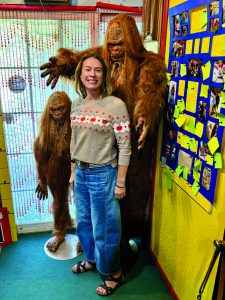
Like many skeptics, I’m fascinated by things people believe in—ghosts, psychics, astrology, reiki—but I’m even more intrigued by why they believe in them. In my experience, everyone believes (or has believed) something that’s a little “out there.”
So, when my husband and I learned about a nearby Bigfoot museum on a recent road trip, I had to go.
Our GPS led us on quite the adventure through farms and woods and onto increasingly remote gravel roads. We finally found a driveway and discovered the “museum” was in someone’s house. After knocking to no avail, I called the number on the window. The woman who answered told us we were the only visitors, but she could let us in shortly.
Jan, a lifelong Bigfoot believer since a childhood sighting, met us with infectious enthusiasm. (“Jan” is a pseudonym to protect her privacy.) She had spent most of her life collecting “evidence,” which she had documented both in a book and across four buildings on her property.
The Evidence
As the local “Bigfoot expert,” Jan had compiled numerous firsthand accounts of sightings over the years. She shared the story of a farm kid, known for being responsible and trustworthy, who was late to school one morning. He told his teacher that a large and hairy human-like animal had crossed in front of his car. It had even looked him in the eye. To Jan, these weren’t just stories; they were the ultimate proof.
Because of her reputation, Jan said the police would occasionally contact her to help investigate “weird things,” such as sightings, large footprints, and unexplained photographs. When I asked to see the police reports, she claimed she couldn’t because they included “private information.” (I thought this was odd, as police reports in that state are generally considered public records.)
Eventually, Jan moved on to a large wall map covered in red pins. “Can you spot the pattern?” she asked. Most of the pins, which she called “confirmed sightings,” were near rivers. To Jan, this proved they were Bigfoot, as Bigfoot likes to be near water.
Next, we were shown photos of tree breaks and arches. Jan explained that Bigfoot uses its massive strength to mark its territory or create shelter by snapping trunks or bending saplings.
Jan then left for a moment to retrieve her most recent line of evidence, returning with a clump of braided horsehair. She explained that all over the world, mysterious braids appeared in horses’ manes and tails, seemingly overnight. While “skeptics” often dismissed them as tangles caused by wind, Jan was convinced they were the work of skilled hands—Bigfoot’s hands.
I asked Jan if there might be other explanations for the evidence. People’s perceptions aren’t always accurate (or truthful). Wildlife are also found near water, and bears are often mistaken for Bigfoot. Storms can bend or break trees. People can braid horse tails. But Jan was convinced; the only logical explanation was Bigfoot.
After her introduction, Jan sent us off to tour the exhibits. We saw several casts of footprints and a report that Vladimir Putin had spotted a family of Yeti in Siberia on April 1, 2016 (“Vladimir Putin” 2016). (This seems to have been an April Fool’s joke.)
As we continued through the museum, an interesting trend emerged: it wasn’t just about Bigfoot. One room, for example, had exhibits featuring aliens at Roswell, Mothman, chupacabra, and mer-moose. (Really.)
The next room featured a mock skeleton of a giant, close to nine feet tall, with two sets of teeth and hands as feet. Over the display was a photo of “skeletons”—up to thirty feet tall!—and a sign that read: “In those days and even afterwards, when the evil beings from the spirit world were sexually involved with human women, their children became giants.” It was the Nephilim from the Bible, paraphrased from Genesis 6:4. (Is it me, or does the Bible blame women a lot?)
Jan then shared a dramatic story: In the early twentieth century, a nearby river flooded, killing many and exposing the remains of giants! The bones had been sent to the state university’s science museum, but when Jan called, the staff claimed ignorance. However, a janitor overheard and asked her to call after hours. He confirmed Jan’s suspicions: the skeletons had disappeared to cover up the evidence.
(It was at this point that my husband ditched me to “take a phone call.”)
The final room featured Carl Baugh, founder of the Creation Evidence Museum. Baugh is known for “discovering” human and dinosaur footprints along the banks of the Paluxy River in Texas, a claim that’s been so thoroughly debunked that many creationist “researchers” have withdrawn support (Cole and Godfrey 1985; Neyman 2008). Next to a replica of the footprints was a photo of Jan on an archeological dig with Baugh.
It turns out that Jan isn’t only a Bigfoot enthusiast; she is a young-earth creationist (YEC). To her, Bigfoot is a “kind” of human, created by God with everything else less than 10,000 years ago. Scientists, she said, were either unwilling to accept the truth or covering it up. (As a former YEC, I can relate to Jan—but not about the Bigfoot part.)
Looking Deeper
Until then, the museum had felt steadily weirder and more confusing. But at that moment, the pieces clicked.
Jan clearly thought science is reliable and that her beliefs are evidence-based. (We all do.)
Here’s the problem: What do we do when important beliefs clash with scientific findings? We could accept the evidence and change our mind, or we could massage the evidence so that we don’t have to change our mind. Jan had clearly chosen the latter option.
The key to this deception is to convince ourselves that we’re the ones doing the real science. So, we pretend by dressing up our views in sciencey-looking costumes.
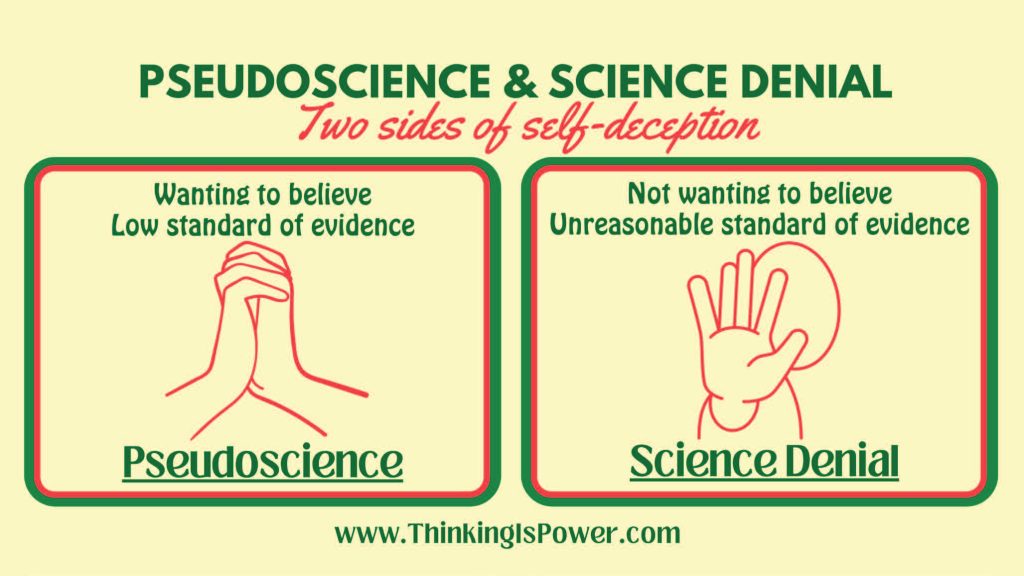
Science has two main pretenders, which can be distinguished by their underlying motivation and resulting standard of evidence (Trecek-King 2021):
- Pseudoscience: Unsupported, false, or unfalsifiable claims. Belief in pseudoscience is motivated by wanting to believe, so our standard of evidence is very low.
- Science denial: The rejection of strongly supported scientific conclusions. It’s driven by not wanting to believe, so our standard of evidence is impossibly high.
Importantly, both rely on the same excuse to explain why their positions are at odds with the overwhelming scientific consensus: it’s a conspiracy.
Our desire to self-deceive is so strong that we can convince ourselves we’re not pretending. But if we take their masks off, we can see them for what they are: motivated searches for evidence to confirm what we want (or don’t want) to believe.
Jan’s exhibits beautifully displayed the characteristics of pseudoscience and science denial: cherry-picked evidence (e.g., horse braids and photographs), anecdotes (e.g., “sightings”), fake experts (e.g., Carl Baugh), and conspiracy theories (e.g., the stolen giant skeletons and the “lie” of evolution).
Science’s pretenders work in concert, raising and lowering our standards of evidence as needed to protect important beliefs, especially those tied to our values, desires, identities, and social groups. Jan’s belief in creationism, rooted in her religious faith, required her to deny evolution and distrust mainstream science, which created fertile ground for other pseudoscientific beliefs. In fact, Jan saw Bigfoot as proof of creationism.
The process of science is reliable because it corrects for the ways we fool ourselves. And key to this process is the scientific community, which provides essential checks and balances by collectively scrutinizing and vetting claims (Oreskes 2019). The system incentivizes scientists to find limitations and flaws in each other’s work. The result is knowledge that’s more reliable and trustworthy than any single person could achieve.
On the other hand, the pretender community dismisses this essential scrutiny as “closed-mindedness” or a conspiracy. Instead, they reward affirmation and agreement, creating a closed loop that protects beliefs from internal conflict and external challenge.
It’s Not about Jan, Either
While Jan’s beliefs were certainly further on the anti-science spectrum than many, sometimes the extreme cases can be the most illuminating. False beliefs that provide comfort and certainty can slip right past our skepticism. And we’re especially vulnerable if we’re part of a community organized around beliefs.
We all have reasons for what we believe, and often they run much deeper than we’re aware. Jan’s Bigfoot belief was tied to many others, all of which likely share a similar foundation. Firehosing reliable information isn’t going to work, because it’s not about Bigfoot.
If I’ve learned anything about misinformation, it’s that we can all be Jan. Every one of us is vulnerable to false claims that confirm our worldview or push the right emotional buttons. To successfully fight misinformation, it’s essential to identify and guard against these underlying motivations.
As I left, I asked if I could purchase a souvenir, but Jan was sold out. When I mentioned I hoped for something to hang on my Christmas tree, she disappeared briefly and returned with a copper Bigfoot footprint attached to a leather tie. Despite my offer to pay, Jan insisted it was a gift, so I discreetly added to her entrance fee jar.
I learned a great deal at my first Bigfoot museum—not about Bigfoot, but about the nature of belief itself. For that, I’m grateful to Jan, a true believer and kind teacher.
References
Cole, John R., and Laurie R. Godfrey, eds. 1985. The Paluxy River footprint mystery—solved. Creation/Evolution 5(1): 1–46. Online at https://ncse.ngo/files/pub/CEJ/pdfs/CEJ_15.pdf.
Neyman, Greg. 2008. Creation Evidence Museum lacks evidence! Answers in Creation (September 5). Online at https://web.archive.org/web/20080905065319/http://answersincreation.org/rebuttal/cem/cem.htm.
Oreskes, Naomi. 2019. Why Trust Science? Princeton, NJ: Princeton University Press.
Trecek-King, Melanie. 2021. Science and its pretenders: Pseudoscience and science denial. Thinking Is Power (August 18). Online at https://thinkingispower.com/science-and-its-pretenders-pseudoscience-and-science-denial/.
Vladimir Putin “sights a Yeti family” in remote Siberian mountains. 2016. The Siberian Times (April 1). Online at https://web.archive.org/web/20240224071200/http://siberiantimes.com/other/others/news/vladimir-putin-sights-a-yeti-family-in-remote-siberian-mountains/.
[ad_2]
Source link
