
[ad_1]
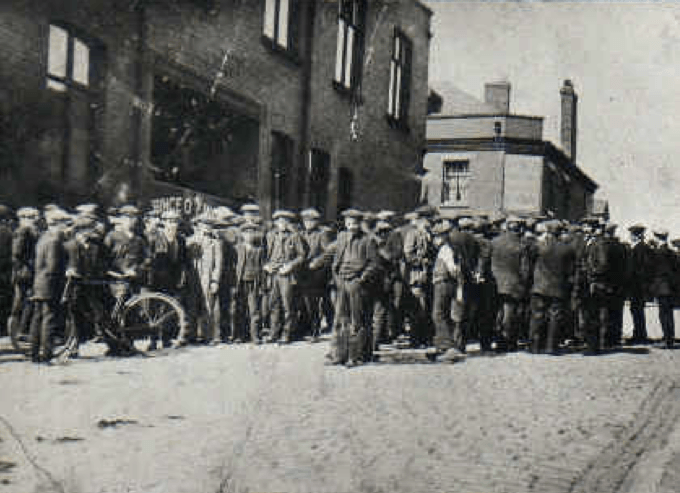
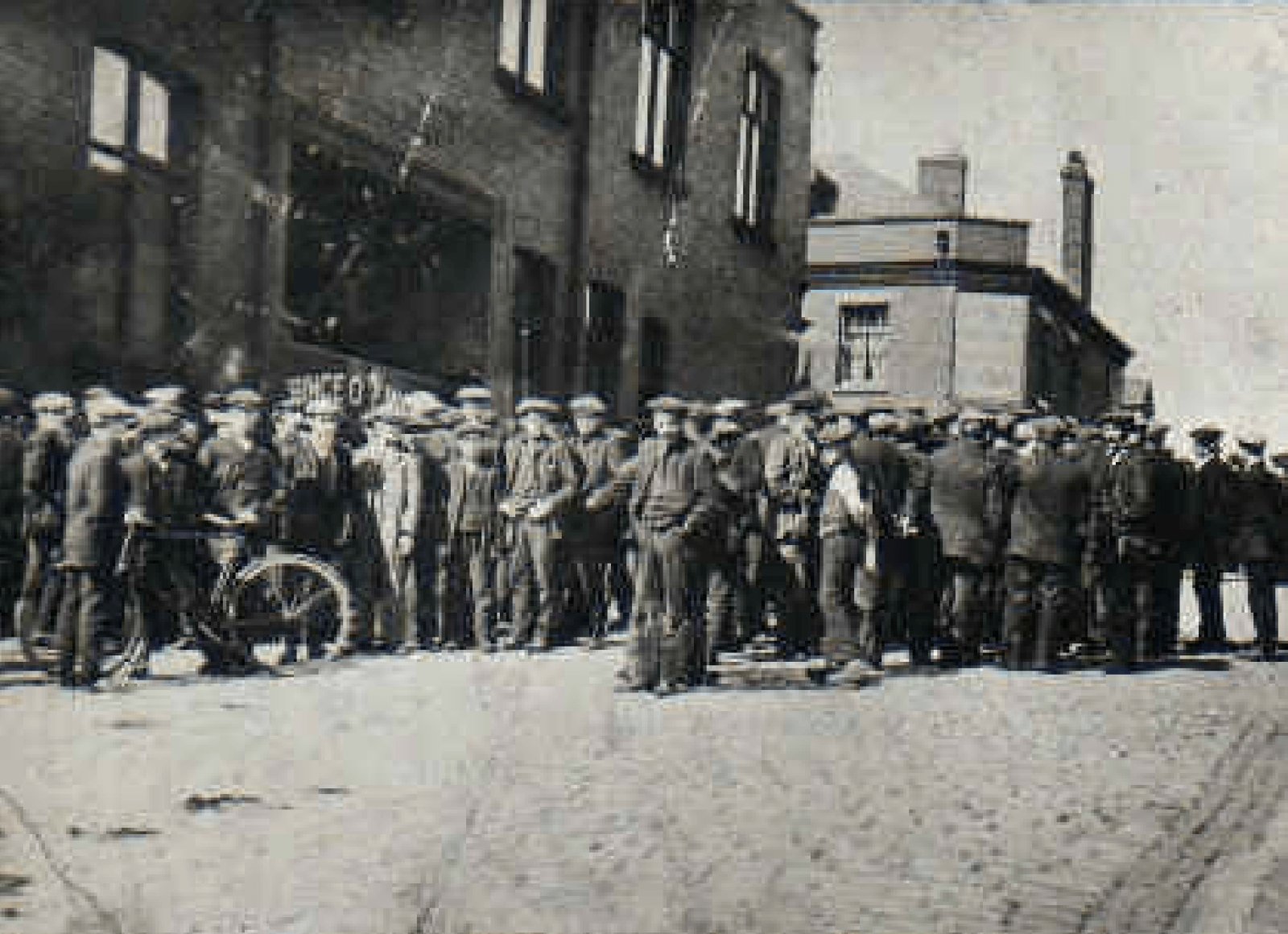
Tyldesley miners outside the Miners Hall during the 1926 General Strike – Public Domain
The General Strike was “the greatest effort the British workers had ever made,” wrote the historian and economist G.D.H.Cole. One hundred years ago, on May 4, 1926, a million British workers walked off their jobs.
These workers struck in sympathy with miners – the more than a million miners who had been locked out by their employers. The miners had refused to accept cuts in pay; in some places, the employers demanded as much as 25%. And they had refused to work longer hours. “Not a penny off the pay, not a minute on the day,” was their response.
The strike was called by the General Council of the Trades Union Congress (TUC), the British federation of trade unions and a specially convened conference of union executives. The General Council’s mission was to set up a negotiating committee and defend the pay of the miners. Ernest Bevin, General Secretary of the Transport and General Workers Union, speaking for the Council, implored “every man and woman…to fight for the soul of labour and the salvation on the miners.” He added that “no person in the first grade must go to work at starting time on Tuesday morning; that is to say, if a settlement has not been found.”
The government, led by conservative Prime Minister Stanley Baldwin, set the conflict in motion by ending temporary subsidies to the mining employers. The government’s subsidies had been meant to stave off an inevitable crisis in a sick industry and a reorganization of the industry. In this event, the government saw the miners as an obstacle to reorganization. But they offered them nothing in return for what would amount to a significant sacrifice; the government was quite prepared for this. The Minister of Health, Neville Chamberlain, speaking for the government, expressed its indifference to the miners and vowed that they would receive “not one scrap of assistance” and reduced outdoor relief to below unemployment benefits, in an opening salvo.
A.J. Cook, the secretary of the Miners’ Federation of Great Britain (MFGB), not to be intimidated, championed the strikers, speaking widely in defense of the “brave” miners and their supporters. “What a wonderful response! What loyalty! What solidarity! From John O’Groats to Land’s End, the workers answered the call to arms to defend us, to defend the brave miner in his fight for a living wage.”
Ellen Wilkinson, the “red suffragette,” campaigning for the miners, wrote “that the imagination can conjure up no such scene of desolation, human suffering and hopelessness to surpass what actually met my eyes in the mining districts. Hungry women and children, stoical patient men weary with inactivity… of children who were too hungry to walk to school, of others whose boots were in pawn and had to go barefoot to the soup kitchens, of babies whose features bore the mark of coming death from malnutrition, and of emaciated women who went without food so their children could eat.”
This was the experience of more than one generation of miners. Extreme poverty continued and workers knew this. So was the memory of Black Friday, the dark day in April 1921 when the leaders of the transport and railroad workers announced their decision not to call for strike action in support of the miners, a “breach of solidarity and a betrayal.” How could they not strike this time? At a time when the trade unions were confident in their strength of organization and numerical growth in the years since the war’s end, but remained embittered by broken promises, “homes for heroes.”
Stanley Baldwin was a moderate, certainly in comparison to the “hawks” in the government, Lord Birkenhead, then the Secretary for India and Winston Churchill, already notorious for ordering troops to shoot striking miners in Tonypandy, Wales in 1910 (wrongly perhaps but widely believed). Baldwin was committed to reorganizing the industry in support of the mine bosses; hence not giving in to the miners, and his refusal to negotiate these issues with the TUC.
So instead, he appealed to the nation in defense of the country and the Constitution, including, ironically, to union leaders who themselves were often constitutionalists. “The Government is being attacked… let all good citizens whose livelihood and labour have thus been put in peril bear with fortitude and patience the hardships with which they have been so suddenly confronted. Stand behind the Government, who are doing their part, confident that you will cooperate in the measures they have undertaken to preserve the liberties and privileges of the people of these islands. The laws of England are the people’s birthright. The laws are in your keeping. You have made Parliament their guardian. The General Strike is a challenge to Parliament and is the road to anarchy and ruin.”
The causes of the strike, then, were both complex and simple. In the words of the historian Keith Laybourn, it was “the product of an interplay of the circumstances whereby the industrial tensions in the coal industry became inflamed at a time when both the government and the TUC were moving on a collision course over industrial relations.” At the same time, it was straightforward; the men came out to support the miners.
Not all Councilors were so enthused as Bevin or Cook. Jimmy Thomas, the former engine driver and General Secretary of the National Union of Railway Workers (NUR), opposed the strike from the beginning and worked to resolve it. The TUC then entered the strike with a current of opposition within it. And this was widespread in the upper echelons of many trade unions, but also in the Labor Party and the labor movement. Still, the majority of the leadership supported the call for action, with reluctance. This was in sharp contrast to the rank-and-file, where support for the strike was overwhelming.
The Council’s plan was to bring the unions out in waves, upping pressure on the government with each wave. The first day, the Council called out the “big battalions,” that is, the most powerful unions – transportation workers, the printers, iron and steel workers, metal workers and chemical workers, building workers, except hospital and housing work. So, no trains, no bus service, no newspapers, no building, no power workers.
The second wave, which came out on the strike’s last day – general engineering, textiles, and telephone plus the workers in the shipyards of the Clyde, the Tyne, the Wear, of Hull and Belfast – brought out another half million, so that at its high point, a million and a half million workers were on strike; with additional waves held back. It was a magnificent display of solidarity. Nowhere were there significant sections of the class that defied the call to action; rather, there were millions of trade union members who waited anxiously to be called out. And there were hundreds of thousands of the unorganized itching to join in, this despite the high levels of unemployment and the deep poverty in the industrial cities.
Against this, the government had mobilized the police and put in place a militia of special constables, volunteers to maintain order in the street. Then the army. The government’s appeals to patriotism brought out thousands of middle-class volunteers, individuals who were held up as the true heroes in the conflict. Their efforts are celebrated to this day: the university men who attempted to drive buses and work on the docks (“the 400 Cambridge undergrads”), the aristocratic women (Lady Astor) who took on an array of charitable initiatives. All this was about class, whose country was it and the dramatic divide- it was of little importance in comparison to the spectacle of the workers, in their millions. More important were the tens of thousands of police and the army; the police were ubiquitous; the army’s presence was seen in the tanks that lumbered along cobblestone streets and the machine gun nests that guarded factory gates. This, the government made clear, also was the face of “the country.”
Cultural historians have emphasized the peacefulness of the strike, even the passivity of strikers – it was an “English strike.” There is some truth in this; the strike was not an insurrection. It was not the mass strike Rosa Luxemburg celebrated. It was a sympathy strike, albeit a massive one, felt in every city and town in Britain.
The strike began with silence; no roar from the great mills; buses sat quietly in their yards. The train stations were empty, free of the clamor of travelers; no clouds of choking morning smoke. No subway, newspaper stalls were bare, no hawking daily papers. The London docks and the East End of London were a silent city.
The picket lines were generally orderly; the strike was well-organized in the localities and strikers did play football with the police. The General Council wanted it this way, advising strike leaders:
Our task is to keep the strike steady and quiet. We must not be provocative; our line is to be dignified, calm in our own strength to make our statements forcibly but with moderation of language.
The unions’ leaders, national and local, were committed to this, to law and order and to the constitution. The communists, relatively few in number, did little to challenge the strike leaders. So, there was no real strategy on the ground where the strikers were and where they could be militant and were, often in defiance of union officers from the General Council on down.
On day one of the strike, Laybourn reports that crowds of strikers blocked the Blackwall Tunnel, the connection between East London and Greenwich, stopping traffic and forcing drivers to walk. The police had to make baton charges to open the tunnel; there were casualties on both sides, and dozens were taken to Poplar Hospital. There were disturbances in Canning Town in East London, where crowds also stopped cars and smashed engines.
All this became not so unusual. And a survey of “disturbances” produces a somewhat different picture of the strike from below. The docks of London and Liverpool were scenes of intense picketing and police violence from the start. There were tremendous battles in Southwark where young people would wait on rooftops of tenement buildings along the New Kent Road for an opportunity to rain stones and bottles down on the heads of the specials.
The trains were targeted in railway centers throughout the country; in Crewe, shots were fired at passing trains, and also in York. The Flying Scotsman, the wonder of British Rail and its most important express, was derailed. Along the south coast, there were “riots” in Southsea, Portsmouth and Swansea. The term riot was used to describe any place where strikers fought to defend their picket lines, just as any demonstration was a “mob.”
In Yorkshire and the Northeast, centers of the miners’ strike, iron and steel in Sheffield were idled, also in Middlesbrough. In Newcastle, where for centuries coal had been shipped out, the Tyne was quiet. Strikers stopped buses in Leeds and Bradford and threw rocks at the police who tried to protect them. In Doncaster, crowds as large as a thousand blocked traffic, effectively shutting down the city center.
The Home Secretary reported 1500 arrests under the Emergency Regulations Act, not a large number, but significant in cities and towns, that is in the working-class centers where they were not acceptable. In Edinburgh and Glasgow, the police stations were the scenes of regular, angry protests. At York, a crowd tried to release a prisoner. And at Preston, a crowd of 5000 tried to storm the police station, only to be beaten back by repeated charges of baton-swinging police.
On days seven and eight of the strike, there were no reports of the strike being broken, of back-to-work movements, or a decline in picket line militancy. On the contrary, strike activity seemed to be on the up tick. In London alone, there were a dozen places a day marked by street battles between police and the strikers. As far as can be judged, wrote Cole, “there was no reasonable doubt that the efficiency and effectiveness of the strike were steadily increasing right up to the very end.” Yet on day nine, the General Council ordered the strikers back to work. And now one of the great strikes of the time is mostly remembered as a catastrophe. “Nothing whatever had been secured by the greatest effort the British workers had ever made.”
Why? At the local level, the strikers and their communities showed creativity and solidarity, a solidarity that was magnificent. But the leaders had no strategy to make use of this. Without that, the strike could not be used to achieve any outcome that would benefit the miners, increasingly becoming estranged from the strike.
At the same time, general council leaders were afraid (unspoken in the absence of negotiations) that the strike might drag on, threatening their unions, their assets and their own positions. Their distrust of the miners underscored these apprehensions.
The government, for its part, recognized the TUC’s divisions and its reluctance to press the strike beyond well-defined limits. So, they muddied the waters by arguing that the issues at stake were political and constitutional, therefore not negotiable. And as the leaders were all constitutionalists, they had no answer to the government line. As for the government, once they realized that the strike was not revolutionary, they avoided confrontations and simply waited for the unions to call off the strike.
Were the workers betrayed? It depends on one’s perspective and this remains a matter of debate, and not the subject here. What is not up for debate is the solidarity, all but universal, of the workers. In the strike’s aftermath, the TUC, weakened, continued intact; the strike’s leaders remained in place. The workers returned to their jobs, many in disbelief, to face emboldened employers. Union membership declined and would not recover until the 1930s. The miners stayed out until November, when hunger drove them back to work. The Baldwin government introduced and quickly passed anti-union legislation, including a ban on sympathy strikes.
With thanks to David Howell and Dave Lyddon.
[ad_2]
Source link
