
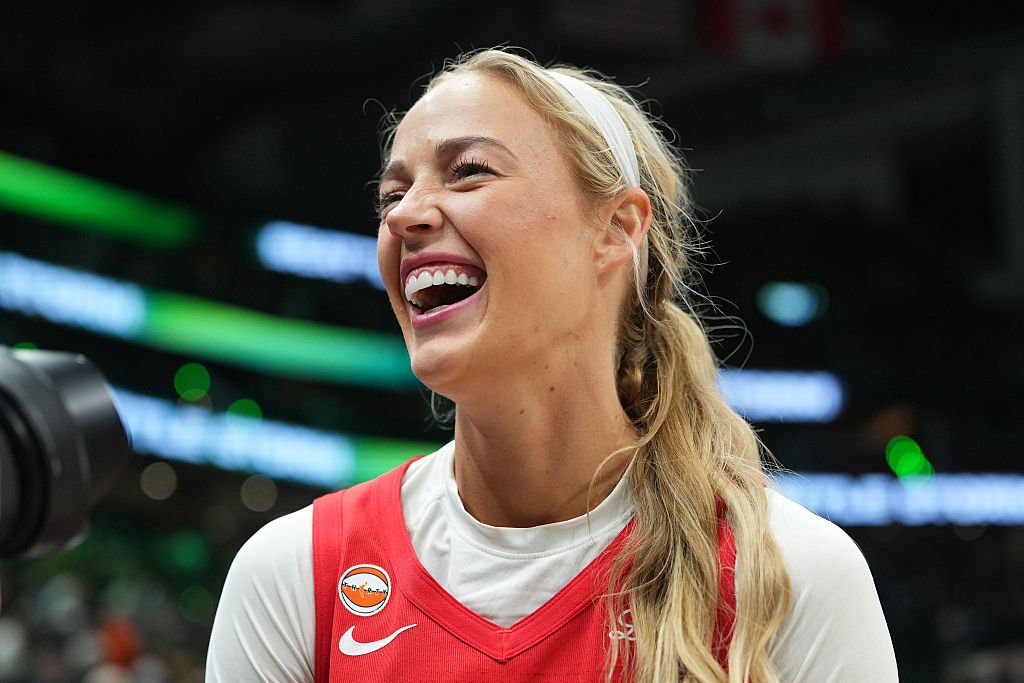
It’s been a big few weeks for the Women’s National Basketball Association (WNBA). Sophie Cunningham, a tall, pretty blonde bench player for the Indiana Fever, has been at the center of what has become a series of attention-grabbing moments for a league that often struggles to earn them.
Cunningham has found herself squarely in a culture-war dustup over well-trodden material: the conversation over transgenders and whether they should be included in women’s sports. The fracas initially kicked off in July after a lengthy ESPN profile of Cunningham—who is not only a Fever guard, but a part-time UFC octagon girl and sometimes Sports Illustrated swimsuit model. In the piece, Cunningham argued that women’s sports should be a safe space for biological women.
“I want to protect young girls in a locker room, or young girls in sport who shouldn’t have to go against biological men,” Cunningham told ESPN, clarifying that she’s some kind of political centrist. “I’m very much in the middle. I agree with things on both sides, disagree with things on both sides. And that’s all I’ve ever said about my political beliefs. But people love to assume.”
But neither the quote nor Cunningham have been perceived to be “in the middle.” Instead, she landed in the middle of a heated controversy. Cunningham has come under increased scrutiny from WNBA players, team owners, political commentators, away crowds, and ESPN itself for the comments, which politically aligned her, intentionally or not, with the American conservative movement.
The controversy was prime viewing material on ABC this Sunday, when Cunningham’s Fever matched up against the Minnesota Lynx and its coach, Cheryl Reeve, who elected to wear a “Trans Kids Belong” t-shirt. The ABC color commentator Rebecca Lobo implored viewers to seek out Reeve’s own framing of her pro-trans position, calling it “incredibly thoughtful.” Speaking after the game, Reeve said she viewed the league-wide controversy as an opportunity to “educate” the American public about a topic that has been discussed ad nauseam for the better part of the last decade.
But the idea of education is itself a widely debated topic in modern America. Exactly who does the educating, and what that education involves, are questions that have roiled both sides of the political divide. Reeve’s use of the word “educate” implies a settled truth being passed down, when in reality the underlying question remains unresolved: Some believe women’s sports should be a haven for biological women, while others argue the women’s sports world in particular is well-positioned to embrace transgender women athletes. Neither side is short on conviction. What’s missing is consensus.
This question is rarely raised in men’s sports, since the athletic gap between women and men is generally such that trans-identified biological women cannot rise to the higher levels of men’s competition. That asymmetry is what makes women’s sports a battleground: Biological males, if allowed, can and sometimes succeed in women’s sports.
Following Sunday’s game, Cunningham snapped pictures with a supportive fan who was on the verge of tears after meeting her heroine. Meanwhile, on X, right-wing commentators were out in full force. The Fox News host Laura Ingraham questioned whether Cunningham should keep playing at all, citing vague safety concerns. The Daily Wire’s Matt Walsh, never one to let a culture war moment pass without inserting himself into it, said liberals “cling to trans bullsh-,t” adding: “The pro-trans side has been thoroughly defeated at every level — politically, culturally, in the courts, in the legislatures, everywhere — and yet they can’t let it go.” Bold talk from a man who has built a career on rarely letting anything go.
This controversy is playing out amid a boom season for the WNBA. The league’s All-Star Game drew 3.3 million viewers. That’s up a remarkable 44 percent from the prior year. For the first time in league history, attendance of the event outperformed that of the NBA. Cunningham’s news cycle seems to be feeding the popularity monster: Days after the All-Star Game, the Fever’s game against the Seattle Storm, which drew rallies outside the arena, averaged 1.4 million viewers, the second-most-watched WNBA game on cable this season.
The Storm game proved a major moment in the trajectory and viewership of the WNBA season after Seattle Storm co-owner Celeste Keaton confronted two teenage fans who held signs in support of Cunningham. Keaton reportedly told the fans they were “f–king insane” for supporting Cunningham’s defense of biological women in a sport built for biological women. Keaton’s tirade cost her a five-game suspension, and articles are still being penned nearly a week after the incident. For a league that has often been accused of being propped up by the NBA, here was a series of viral moments that pushed the game—or more accurately, its players, coaches, and fans—into a new stratosphere of pop-culture viability.
The Guardian saw the affair as an opportunity to slam Cunningham. The British news site, fond of lamenting the state of American politics and culture, accused Cunningham of “cashing in” on culture-war politics. The writer, Howard Bryant, wrote that Cunningham is “too meek to address the toxic roots of her newfound fame” and claimed she had willingly accepted the role of “the right’s anti-Black, anti-transgender culture war ambassador.” There is some truth to Bryant’s comments. After all, Cunningham’s friendly relationship with the UFC luminary Dana White, a vocal supporter of President Donald Trump, and her decision to snap a photo with Riley Gaines, the Fox News pundit best known for her campaign against transgender athletes, both suggest the Fever guard is more invested in right-wing politics than her “I’m very much in the middle” quote would have you believe.
Subscribe Today
Get daily emails in your inbox
But the Guardian’s focus on Cunningham alone misses the larger dynamic at play. The culture-war optics haven’t boosted only Cunningham’s fame and notoriety; they’ve also elevated a league that is often overlooked by sports media. The fallout from each incident has earned prime real estate on ESPN, where the WNBA normally struggles to find space. It’s an ironic development given that Caitlin Clark, arguably the league’s biggest star in its history, has been receding from the spotlight as Cunningham, a bench player, absorbs the attention and scrutiny that’s followed her everywhere else.
None of this, of course, will move the underlying debate regarding transgender athletes an inch. The WNBA has no transgender players on any roster, and neither Cunningham’s stance nor her critics’ outrage will change league policy, federal law, or even, most likely, the mind of a single fan. What it will do is keep cameras rolling, keep rallies forming outside arenas, and keep a league that has spent decades fighting for a fraction of the NBA’s attention sitting, however uncomfortably, in the middle of a national conversation.
The Guardian is right that Cunningham is cashing in on the controversy. But that misses the point: The rest of the WNBA is too.
