

[ad_1]
Marjorie Cohn on the Roberts’ Court’s demolition of the 1965 Voting Rights Act, the law that brought an end to Jim Crow system of post-Civil War legalized racial segregation.
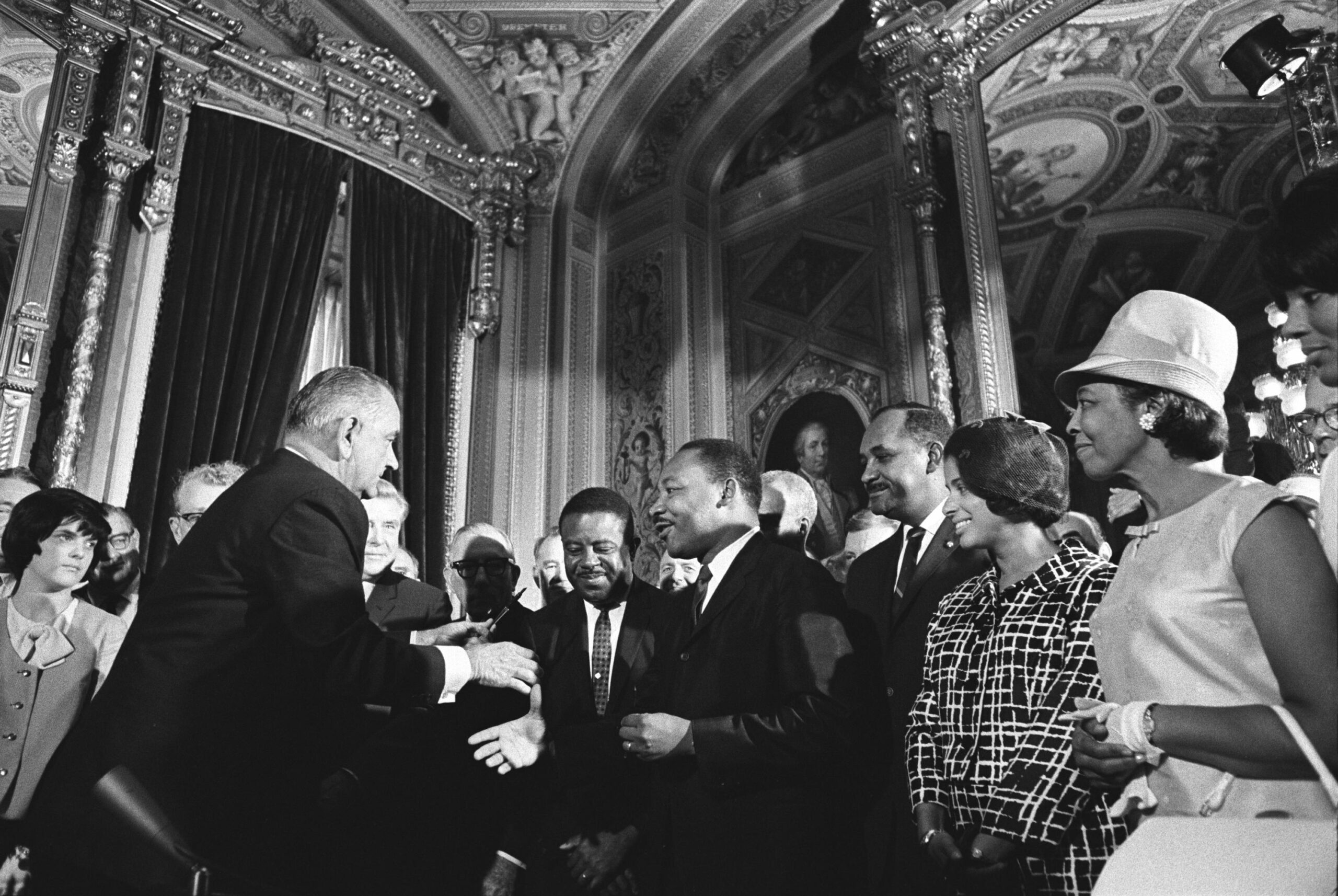
President Lyndon B. Johnson shaking hands with Martin Luther King Jr. at the signing of the Voting Rights Act on Aug. 6, 1965. (Yoichi Okamoto, LBJ Library, Wikimedia Commons)
By Marjorie Cohn
Special to Consortium News
 In perhaps its most insidious decision in nearly a century, the U.S. Supreme Court disemboweled Section 2 of the landmark Voting Rights Act (VRA) of 1965, the “crown jewel” of the U.S. civil rights movement.
The VRA ended Jim Crow-era election procedures that precluded Black people from voting in the South through intimidation, literacy tests and poll taxes. It was part of a system of post-Civil War legalized racial segregation meant to restore white supremacy after the end of slavery and the federal, military occupation of the South.
Jim Crow lasted from 1877 until passage of the Civil Rights Act of 1964 and the Voting Rights Act the following year.
Section 2 of the VRA allows states to draw voting districts that benefit candidates from racial minorities and enables citizens to challenge election maps as racially discriminatory.
In its Wednesday ruling in Louisiana v. Callais, the 6-3 rightwing supermajority of the Court struck down a congressional map that a group of self-described “non-African American” voters had challenged as an unconstitutional gerrymander.
Court members Samuel Alito, John Roberts, Clarence Thomas, Brett Kavanaugh, Neil Gorsuch and Amy Coney Barrett held that drawing districts to remedy past discrimination itself constitutes unconstitutional racial discrimination.
For 61 years, the VRA has been one of the most significant protections against racial gerrymandering. Thanks to the VRA, there are now more than 10,000 Black elected officials throughout the country, compared to about 1,500 in 1970.
Callais paves the way for the largest decrease in representation by Black members of Congress. It will lead to the elimination of dozens of Black and Latino-majority districts throughout the South and a substantial number of current congressional seats.
“This court’s project to destroy the Voting Rights Act is now complete,” Elena Kagan wrote in dissent, joined by Sonia Sotomayor and Ketanji Brown Jackson. “Today’s decision renders Section 2 all but a dead letter.”
Section 2 prohibits any voting qualification or prerequisite to voting, or practice or procedure, that “results in a denial or abridgment of the right of any citizen of the United States to vote on account of race.”
That occurs when voters of color “have less opportunity than other members of the electorate to participate in the political process and to elect representatives of their choice.”
Congress amended Section 2 in 1982 to provide that evidence of discriminatory intent is not necessary to prove racial discrimination; even policies that appear neutral can have a discriminatory effect on a particular group.
In the 1986 case of Thornburg v. Gingles, the Supreme Court interpreted the amended Section 2 and established a multi-factor test to decide when a jurisdiction must draw districts to provide minority voters a fair opportunity to elect representatives of their choosing.
The Gingles test has been used by courts for 40 years. Three years ago, the high court affirmed the test in Allen v. Milligan and held that Alabama’s congressional map likely violated Section 2.
The Callais Majority Rewrites a Congressional Statute
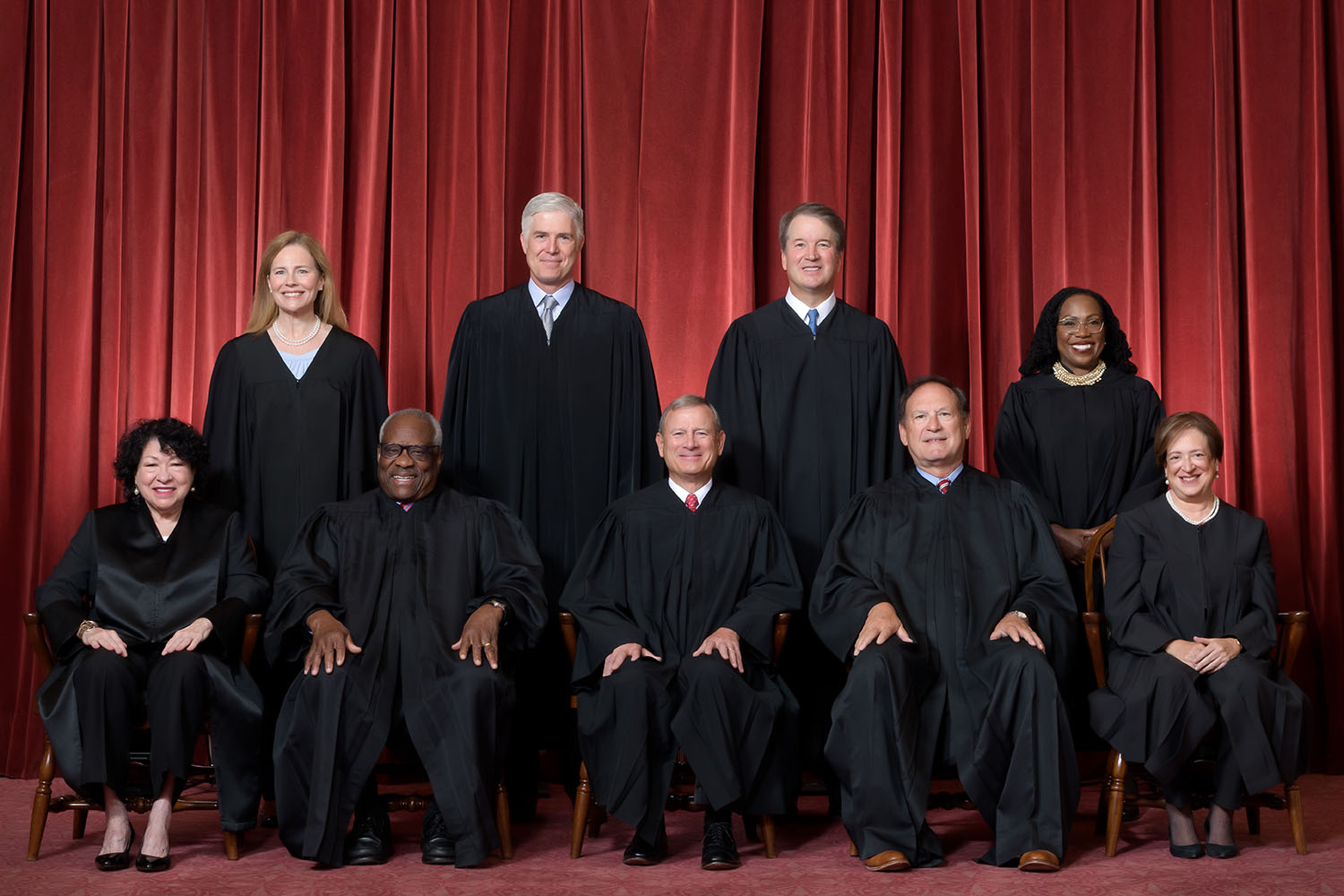
The Roberts Court since June 2022: Front row, from left: Sonia Sotomayor, Clarence Thomas, Chief Justice John Roberts, Samuel Alito and Elena Kagan. Back row, from left: Amy Coney Barrett, Neil Gorsuch, Brett Kavanaugh and Ketanji Brown Jackson. (Fred Schilling, Collection of the Supreme Court of the United States, Wikimedia Commons, Public Domain)
In Louisiana v. Callais, a coalition of Black voters and civil rights groups sought to reinstate a map that the Louisiana state legislature had adopted in 2024. The map established a second majority-Black congressional district. It was drawn in response to a U.S. district court ruling that a map drawn in 2022 likely violated Section 2.
That 2022 map included only one majority-Black district out of Louisiana’s six congressional districts. The coalition maintained that the 2022 map diluted the votes of Black residents, who comprise about one-third of Louisiana’s population.
The Fifth Circuit Court of Appeals affirmed the district court decision that the 2022 map likely violated Section 2, and the appellate court ordered Louisiana to draw a new map by Jan. 15, 2024. The Louisiana Legislature complied and drew a map with a second majority-Black district.
In response, the “non-African American” voters challenged the 2024 map as unconstitutional because it separated voters based primarily on race.
Samuel Alito, writing for the Court’s supermajority, said that the 2024 map “relied too heavily on race.” He wrote that the coalition of Black voters had not proved “an objective likelihood that the [2022] map was the result of intentional racial discrimination,” even though it only contained one majority-Black district out of the state’s six Black districts.
Despite the 1982 congressional amendment to Section 2, stating that racial discrimination can be proved by showing discriminatory effect, the Court restored the requirement that voters challenging district maps must prove that “circumstances give rise to a strong inference that intentional discrimination occurred.”
While asserting that it was simply “updating” the Gingles test, the Court actually rewrote it to erect an insurmountable barrier to plaintiffs’ claims of racial discrimination.
“In sum,” Alito concluded,
“because the Voting Rights Act did not require Louisiana to create an additional majority-minority district, no compelling interest justified the State’s use of race in creating [the 2024 map]. That map is an unconstitutional gerrymander, and its use would violate the plaintiffs’ constitutional rights.”
After the Supreme Court’s decision, states can now defend their maps by claiming they were just engaging in partisan (as opposed to racial) gerrymandering. The high court decided in the 2019 case of Rucho v. Common Cause that although partisan gerrymandering is unconstitutional, it cannot be challenged in federal court.
“Today . . . the majority straight-facedly holds that the Voting Rights Act must be brought low to make the world safe for partisan gerrymanders,” Kagan wrote in her dissent.
Now “the State need do nothing more than announce a partisan gerrymander. Assuming the State has left behind no smoking-gun evidence of a race-based motive (an almost fanciful prospect), Section 2 will play no role.”
Kagan further declared:
“The Voting Rights Act is — or, now more accurately, was — one of the most consequential, efficacious, and amply justified exercises of federal legislative power in our Nation’s history. It was born of the literal blood of Union soldiers and civil rights marchers. It ushered in awe-inspiring change, bringing this Nation closer to fulfilling the ideals of democracy and racial equality.
And it has been repeatedly, and overwhelmingly, reauthorized by the people’s representatives in Congress. Only they have the right to say it is no longer needed — not the Members of this Court. I dissent, then, from this latest chapter in the majority’s now-completed demolition of the Voting Rights Act.”
Roberts Fulfills Longtime Goal of Neutering Voting Rights
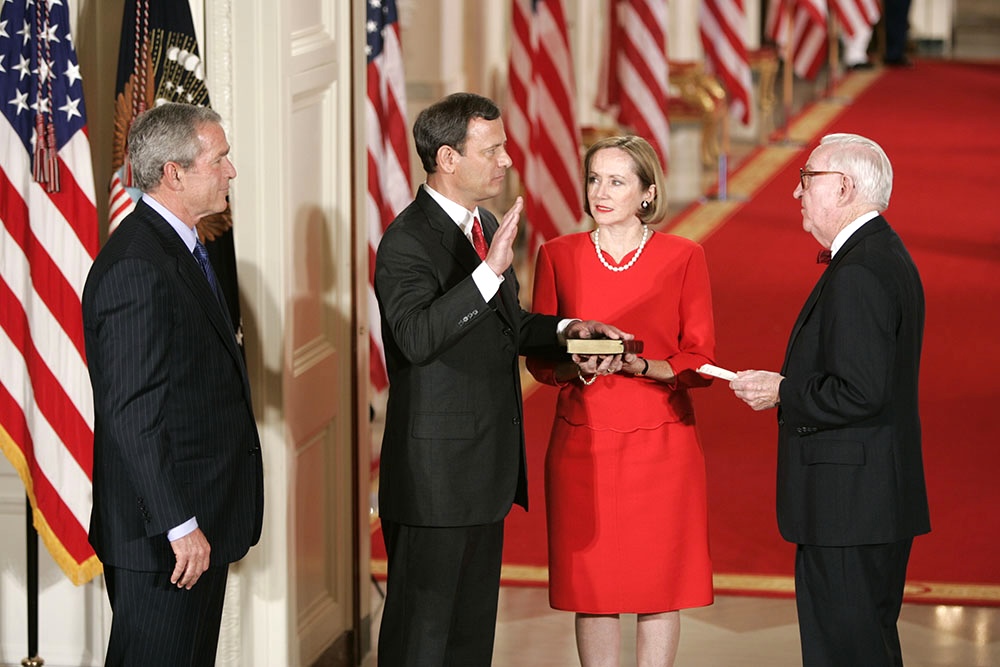
Roberts taking the oath of office as chief justice by Justice John Paul Stevens in the White House as President George W. Bush and Roberts’ wife Jane look on, Sept. 29, 2005. (White House Photo Office /Wikimedia Commons/Public Domain)
“John Roberts has proven far more dangerous than ideologues like Thomas and Alito. He is a politician who plays a long game, slicing the salami piece by piece until there’s nothing left,” David Gespass, Alabama civil rights attorney and past president of the National Lawyers Guild, posted on Facebook.
Roberts has a history of eschewing the consideration of race in voting and discrimination cases. As a young lawyer in the Ronald Reagan administration, Roberts promoted a “colorblind” approach to voting rights and discrimination in public schools.
In 1982, when Congress was considering amending Section 2 to prohibit voting practices that had a racially discriminatory effect, Roberts was the point person in the Justice Department in the campaign to defeat the amendment.
In a 2006 voting rights case, Roberts cynically wrote, “It is a sordid business, this divvying us up by race.” The following year, he flippantly wrote in a case striking down voluntary desegregation programs in Louisville and Seattle, “The way to stop discrimination on the basis of race is to stop discriminating on the basis of race.”
Roberts authored the 2013 opinion in Shelby County v. Holder that gutted Section 5 of the Voting Rights Act, which had required federal preclearance before changes to election rules could go into effect in jurisdictions with a history of discriminatory voting practices.
“What the Supreme Court did today is stab the Voting Rights Act of 1965 in its very heart,” civil rights icon Rep. John Lewis said at the time.
But in Shelby, Roberts provided assurances that Section 2 would still be available to challenge racial discrimination in voting.
Now, the Roberts Court has neutered Section 2 as well.
Roberts’ “aim has always been clear, but he takes his time to reach it to deceive people into thinking he’s careful and deliberative, looking at each case on its own merits,” Gespass added. “He is careful and deliberative, carefully and deliberately moving toward a country that returns what little power others have won from rich white men back to them.”
‘An Outright Power Grab’
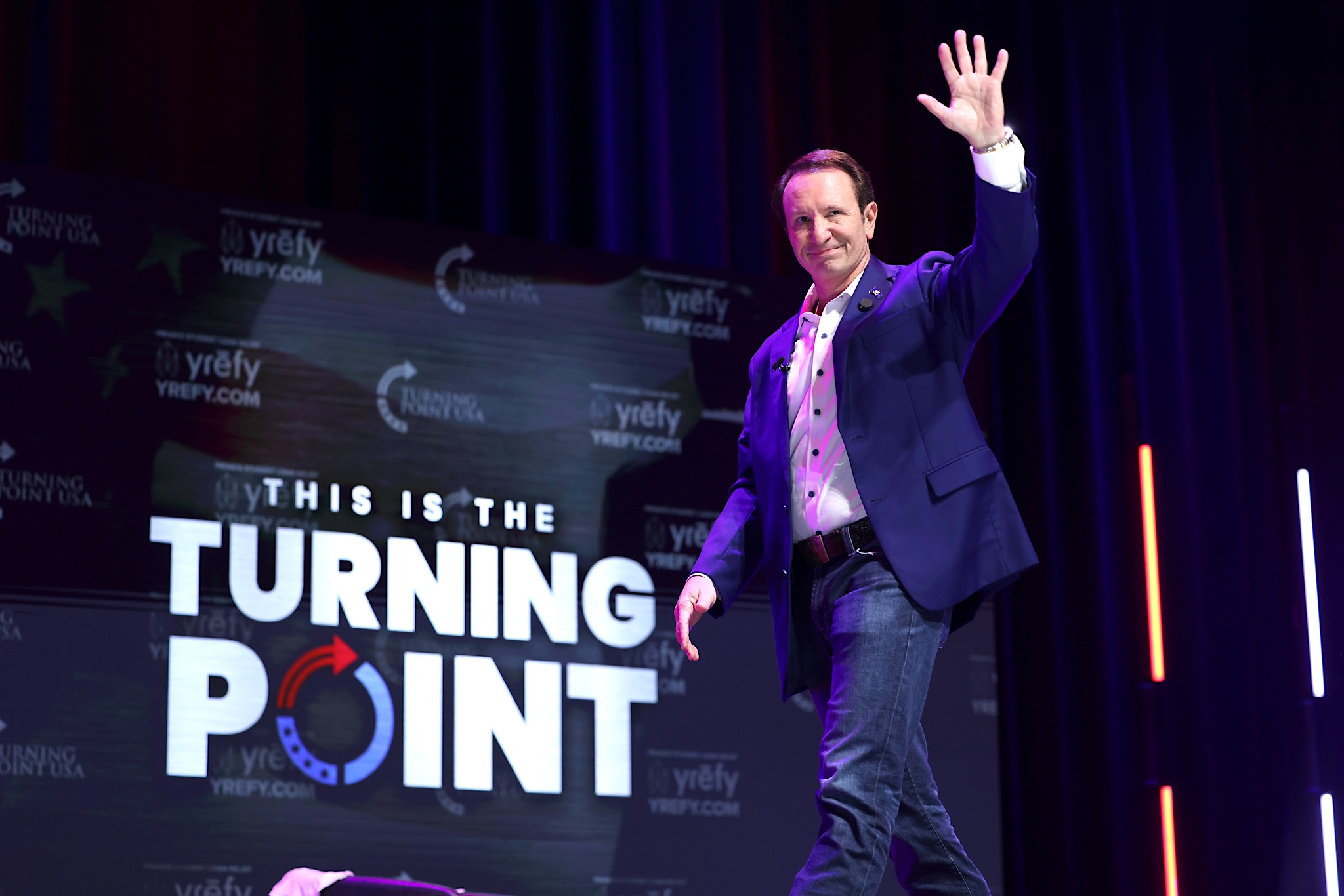
Louisiana Gov. Jeff Landry at an even in Baton Rouge in October 2025. (Gage Skidmore / Flickr / CC BY-SA 2.0)
“With this decision in Louisiana v. Callais, the Supreme Court has opened the door to a coordinated attack on Black voters across this country,” Democratic Rep. Yvette Clarke of New York and chair of the Congressional Black Caucus, said at a press conference after the ruling was announced.
Nearly 70 of the 435 congressional districts are protected by Section 2, according to election law expert Nicholas Stephanopoulos.
Democracy Docket has data showing that the Callais ruling will likely derail 28 pro-voting lawsuits that seek to prevent state legislatures from drawing maps that dilute the power of racial minority voters.
The ruling has already prompted a rash of Republican redistricting efforts throughout the South in advance of the 2026 midterm elections this November. Republicans in Louisiana, Tennessee and Georgia are considering redistricting before the midterms.
Today, I joined my colleagues as Chair of @TheBlackCaucus to speak out against the Supreme Court’s troubling decision to weaken a critical provision of the Voting Rights Act.
This ruling will have real and lasting consequences for Black and brown voters across the country.
Our… pic.twitter.com/sZF0TnegNd— Rep. Yvette D. Clarke (@RepYvetteClarke) April 29, 2026
Louisiana has suspended next month’s primaries to allow lawmakers to pass a new congressional map first. If these efforts occur and sustain legal challenges, the GOP stands to gain as many as five new seats this year.
GOP-led states could pick up as many as 19 new GOP-allied House seats in the coming years.
David Wasserman, senior editor and elections analyst for The Cook Political Report with Amy Walter, told Axios, “I think, realistically, we’re probably talking about one to three seats for 2026, but it’s not hyperbolic to call this an apocalyptic ruling for Black majority districts in 2028 in the Deep South.”
An analysis conducted by The New York Times last year found that Democrats could lose about 12 majority-minority districts throughout the South if the Court struck down part of the VRA.
“This is an outright power grab,” Rep. Clarke said. “It’s about silencing Black voices, dismantling majority Black districts and rigging the maps so that politicians can choose their voters instead of the other way around.”
Marjorie Cohn is professor emerita at Thomas Jefferson School of Law, dean of the People’s Academy of International Law and past president of the National Lawyers Guild. She sits on the national advisory boards of Veterans For Peace and Assange Defense, and is a member of the bureau of the International Association of Democratic Lawyers and the U.S. representative to the continental advisory council of the Association of American Jurists. Her books include Drones and Targeted Killing: Legal, Moral and Geopolitical Issues.
Views expressed in this article and may or may not reflect those of Consortium News.
[ad_2]
Source link
