

[ad_1]
Imagine the consequences for the empire’s managers were Americans to understand others and have some grasp of how they look upon the world.
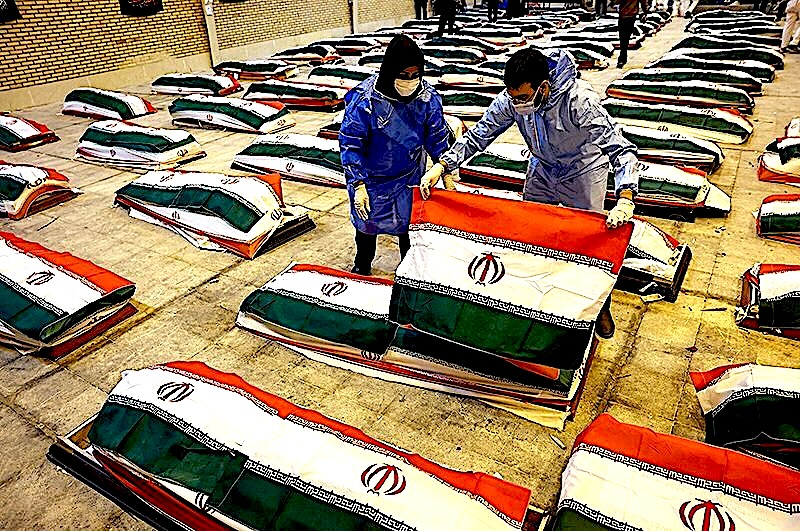
The arrival in the Tehran cemetery Behesht-e Zahra on March 15, 2026, of the bodies from the U.S. sinking of the Iranian ship the Dena in the Indian Ocean. (Tasnim News Agency/Wikimedia Commons/ CC BY 4.0)
By Patrick Lawrence

The other night, I watched a documentary called Coup 53, a brilliant treatment of the Anglo–American operation that deposed Mohammad Mossadegh as prime minister of Iran in the year the film notes in its title.
Taghi Amirani, the director, has produced a superb piece of work, narrated in part by the estimable Steve Kinzer. Aug. 19 marked the 73rd anniversary of Operation Ajax, as M.I.6 and the C.I.A. named their covert assault on Iran’s first democratically elected government.
A link to the film’s trailer is here.
How well I recall learning of the Iran coup during my teenage years, when my eyes were just opening upon how, by the mid–1960s, the United States (and in this case Britain) treated those in foreign lands whose misfortune was to possess resources the world’s newest imperium sought compulsively to control. And how well I recall discovering at the same time the remarkably pervasive ignorance of this conduct among all but a very few Americans.
Late one evening, I must have been 18 or so, this topic came up in conversation with my dear mother. “But no, we wouldn’t do that!” she exclaimed in a tone of anxious disbelief.
“But we did, Mother. If you know where to find the record, what we did is in it.”
My mother lowered her eyes and glanced away. I could see her mind was simply incapable of absorbing the information I had put before her. There was a sort of psycho-emotional blockage. The subject never again came up.
I have long been preoccupied, maybe since those days, indeed, with the question of seeing. And just as much if not more, with the question of not-seeing. This is only natural, it seems to me, given that seeing and not-seeing, the latter vastly more prevalent than the former, is so defining of who Americans are and what makes them so different from other peoples.
In a recent interview in Consortium News, Patrik Baab, the conscientious and beleaguered-because-conscientious Berlin correspondent, writer, and podcaster, referred to the “apocalyptic blindness” he finds among Germans. I know this is so, especially among West Germans, having traveled among them recently. But in the way of collective blindness, I must suggest to my friend and colleague, no people are more addicted to total darkness than Americans.
What I saw in my mother all those years ago was a refusal — a refusal to see that could not even understand itself as an act of refusal. I cannot say whether this condition has worsened in the decades since the conversation I had with her in the mid–1960s, but I don’t think this matters much one way or the other. If I have to offer an answer, I think it is both: People see more now than then, people see less now than then. The thought requires explanation, obviously.
Among those who watch Taghi Amirani’s film, and I hope many do, I imagine few will be as surprised as my mother was to learn of Operation Ajax. America’s lawless barbarism and all its messes are easier to see now. The plain-as-day defeats of April 1975 have something to do with this. So do digital technologies and the emergence of independent media. The invasion of Venezuela and the blockade of Cuba, the killings-from-the-air of fishermen in the Caribbean and the eastern Pacific, the installation of a murderous jihadist in Syria, the genocides in Gaza and the West Bank, the illegal bombing of Iran: There is no missing any of this.
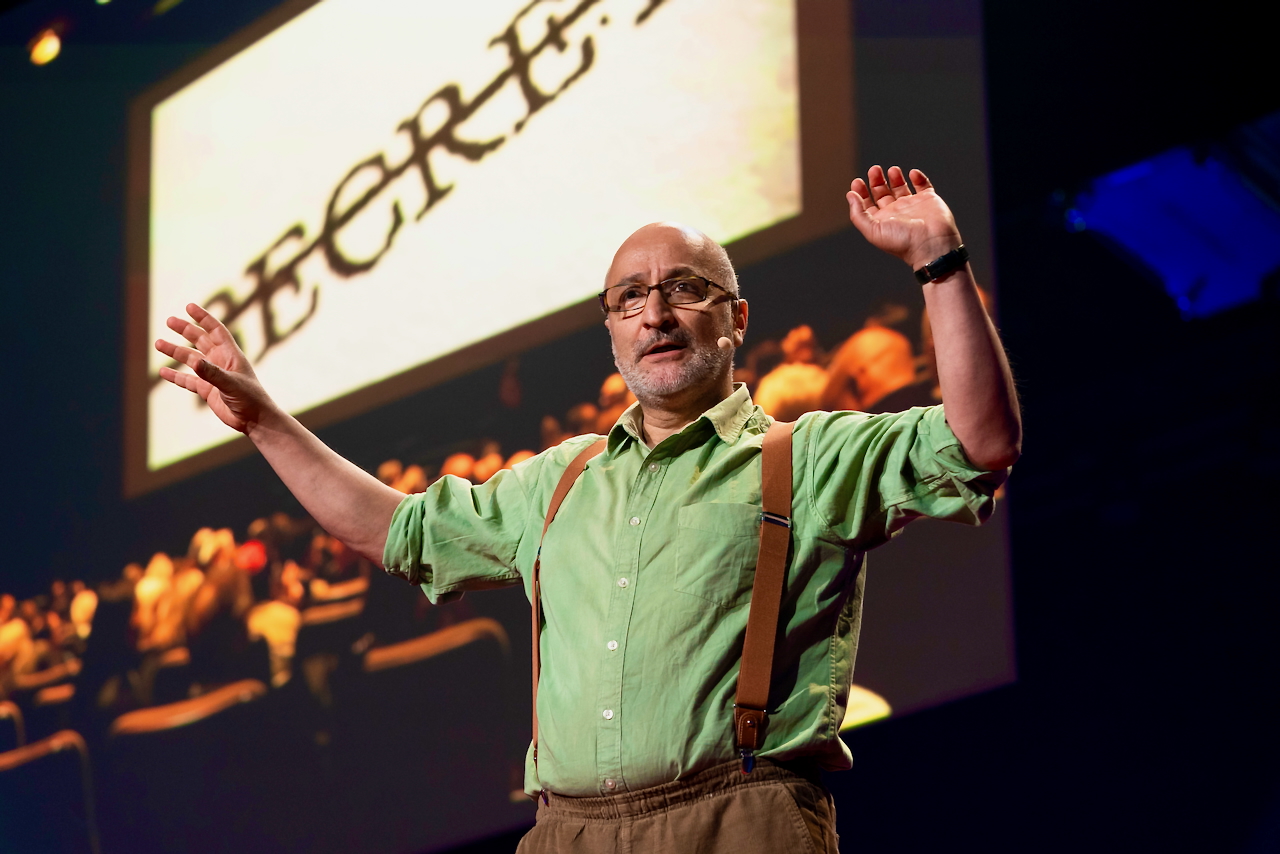
Amirani speaks during Fellows Session at TED2019: Bigger Than Us. April 2019, Vancouver, BC, Canada. (Ryan Lash / TED / Flickr / CC BY-NC-ND 2.0)
But there is one failure to see that remains, and its persistence is symptomatic, it seems to me, of an empire in its late, desperate phase. This is the steadfast refusal among most Americans to see their complicity in the imperium’s conduct.
The two phenomena, the seeing and the not-seeing, go together in this case. People see more, but few are able to see, are honest enough to see, themselves — to see that Americans comprise “a perpetrator population,” a term I cite with admiration and which I will shortly explain.
I do not know how many readers will have noticed the death on Aug. 11 of Ward Churchill, the clear-eyed scholar whose forthright honesty landed him in all sorts of trouble over the years. The New York Times published an obituary in its Aug. 12 editions, written in the insidious language the Times uses when the intent is to cast doubt on someone’s integrity. Yesterday Counterpunch ran an appreciation by Eric Cheyfitz, a scholarly colleague. I have not seen much else.
I will dwell on Churchill for a time, as he understood as well as anyone I have read the consequences of America’s collective blindness.
Churchill was a tenured professor of Native American Studies at the University of Colorado when the attacks on the World Trade Center and the Pentagon occurred on Sept. 11 2001.
He must have stayed up all night, as the following day, Sept. 12, he published a 5,200–word essay he called “Some People Push Back: On the Justice of Roosting Chickens.” Passionately written, white-hot with anger, the piece first appeared in an online site called ratical.org. The Anarchist Library continues to make it available, as here.
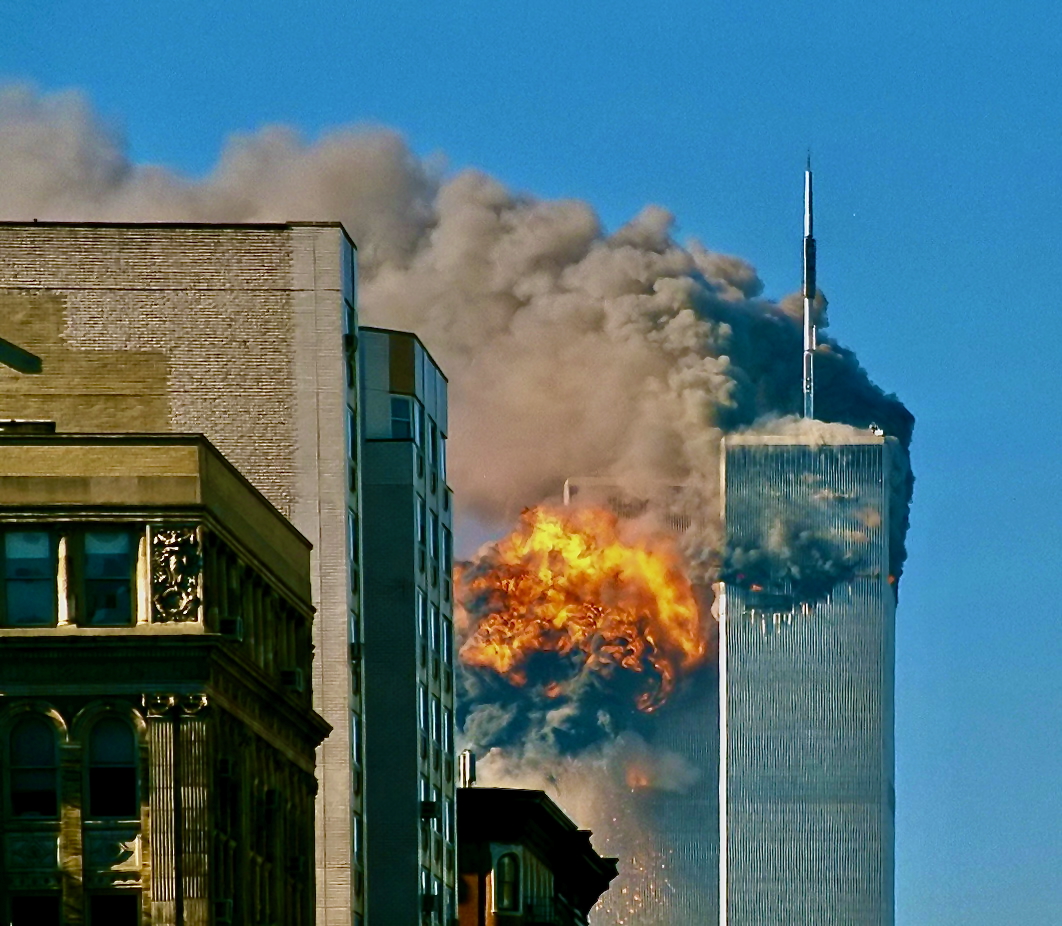
UAF 175 crashes into the south tower of the World Trade Center complex in New York City during the Sept. 11 attacks. (TheMachineStops / Robert J. Fisch / Wikimedia Commons / CC BY-SA 2.0)
Churchill took his title from a remark Malcolm X made after the Kennedy assassination: His murder was merely “chickens coming home to roost.” I do not accept Malcolm’s interpretation of Nov. 22nd, 1963, but Churchill’s use of the phrase is exactly right.
The Sept. 11 attacks did not begin any kind of “War on Terror,” as the Bush II regime instantly declared: They were a just response — measured, indeed, when put in historical context — to aggressions that went back, depending on how we count, to the First Gulf War in 1990–91 and the deadly embargo that followed (denounced at the U.N. as genocide), or to L.B.J., who first lent U.S. support to the Zionist regime’s dispossession of Palestinians in the early 1960s, or… or going back to the Christian Crusades against Islam a millennia ago.
Here is Churchill working with available facts to clear them of the propaganda that instantly arose to obscure them. I will quote a few passages at length so readers can hear his voice and understand his argument.
On the Iraqis’ pre–Sept. 11 suffering:
“All told, Iraq has a population of about 18 million. The 500,000 kids lost to date thus represent something on the order of 25 percent of their age group. Indisputably, the rest have suffered — are still suffering — a combination of physical debilitation and psychological trauma severe enough to prevent their ever fully recovering. In effect, an entire generation has been obliterated.
The reason for this holocaust was/is rather simple, and stated quite straightforwardly by President George Bush, the 41st “freedom-loving” father of the freedom-lover currently filling the Oval Office, George the 43rd: “The world must learn that what we say, goes,” intoned George the Elder to the enthusiastic applause of freedom-loving Americans everywhere….”
From a section subheaded, “On Matters of Proportion and Intent”:
“As things stand, including the 1993 detonation at the WTC, ‘Arab terrorists’ have responded to the massive and sustained American terror bombing of Iraq with a total of four assaults by explosives inside the US. That’s about 1% of the 50,000 bombs the Pentagon announced were rained on Baghdad alone during the Gulf War (add in Oklahoma City and you’ll get something nearer an actual 1%).
They’ve managed in the process to kill about 5,000 Americans, or roughly 1% of the dead Iraqi children (the percentage is far smaller if you factor in the killing of adult Iraqi civilians, not to mention troops butchered as/after they’d surrendered and/or after the ‘war-ending’ ceasefire had been announced).
In terms undoubtedly more meaningful to the property/profit-minded American mainstream, they’ve knocked down a half-dozen buildings — albeit some very well-chosen ones — as opposed to the ‘strategic devastation’ visited upon the whole of Iraq, and punched a $100 billion hole in the earnings outlook of major corporate shareholders, as opposed to the U.S. obliteration of Iraq’s entire economy….”
On the intentions of those who led the Sept. 11 attacks. It is well to recall, à propos the following, the endless post–Sept. 11 histrionics in corporate media to the effect that the attacks were driven by an abiding hatred of “our freedom” and an envy of “our stuff”:
“… they’ve given Americans a tiny dose of their own medicine. This might be seen as merely a matter of ‘vengeance’ or ‘retribution,’ and, unquestionably, America has earned it, even if it were to add up only to something so ultimately petty.
The problem is that vengeance is usually framed in terms of ‘getting even,’ a concept which is plainly inapplicable in this instance. As the above data indicate, it would require another 49,996 detonations killing 495,000 more Americans, for the ‘terrorists’ to ‘break even’ for the bombing of Baghdad/extermination of Iraqi children alone. And that’s to achieve ‘real number’ parity. To attain an actual proportional parity of damage—the US is about 15 times as large as Iraq in terms of population, even more in terms of territory—they would, at a minimum, have to blow up about 300,000 more buildings and kill something on the order of 7.5 million people….
In sum one can discern a certain optimism — it might even be called humanitarianism — imbedded in the thinking of those who presided over the very limited actions conducted on September 11.
Their logic seems to have devolved upon the notion that the American people have condoned what has been/is being done in their name — indeed, are to a significant extent actively complicit in it—mainly because they have no idea what it feels like to be on the receiving end.
Now they do.
That was the ‘medicinal’ aspect of the attacks.
To all appearances, the idea is now to give the tonic a little time to take effect, jolting Americans into the realization that the sort of pain they’re now experiencing first-hand is no different from — or the least bit more excruciating than — that which they’ve been so cavalier in causing others, and thus to respond appropriately.
More bluntly, the hope was — and maybe still is — that Americans, stripped of their presumed immunity from incurring any real consequences for their behavior, would comprehend and act upon a formulation as uncomplicated as “stop killing our kids, if you want your own to be safe”….”
And to conclude these extracts, a paragraph here that precedes those above, wherein Churchill tips the whole of the post–Sept. 11 discourse upside down:
“Hence, it can be concluded that ravings carried by the ‘news’ media since September 11 have contained at least one grain of truth: The peoples of the Mideast ‘aren’t like’ Americans, not least because they don’t ‘value life’ in the same way. By this, it should be understood that Middle-Easterners, unlike Americans, have no history of exterminating others purely for profit, or on the basis of racial animus. Thus, we can appreciate the fact that they value life — all lives, not just their own — far more highly than do their U.S. counterparts.”
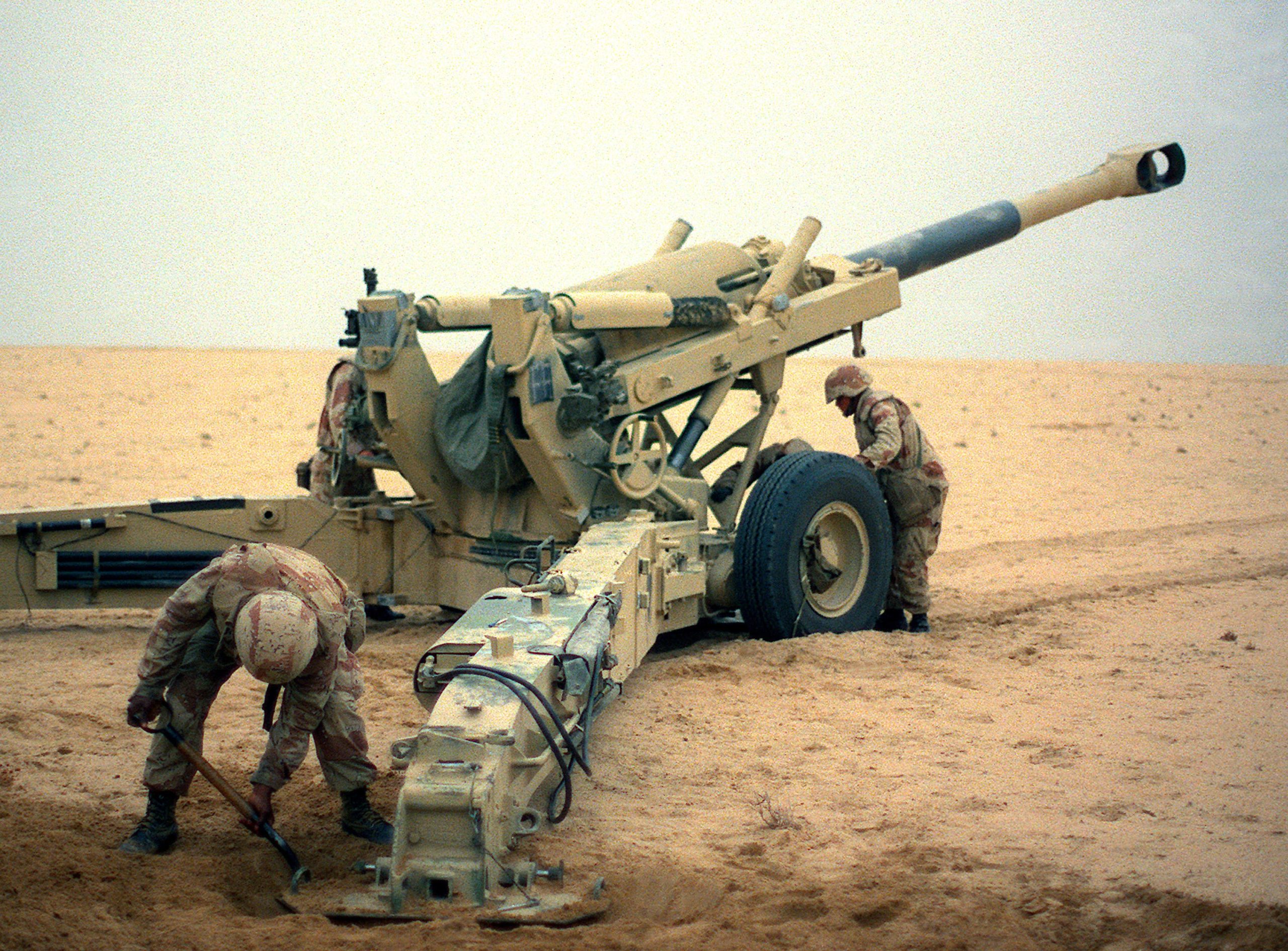
Marine artillerymen set up their M-198 155mm howitzer for a fire mission against Iraqi positions during Operation Desert Storm. (Staff Sgt. Vance / Wikimedia Commons / Public Domain)
A full-scale assault on American hypocrisy is one of Churchill’s purposes, plainly. To rehumanize the dehumanized is another. But to me, and the reason I fasten onto Churchill’s essay as I do here, is his attack on the near to criminal triviality of American life in the face of their nation’s incessant crimes. In this connection, I love this passage, which concerns public indifference as the consequences of the Gulf War and the post–War embargo became known:
“As a whole, the American public greeted these revelations with yawns. There were, after all, far more pressing things than the unrelenting misery/death of a few hundred thousand Iraqi tikes to be concerned with. Getting ‘Jeremy’ and ‘Ellington’ to their weekly soccer game, for instance, or seeing to it that little ‘Tiffany’ and ‘Ashley’ had just the right roll-neck sweaters to go with their new cords. And, to be sure, there was the yuppie holy war against ashtrays — for ‘our kids,’ no less — as an all-absorbing point of political focus.”
It is Churchill’s eloquent bitterness I find so very right, his piercing sense of proportion and disproportion — his stone-solid charge that Americans are willfully blind to their responsibility for their nation’s crimes.
I well recall, of those first months after Sept. 11, that some number of Americans — a minority, certainly, but some — took the attacks as an occasion to reflect honestly on U.S. conduct in West Asia and elsewhere in the non–West. There was a search for causality, at last. I honored this brief interim in a book I later published.
But Churchill had no more time for the self-examiners than he had for the parents of Jeremy and Tiffany. “Those involved by-and-large contented themselves with signing petitions,” he wrote, “and conducting candle-lit prayer vigils, bearing “moral witness” as legions of brown-skinned five-year-olds sat shivering in the dark…”
Churchill’s pithiest observations, to continue a little further with his essay, concerned the prevalent presumption that those directly involved in the operations of empire the day of the attacks were innocent. “There is simply no argument to be made,” he wrote, “that Pentagon personnel killed on September 11 fit that bill.” What could be truer? As to those in the Twin Towers:
“Let’s get a grip here, shall we? True enough, they were civilians of a sort. But innocent? Gimme a break. They formed a technocratic corps at the very heart of America’s global financial empire — the ‘mighty engine of profit’ to which the military dimension of U.S. policy has always been enslaved — and they did so both willingly and knowingly. Recourse to ‘ignorance’ — a derivative, after all, of the word ‘ignore’ — counts as less than an excuse among this relatively well-educated elite. To the extent that any of them were unaware of the costs and consequences to others of what they were involved in —and in many cases excelling at — it was because of their absolute refusal to see.”
The absolute refusal to see. I detected this same 13 years later, when the 9/11 Memorial Museum opened at the site of the Twin Towers in Lower Manhattan.
How can you work for Morgan Stanley, Lehman Brothers, Bank of America, or Cantor Fitzgerald and consider yourself innocent of the imperium’s aggressions and exploitations, I wondered in the piece I wrote at the time. The museum, it seemed to me, was a morbid monument to the obsessive individuation of “victims” and the racist dehumanization of “perpetrators.”
It is greatly to Ward Churchill’s credit that he turned this equation hourglass upside-down long before I did, defending in his searing prose his description of Americans as “a perpetrator population.” What phrasing, even after all these years. And it is to the late scholar’s credit also that he demonstrated the vital connection between empire and blindness — the former requiring the latter of its citizens for the exercise of its power.
With the vigor evident in every sentence of “Some People Push Back,” Churchill condemned all “pious Americans” — especially those directly serving the empire, whom he called “little Eichmanns” — just as Americans vigorously condemned, post–1945, those Germans who were silent during the years of the Reich: “If the principle was valid then, it remains so now, as applicable to Good Americans as it was the Good Germans.”
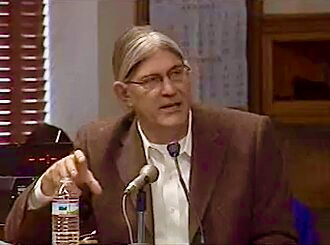
Churchill testifying in defense of his scholarship in the civil trial, Ward Churchill v. University of Colorado. (Albaum / Wikimedia Commons / Public Domain)
It was these remarks that got Churchill in trouble — so it is generally understood. The University of Colorado fired him on the pretext of scholarly misconduct, a decision he had reversed in a court case some years later. But I don’t think the passages concerning the “little Eichmanns” who “just followed orders” account for Churchill’s treatment, or the storm of controversy the essay prompted. No, it was his charges of shared responsibility, of purposeful blindness, of “an absolute refusal to see.”
As Eliot wrote in Burnt Norton, the first of the Four Quartets, “Go, go, go said the bird: human kind / Cannot bear very much reality.”
Ratical.org, where “Some People Push Back” first appeared, now publishes a journal called Rat Haus Reality. The clipped, concise mot atop its home page reads, “Exercising our intelligence with clarity and coherence.” I cannot think of a better summation of the responsibility Americans bear if they are to overcome their late-imperial neurosis and, so, learn to see.
The reigning orthodoxy has it that the Pentagon and its obscenely immense armies, along with America’s obscenely powerful intelligence apparatus, are the nation’s guardians, protecting all 340 million of us from “threats” — threats, threats, threats everywhere. This is preposterous on the very face of it, given the United States’ serial military and intelligence failures.
No, it is when we learn to see that we will enable ourselves to make our way in the world unthreatened by others.
Nietzsche published The Gay Science, which he considered the most personal of his books, in 1882. To know ourselves truly, to see ourselves as we are, he urged, we must board our boats and sail beyond our shores, there to turn back to see how it is we have lived. “We have forsaken the land and gone to sea!” one translation — there are others — has him writing. He meant — although interpreting Nietzsche is always a little perilous — we must unmoor ourselves of all we have presumed to be so, accepting the dangers that come with true freedom.
To surrender the illusory safety of blindness in favor of risk and clear sight: It is we who are our greatest threat until we get this done, so discovering that in the embrace of risk lies a truer future, the possibility of the freedom of which Nietzsche wrote.
‘Seeing Others as They are’
The Cold War redefined the world for 42 or 44 years, depending on whether we mark its end with the fall of the Berlin Wall or the final dissolution of the Soviet Union. Beginning with Truman’s 1947 intervention on behalf of Greece’s fascist monarchy, all was subsumed in the East–West binary, that blight upon the human community. It was difficult for any nation to manifest an identity of its own. India to an extent, Indonesia until Sukarno was deposed, de Gaulle’s France to an extent, Tito’s Yugoslavia: These were among the notable exceptions. For the rest it was with-this-lot-or-with-the-other.
The Cold War’s end changed everything, or nearly, once again. As East–West enmities evaporated, nations were able to define themselves on their own terms and no one else’s. Those paying attention in the 1990s could scarcely miss this, a promising time after four grim decades — for many people crushing decades. It was as if the world had gone back to the first years after the 1945 victories, I recall thinking. The same aspirations were again evident.
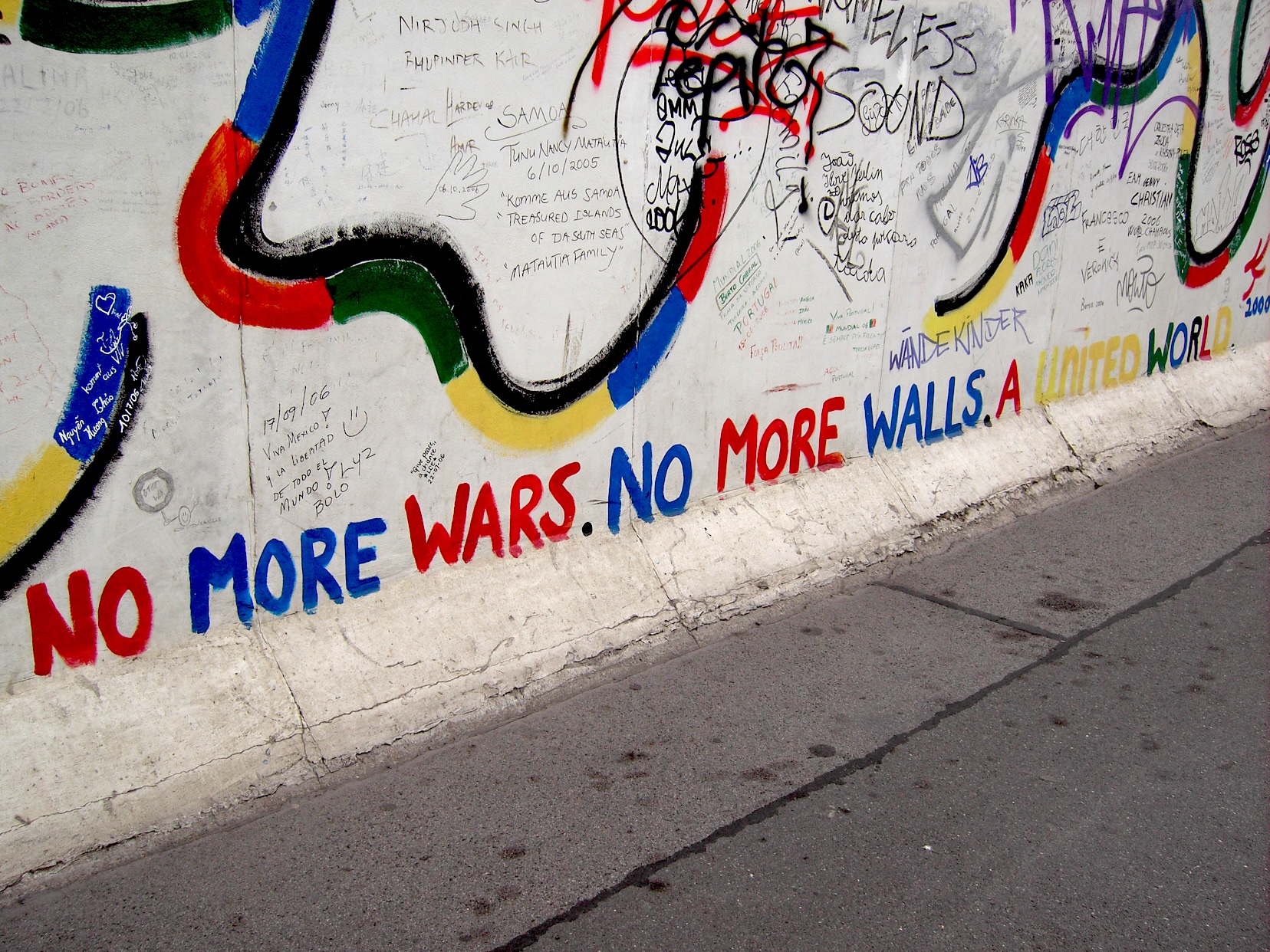
A popular slogan graffitied on one of the sections of the East Side Gallery, a permanent open-air gallery on the longest surviving section of the Berlin Wall, reading: “No more wars. No more walls. A united world.” (Dr Santa /Wikimedia Commons/ Public Domain)
“Become who you are” is one of Nietzsche’s frequently quoted aphorisms. This was the post–Cold War project for much of humanity. It was a question of restoring social relations the East–West binary had done much to tear apart. Cultures, traditions, submerged histories, foreign relations, political systems, systems of justice, social structures, the lessons taught in schools…:By way of these and many other such things people and nations set about retrieving identities the Cold War decades had suppressed but never extinguished.
The Cold War’s passing precipitated an historic turn in the collective consciousness, I will take the risk of saying. In my read it was as much a revival as it was the advent of anything new. Certain inevitable realities reappeared. It was as if they had been preserved in an earthen jar, like scrolls, and disinterred more or less intact. I have named two of these here and there in previous commentaries. One was parity among Western and non–Western nations and peoples: The demand for this came once more to the surface. There was also the necessity of seeing others as they are and developing the capacity — the desire, indeed — to understand their perspectives.
A couple of examples seem in order so as to avoid drifting into airy abstractions. If the People’s Republic asks one thing of the West, beyond the export markets and the foreign investment and the technology, it is to be recognized as an equal of the Western powers. China’s infamous “century of humiliation” — from the Opium Wars to the Revolution — adds a piquancy to its insistence on this point.
As to seeing others as they are, the case of post–Sukarno Indonesia is a ready-to-hand illustration of my point. It was politics in command for the archipelago nation’s first president. Sovereignty, independence and pride came before all else, “the Bung,” Brother Karno, taught his people. When the C.I.A. deposed him and installed Suharto as another of Southeast Asia’s dictators, Indonesians were instantly rendered invisible and their aspirations counted for nothing. For the next three decades Indonesia was shorthanded as “a staunch Western ally”— a phrase I heard so often it came to repel me during my correspondent years in Asia.

Official Portrait of Sukarno in 1949. (Wikimedia Commons/ Public Domain)
Parity among nations, seeing as others see: I count these 21st century imperatives and have done so for some years. If we are fully to understand what amounts to a revolution in the world order we must grasp first of all that it reflects the non–West’s insistence that a half-millennium of inequality is ending. But I will leave aside the matter of parity for now. My immediate concern is clear sight, our ability — ours as in America’s, as in the West’s altogether — to see others just as they are. Our ability or our inability, as the case so often is. If we are unable or unwilling to see ourselves as we are, as I argued in the first of these essays, it follows ineluctably that we have blinded ourselves to other peoples and the cultures and traditions that define them.
How costly it is to live in a pervasive darkness.
In the autumn of 1990 — just as the divide that had ruled humanity for so long was ending — Ryszard Kapuscinski delivered a lecture called “My Other” at a writer’s symposium in Graz. Could the celebrated Polish correspondent and author have been more prescient? It is time, he argued “to build bridges of understanding” between the West and all its Others. This had to begin, he thought — and how could it be otherwise? — with seeing our Others as they are.
“My Other” was later published in The Other (Verso, 2008), a collection of Kapuscinski lectures on the theme. Transcending the fundamental fallacy of the very notion of Otherness, he remarked, “is not just an ethical duty but also an urgent task for our time in a world where everything is so fragile and where there is so much demagogy, disorientation, fanaticism, and ill will.”
To say it is a pressing task of our time to see others as they are and not as we wish them to be or insist they must be is another way of saying that it is imperative we see the world as it is. And so to the crux of a question: To the late-phase imperium, clear sight is a matter of great contention. Try to imagine the consequences for the empire’s managers were Americans to understand others and have some grasp of how they look upon the world. I have no trouble with this: It would be transformative. Clear sight, it follows immediately, is a cause it behooves paying-attention people to advance.
In the philosophic principle called perspectivism, all knowledge is held to be determined by where a given observer is standing. At the risk of undue simplification, if you are… fill in the blank… Chinese or Brazilian or Ghanaian, you will understand life and events as they look from East Asia or Latin America or West Africa. Perspectivism is as old as the pre–Socratic Greeks (although Plato, with his absolute ideals, stood against it). Another name for perspectivism among modern scholars is epistemological pluralism: There are many different ways of knowing the world, depending on your method of knowing it.
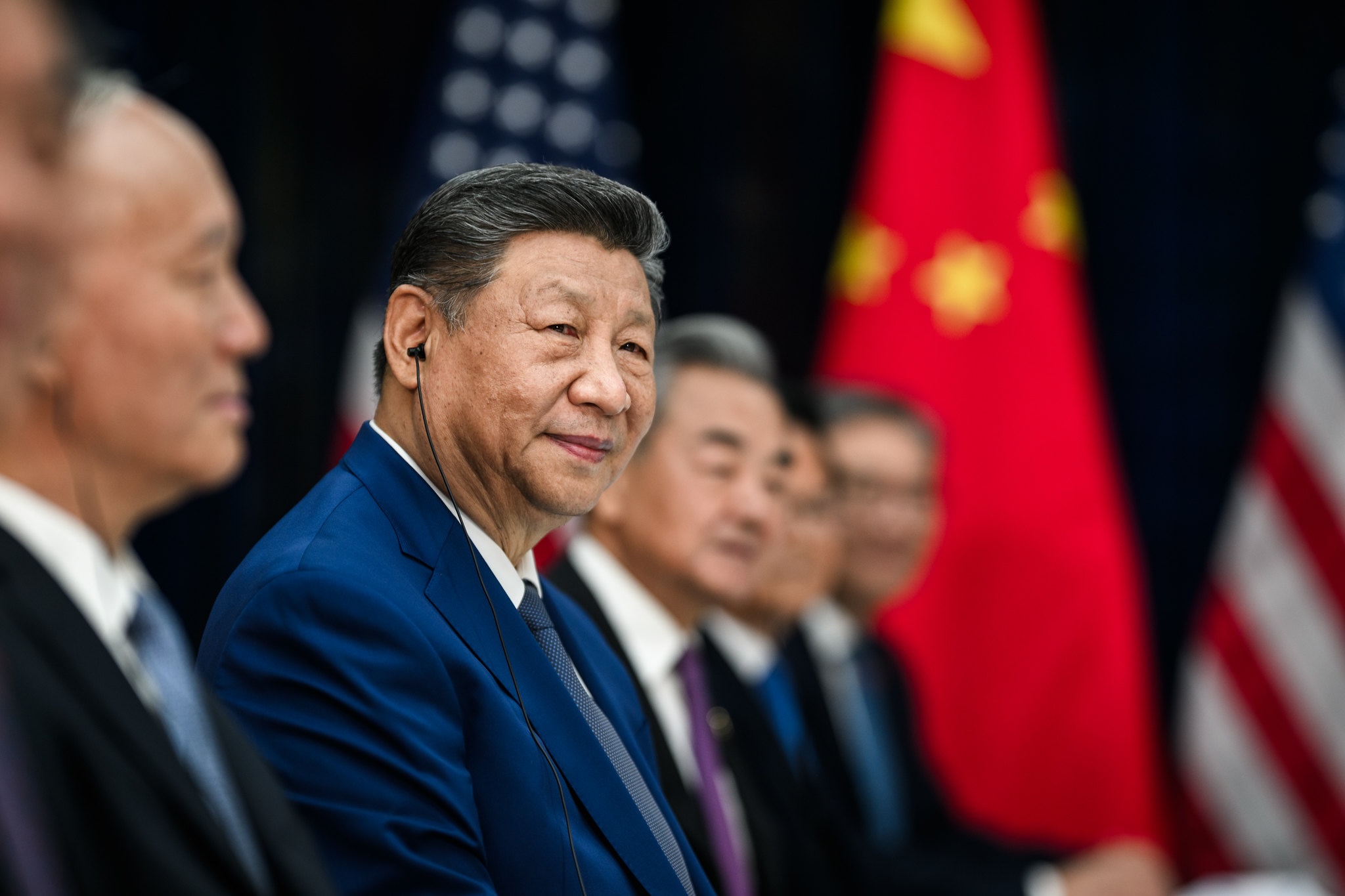
Chinese President Xi Jinping during a meeting with U.S. President Donald Trump in Busan, South Korea, on Oct. 30, 2025. (White House/Daniel Torok/Public Domain)
Nietzsche was very high on perspectivism. There is no such thing as “viewing from nowhere,” he wrote, or “viewing from everywhere.” From The Genealogy of Morals (1887). The italics are in the Walter Kaufman translation:
“Let us be on guard against the dangerous old conceptual fiction that posited a ‘pure, will-less, painless, timeless knowing subject.’ Let us guard against the snares of such contradictory concepts as ‘pure reason,’ … ‘knowledge in itself.’… These always demand of the eye an absurdity and a nonsense. There is only a perspective seeing, only a perspective knowing; and the more affects we allow to speak about one thing, the more eyes, different eyes, we can use to observe one thing, the more complete will our ‘concept’ of this thing, our ‘objectivity’ be….”
Perspectivism has not traveled far beyond philosophical treatises and speculations in the Age of Empire, fair to say. It conflicts too frontally with imperial interests, which invariably turn on the superiority of the imperial power’s version of reality — la mission civilisatrice, “beacon of the world,” etc. In the imperial perspective, perfectly evident in the British, French, and American cases, there is only one perspective, one way of seeing the world, and it is the empire’s; the Other must always remain invisible — a stick figure, 2–D, having no perspective of his or her own.
To illustrate this point, one of my favorite books in the perspectivist line is Montesquieu’s Persian Letters, published in 1721. The great philosophe never used the term, he may not even have known it, but his book is perspectivist start to finish. It consists of letters an imagined entourage of Persian nobles write home during their travels to Paris, wherein they comment on the nonsensical absurdities of upper-class French life. Persian Letters is riotously satiric, but Montesquieu took pre-emptive cover against the controversies he knew the book would prompt by publishing it anonymously in Amsterdam.
Suppressing any thought of the perspectives of others is essential to the operation of the American imperium, if this is not to state the obvious. As I just wrote elsewhere, American diplomacy no longer makes even a pretense of interest in Russia’s views of events or its aspirations. Even accomplished scholars such as John Mearsheimer, having spent little time among the Chinese, stop just short of reviving the “yellow peril” theme of the early 20th century. There is a long tradition among American newspapers of rotating foreign correspondents from one posting to the next every three to five years, this to guard against the danger of “going native”— that is, reflecting in the work how the world looks to the people upon whom one is reporting.
I am regularly surprised to discover how few Americans are aware that a new world order is emerging as we speak. When the media reports this reality, they put it across as some kind of diabolic design to subvert America and the rest of the West. It is ridiculous, but ridiculous passes in the land of the thoroughly unseeing. Preventing us from seeing others as they are — emergent non–Western nations a case in point — comes to an exercise in blocking human development. This is the unstated, disguised intent, given the policy cliques are well aware that the Age of Empire is passing.
Nietzsche, much taken up with these matters, was well aware of the social-psychological prisons in which modern societies confine their citizens. In The Gay Science, published five years before The Genealogy of Morals, he urged that we “take off the garb of the West” so as to liberate ourselves from the limits of the modern consciousness, so escaping our material nihilism to make something new of ourselves, something larger, something more expansive.
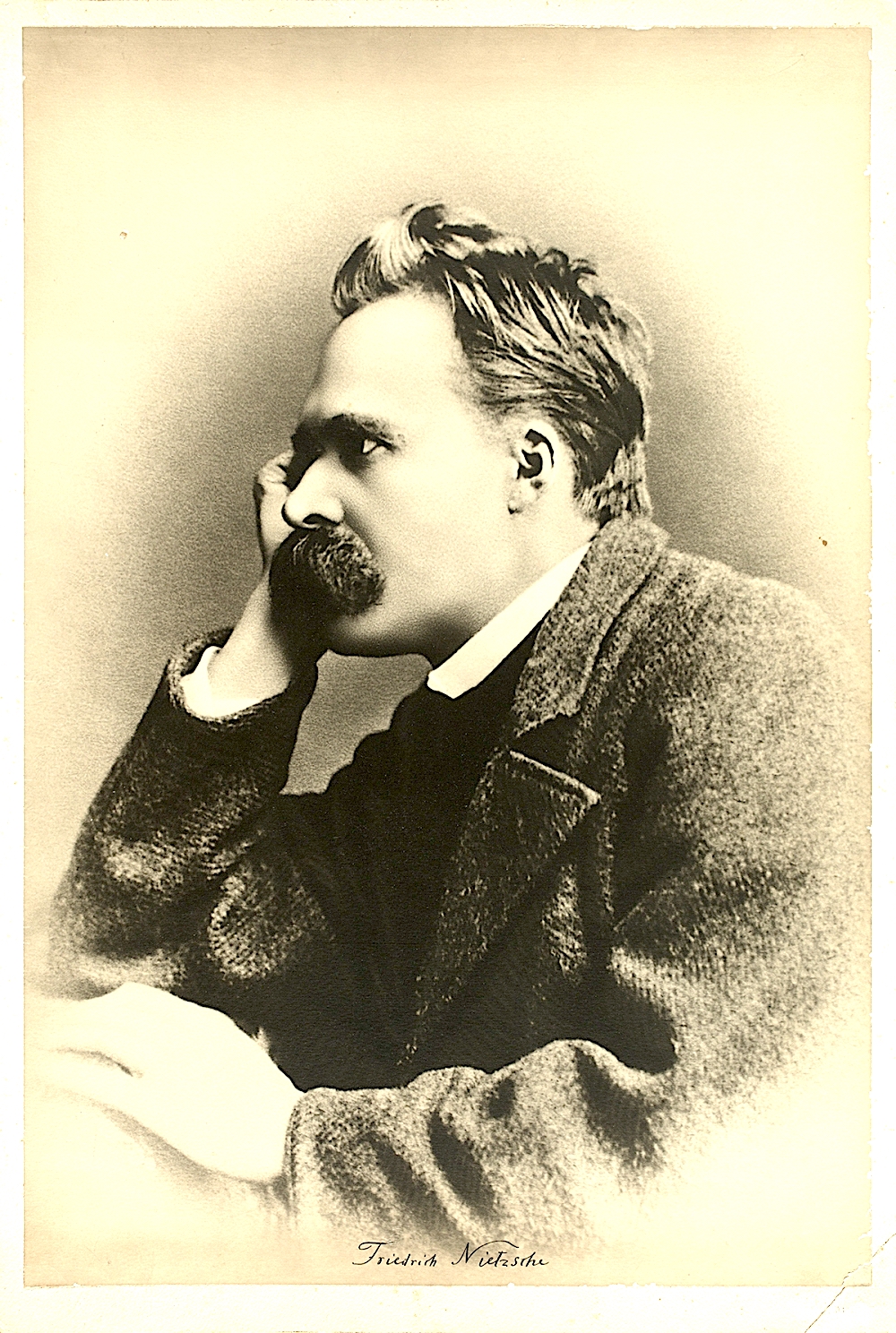
Portrait of Nietzsche in 1882 by Gustav Adolf Schultze. (Wikimedia Commons / CC BY-SA 4.0)
Stripping ourselves of the heavy clothes of “Western civilization” (let’s stay with the quotation marks) is one way of defining the project that lies before us. To escape the confinements the imperium imposes — this is the fight worth fighting in our time, or the beginning of a long, large fight. Americans are getting this done a little at a time, it seems to me, and in this they are ahead of their purported leaders. It falls to the purportedly led, then, to insist on new ways of seeing. In lots of cases public sentiment is far ahead of policy. The gathering fervor against the terror regime in Israel is a plainly legible case in point.
Cara Marianna, my colleague and partner (etc.), publishes Palestinian Voices in association with The Floutist and in the Substack newsletters West Bank Alerts and Winter Wheat. This project began in response to the events of Oct. 7th, 2023, and the phrase chosen at the outset to describe its purpose was “to rehumanize the dehumanized.” But precisely. To listen to Palestinians as they speak: Is there any better way to transcend our confinements and embrace another people for who they are?
Russia, China, Cuba, all manner of others: The endeavor is the same in each case — to rehumanize all our dehumanized Others against the Russophobes, the Sinophobes, the Islamophobes, the Castrophobes. And isn’t it so that in getting to know others we will get to know ourselves, too, and know the world as it is for the first time?
Patrick Lawrence, a correspondent abroad for many years, chiefly for the International Herald Tribune, is a columnist, essayist, lecturer and author, most recently of Journalists and Their Shadows, available from Clarity Press or via Amazon. Other books include Time No Longer: Americans After the American Century. His Twitter account, @thefloutist, has been restored after years of being censored.
TO MY READERS. Independent publications and those who write for them reach a moment that is difficult and full of promise all at once. On one hand, we assume ever greater responsibilities in the face of mainstream media’s mounting derelictions. On the other, we have found no sustaining revenue model and so must turn directly to our readers for support. I am committed to independent journalism for the duration: I see no other future for American media. But the path grows steeper, and as it does I need your help. This grows urgent now. In recognition of the commitment to independent journalism, please subscribe to The Floutist, or via my Patreon account.
The views expressed are solely those of the author and may or may not reflect those of Consortium News.
Please Donate to
CN’s Summer
Fund Drive!


[ad_2]
Source link
