
[ad_1]
Wealth flight is a Mirage. There are More Billionaires and Multi-Millionaires than ever before
Blake Fleetwood ScheerPost
Despite the hyperbolic predictions, there has been very little wealth flight under Mayor Zohran Mamdani, even after the enactment of a pied-à-terre tax on second homes valued at $5 million or more. New York has far more billionaires and multimillionaires today than it did under any previous mayor. This new 1% tax is not discouraging the ultra-wealthy.
The city is home to a staggering 123 billionaires. Together, they form the most exclusive private club in the world, with a combined net worth of $759 billion. In 2024, the city gained 15 billionaires and lost only two. By contrast, London has 71 billionaires.
But the official figures are only the tip of an unseen iceberg. Real estate experts estimate that another 200 to 300 billionaires maintain some kind of residence in the city. New York also has nearly 400,000 millionaires.
Although the city lost 2,400 millionaire households between 2020 and 2022, during the pandemic, it gained 17,500 millionaire households over the same period, driven by a strong economy. Miami, by comparison, has a paltry 38,800 millionaires and 17 billionaires.
Of course, many millionaires leave the city, most often for nearby, family-friendly suburbs. But more millionaires are created every day, and many more continue to move in. Contrary to popular belief, the richest 1% of New Yorkers—those earning more than $815,000—leave New York State at one-quarter the rate of the rest of the population.
Citadel hedge fund billionaire Ken Griffin, notoriously hostile to taxes, has loudly predicted a mass exodus to Miami or Austin because of the new tax. But it is not happening.
The luxury tier of Manhattan’s real estate market is running hotter than ever. Sales above $20 million rose sharply in 2026, climbing 25% year over year, while activity in the $10 million-to-$20 million segment increased by 38.6%.
According to a Compass report, this is no coincidence. “At this level, buyers are seeking something rare—they’re buying provenance and irreplaceability, not just square footage,” Compass broker Christine Miller Martin told Realtor.com.
With the stock market rising by an average of more than 23% annually over the past three years and 13.7% year to date, who cares about a 1% pied-à-terre tax? A New York Times study estimates that the initial public offerings of SpaceX, Anthropic and OpenAI could create 20 billionaires—and, by extension, who knows how many centimillionaires.
Europeans are also flooding into the New York City market, drawn by the strength of the euro and the pound against the dollar.
New York is Richistan. Money follows money.
By any honest measure, New York City is the greatest wealth-generating machine the Earth has ever seen. It remains the economic engine of America and the world. New York is not just another city. It is the capital of capital.
The New York metropolitan area is, by a wide margin, home to the world’s largest concentration of hedge funds and hedge fund capital. Business Insider reported 4,373 hedge fund-related investors and managers in New York and another 312 in Greenwich.
That is why the world’s ultra-wealthy continue to buy apartments here at absurd prices, compete for invitations to private clubs and exclusive dinner parties, and fight for status within the city’s social, cultural and financial ecosystem. They are not victims of New York. They are its beneficiaries.
The explanation is simple: They can wield more influence, gather more financial intelligence and make more money in New York. To be a major player in New York is to be a major player in the world.
The city’s critical mass brings together an extraordinary number of ambitious, talented, creative and competitive people within a relatively small geographic area. That concentration creates wealth on a scale that no other city can match.
“All these people live only on their ideas,” urbanist Peter Hall wrote.
This cultural and financial centrality continues to intensify. New York can be understood as a specialized machine for producing, processing and trading valuable intelligence. In the modern economy, capital is plentiful. Ideas are scarce. Ideas and information are the new currency, and the knowledge economy is growing many times faster than industry as a whole.
The notion that New York is expensive is hardly news. The ultra-wealthy have always known that, but they do not seem to care.
Ken Griffin’s behavior, rather than his anti-tax bluster, tells the story better than any statistic. He paid a record-shattering $238 million for a Manhattan condominium—a part-time residence. The same amount of space in Miami or Chicago might have cost one-third as much. Griffin willingly paid a premium of more than $150 million simply to be in New York.
For all his threats to leave, Griffin is moving forward with a 1.8-million-square-foot, $6 billion, 62-story skyscraper that will serve as his New York headquarters.
City officials believe the new tax will generate between $340 million and $500 million annually for the city’s coffers, affecting approximately 13,000 luxury second homes. The tax will cost Griffin about $1 million more per year.
New York is the preeminent Richistan—a separate world within the country where the ultra-wealthy create their own customs, services, markets and social norms, as described by author Robert Frank.
Julie Macklowe, a wealthy socialite who married into a billionaire family, wrote in a Wall Street Journal article, “I am done watching people otherwise identical to me enjoy this city free.”
Macklowe pays nearly 15% in combined New York State and city income taxes, while some members of the ultra-rich pay no New York income taxes at all.
Every fall, like clockwork, these nonresidents return, she says. “They’re at Sant Ambroeus. They’re at the Frick. They’re at Sotheby’s. They’re in the front row at the Met Gala and the back room at Cipriani.”
Their entire identities—their art collections, club memberships and social currency—are denominated in New York prestige.
In one survey, New York City ranked third among the happiest places in the United States, ahead of hundreds of other American cities. The social season runs from September through June, filled with galas, openings and private dinners. It does not pause simply because someone files a change-of-domicile form, Macklowe observes.
Yet some of these people do not want to pay their dues.
The lyric popularized by Frank Sinatra—“If I can make it there, I’ll make it anywhere”—captured more than civic pride. It captured a social bargain. New York rewards ambition, hard work and good ideas more extravagantly than almost any other place on Earth. But that bargain runs both ways.
The city keeps performing. It maintains the infrastructure, institutions, world-class hospitals and cultural organizations to which billionaires so generously lend their names, even as some of them write their tax checks from states with no income tax.
That is not clever planning. It is a free ride.
Today, as the gap between the penthouse and the pavement grows to grotesque proportions, it is time for those at the top to honor their end of the bargain.
That is why the outrage from some billionaire financiers over higher taxes has become so unconvincing. Ken Griffin warns, “Tax us more, and we will leave.” New Yorkers have heard this song for decades. But it is not happening.
The top of the Manhattan market increasingly resembles the art market rather than a typical housing market: Rare, irreplaceable properties continue to command strong demand. The rich keep coming.
New York City has 49 Fortune 500 headquarters, an increase of two from 2024. Another 37 are located in the nearby suburbs, bringing the metropolitan-area total to 86. Miami has 10.
New York’s size and complexity attract a critical mass of creative and wealthy people that no other city can match. Why? It is home to the New York Stock Exchange and the headquarters of many of the world’s most powerful banks, hedge funds and investment firms. It is a center of global media, publishing, fashion, theater and contemporary art.
It possesses some of the finest medical institutions on Earth, including Memorial Sloan Kettering Cancer Center, Rockefeller University, Mount Sinai, NYU and NewYork-Presbyterian. It has also become a dominant center for applied artificial intelligence, with thousands of startups and elite academic institutions feeding its talent pipeline.
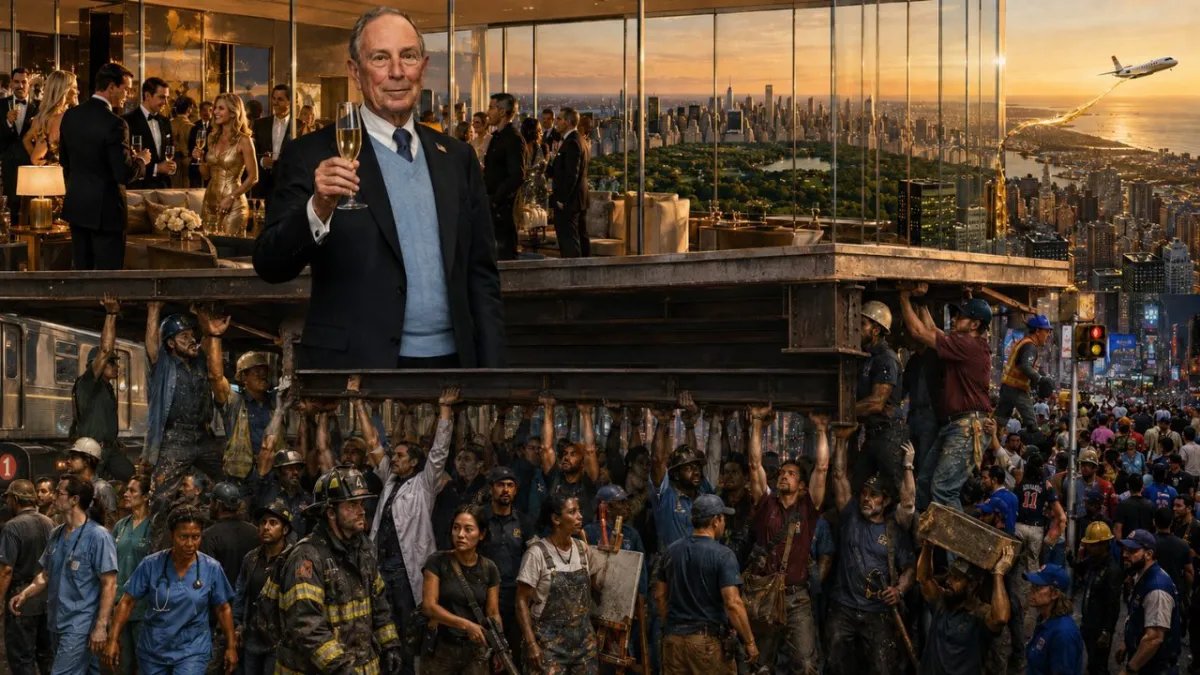
None of this wealth was created in a vacuum. The financiers did not build New York. New York built the financiers.
The city’s immense fortunes rest atop generations of public investment: the subway system that moves millions of workers; the bridges, airports and tunnels that facilitate commerce; the police and fire departments that protect property; the courts that enforce contracts; the universities that educate workers; and the parks and museums that make life in the city desirable.
Even the artists and writers who made New York culturally magnetic were sustained by public infrastructure—libraries, rent stabilization, public transit, public universities, museums and arts funding—long before global capital arrived to monetize the city’s cool.
Median rents have risen by 10%, bringing the average apartment rent to $6,655. New York’s vacancy rate is 1.49%, the lowest it has been since 1968.
The billionaire class loves to celebrate meritocracy and self-creation. But New York’s success has always been collective.
Despite the endless threats to leave, history and data suggest that wealthy people rarely relocate solely because of taxes. When New Jersey raised taxes on millionaires, the predicted mass exodus never meaningfully materialized. When California enacted higher taxes on the wealthy, Silicon Valley did not flee to Texas. When Massachusetts adopted a 4% millionaire’s tax, revenues surged. New York itself raised taxes on high earners in 2009, and the number of wealthy residents continued to grow.
Research, including studies from the Fiscal Policy Institute, consistently shows that taxes are only one factor—and often not the decisive one—in determining where affluent people choose to live.
The wealthy remain in New York because of their proximity to other wealthy, creative and powerful people, as well as the dynamism that results from that concentration. They stay for the energy, ambition, prestige, culture, restaurants, art, density of talent and the sense that everything important is happening here first.
Miami has beaches. Palm Beach has sunshine. Austin has lower housing costs. But none of them has New York.
New York is the most exclusive private club in the world. To be a player in New York is to be a player on the world stage. That status commands a premium—one the ultra-wealthy should be glad to pay to sustain the city’s singular dynamism.
Blake Fleetwood was formerly a reporter on the staff of The New York Times and has written for The New York Times Magazine, New York Magazine, The New York Daily News, the Wall Street Journal, USA Today, the Village Voice, Atlantic, and the Washington Monthly on a number of issues.
He was born in Santiago, Chile and moved to New York City at the age of four. He graduated from Bard College and did graduate work in political science and comparative politics at Columbia University. He has also taught politics at New York University. He can be reached at jfleetwood@aol.com.
Editor’s Note: At a moment when the once vaunted model of responsible journalism is overwhelmingly the play thing of self-serving billionaires and their corporate scribes, alternatives of integrity are desperately needed, and ScheerPost is one of them. Please support our independent journalism by contributing to our online donation platform, Network for Good, or send a check to our new PO Box. We can’t thank you enough, and promise to keep bringing you this kind of vital news.
You can also make a donation to our PayPal or subscribe to our Patreon.
Please share this story and help us grow our network!
[ad_2]
Source link
