
[ad_1]

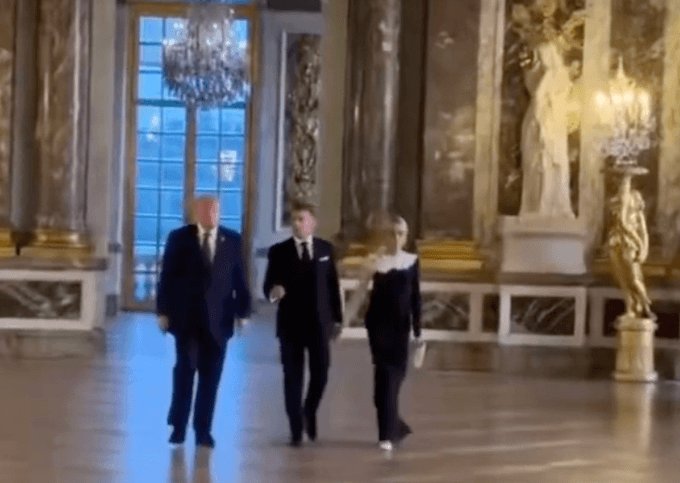
Trump and the Macrons at Versailles. (Screengrab from CSPAN.)
Donald Trump’s visit to Évian and Versailles offered this Geneva resident an unusually close look at the American president as the local press reported on all the ins and outs of his drop-by. While much of the commentary has focused on the G7 and the very thin memorandum of understanding with Iran, what stood out was Trump’s conduct. His declaration that “I’m the boss,” his hostility toward journalists, and the pageantry at Versailles all reinforced the image of a president increasingly drawn to the trappings of royal power. Trump turned the visit into another display of self-aggrandizement, reinforcing his image as the “Ugly American.”
The “Ugly American” is the stereotype of an American abroad: loud, domineering, culturally tone-deaf, and convinced that American ways are inherently superior. During his 48-hour visit to France, Trump checked every box. With Trump, the tourist stereotype has become a style of statecraft.
First, at the G7, Trump arrived late for a working session. As he entered the room, where the session had already started, instead of apologizing for being late, he greeted the room with “I’m the boss.” He then offered to let the press stay in what was supposed to be a closed-door meeting.
Trump’s remark landed with an awkward silence. His tap on the German Chancellor’s shoulder as he took his seat did nothing to change the atmosphere. No leader publicly challenged him, allowing his statement to pass without visible objection. The principal people around the table were the leaders of France, Germany, Great Britain, Italy, Canada, and Japan. Trump’s comment has been optimistically interpreted as a joke.
Whether intended as humor or not, the remark asserted Trump’s domination over the group. The very word “boss” evokes a mafia kingpin more readily than a diplomatic leader. In Europe, where diplomacy still places a premium on courtesy, protocol, and the fiction that sovereign equals meet as partners, the moment carried a symbolism. French and Swiss coverage focused on what the comment revealed about his conception of hierarchical leadership. An AFP dispatch published in a local Swiss paper noted that Trump “made a point of reminding the other G7 leaders who was in charge.”
Having declared to the assembled G7 leaders that “I’m the boss,” Trump closed the summit with a press conference that quickly turned adversarial. When an ABC reporter was called on, he cut off the exchange immediately: “You’re from ABC. You’re fake news. Go ahead.” The tone was pre-emptive dismissal.
On policy questions about the Iran memorandum, criticism itself was treated as illegitimate. Dissenting views were reduced to ignorance or bad faith, summed up in phrases such as “the stupid people say that,” while the president insisted that the agreement would simply speak for itself once published.
What emerged was not a dialogue with the press but a pattern in which questioning authority was met either with ridicule or with the suggestion that no interpretation was necessary beyond his own, convinced that his interpretation was inherently superior.
If Évian revealed Trump’s view of the “Ugly American” as loud, domineering, and culturally tone-deaf, Versailles provided the perfect stage for it. At Versailles, surrounded by the architecture of absolute monarchy, the “Ugly American” seemed perfectly at home. The palace built to glorify Louis XIV became the backdrop for a president who increasingly presents himself not simply as the head of a constitutional republic, but as a ruler whose personal will eclipses institutions. It was as though an American political fantasy had merged with a French royal one.
Donald XLVII met Louis XIV.
“I’m the boss” translated from “L’État, c’est moi.”
“I don’t want to hear about the affordability” updated “Let them eat cake.”
The East Wing Ballroom reimagined Versailles’ Hall of Mirrors.
But not everyone has bowed to Trump. Not everyone appears spineless.
Two European leaders deserve particular attention. The Spanish Prime Minister, Pedro Sánchez, has refused to follow Trump. At the 2025 NATO summit, he would not commit Spain to spending 5% of GDP on defense, arguing that about 2.1% would be enough to meet Spain’s military commitments. In response, Trump called Spain’s stance “terrible” and suggested Spain was “free-riding” on the alliance. Recently, Sánchez refused to allow the U.S. to use the jointly operated military bases at Rota and Morón for offensive missions against Iran. Spain said any use of the bases must comply with existing bilateral agreements and international law, and called the U.S. and Israeli strikes on Iran “unjustified”and “dangerous.”
A second European leader has also gotten under Trump’s skin. Like Spain, Italy refused to allow U.S. forces to use Italian bases for offensive operations against Iran, saying any use must comply with existing bilateral agreements and Italian law. The previously close relationship between Trump and Italian Prime Minister Giorgia Meloni has degenerated into a personal feud worthy of the gossip columns. Trump claimed she asked him for a photo at the G7 summit because she wanted to boost her popularity. Meloni categorically denied the claim, calling it “completely fabricated,” and responded that Trump should “focus on your own popularity.” As Reuters headlined: “From Trump whisperer to Trump basher: Meloni takes on US president.” The immediate result of the feud was that Italian Foreign Minister Antonio Tajani canceled a planned trip to the United States after Trump’s remarks.
The “Ugly American” was once a caricature of the loud tourist who embarrassed his country abroad. Under Donald Trump, the stereotype has become diplomatic practice. Whether leaders such as Sánchez and Meloni remain exceptions—or become the beginning of a broader European resistance—may determine whether the “Ugly American” remains a stereotype or becomes America’s enduring face abroad.
[ad_2]
Source link
