
[ad_1]
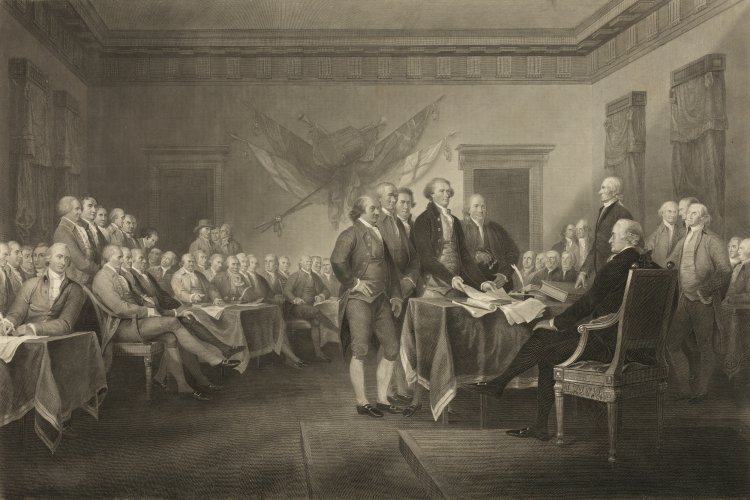
On July 2, 1776, the Second Continental Congress approved the following resolution:
That these United Colonies are, and of right ought to be, free and independent States, that they are absolved from all allegiance to the British Crown, and that all political connection between them and the State of Great Britain is, and ought to be, totally dissolved.
The public statement of these sentiments occurred two days later, memorialized in our Declaration of Independence.
John Adams wrote to his wife Abigail describing his thoughts about that day:
The Second Day of July 1776, will be the most memorable Epocha, in the history of America. I am apt to believe that it will be celebrated, by succeeding Generations, as the great anniversary Festival. It ought to be commemorated, as the Day of Deliverance by solemn Acts of Devotion to God Almighty. It ought to be solemnized with Pomp and Parade with Shows, Games, Sports, Guns, Bells, Bonfires and Illuminations from one End of this Continent to the other from this Time forward forever more.
Our nation has settled on the 4th of July as the official day to celebrate our independence and it remains right to marvel at this most memorable Epocha in the history of humanity. It is proper and appropriate to celebrate our great anniversary Festival, during our semiquincentennial and every year. It ought to be solemnized with pomp and parade from one end of our continent to the other. It must be commemorated with solemn acts of devotion, shows, games, sports, guns, bells, bonfires, and illuminations while being diligently taught to our children.
Interestingly, in addition to unanimously adopting the Declaration of Independence on July 4, 1776, the Second Continental Congress also formed a committee consisting of Benjamin Franklin, Thomas Jefferson, and John Adams to design the seal of our newly declared independent nation. Their designs were ultimately tabled, with a completely new design finally adopted in 1782.
Their drafts, however, powerfully reveal a mindset that dominated the founder’s motivations and perspectives about independence. They saw their courageous act in that moment of time as a Day of Deliverance.
Franklin’s draft of the national seal displayed images of Moses and God’s people in a position of safety on the far side of the Red Sea, with Pharaoh and his men being overwhelmed by the waters. A pillar of fire is central to this design, designating the source of power and strength for God’s people. His recommended motto: Rebellion to Tyrants is Obedience to God.
Jefferson created a draft with a similar theme, displaying the children of Israel in the Wilderness. In his depiction, they were led by a pillar of cloud by day and a pillar of fire by night, demonstrating a powerful image from Exodus 13:21-22:
And the LORD went before them by day in a pillar of a cloud, to lead them the way; and by night in a pillar of fire, to give them light; to go by day and night: He took not away the pillar of the cloud by day, nor the pillar of fire by night, from before the people.
Our Founders saw their departure from British rule as an analogue of the flight of the Israelites from Egypt – observed by some as “the master story of human freedom.” These rebels understood that their revolutionary pursuits and our nation’s independence would only be successful by trusting in God’s direction, day and night. We were on a journey of deliverance away from bondage and toward the promised land of liberty. Our ultimate success must be buoyed by a spirit of dependence and humility.
Today, our ultimate success depends upon the same.
They are the pillars of our success – may we never forget it.
United States Air Force Brig. Gen. John Teichert (Ret.) is a leading expert on foreign affairs and military strategy. He served as commander of Joint Base Andrews and Edwards Air Force Base, was the U.S. senior defense official to Iraq, and recently retired as the assistant deputy undersecretary of the Air Force for international affairs. A prolific author and speaker, he can be followed at johnteichert.com and on LinkedIn.
[ad_2]
Source link
