
[ad_1]
If you communicate with people overseas – friends, family, coworkers – the federal government will likely never acknowledge it collected your communications. Unless, perhaps, you have a large cable TV audience and politicians willing to demand answers. That at least is the lesson to be drawn from records obtained by the Cato Institute through Freedom of Information Act (FOIA) litigation against National Security Agency (NSA).
Those records illuminate two very different cases.
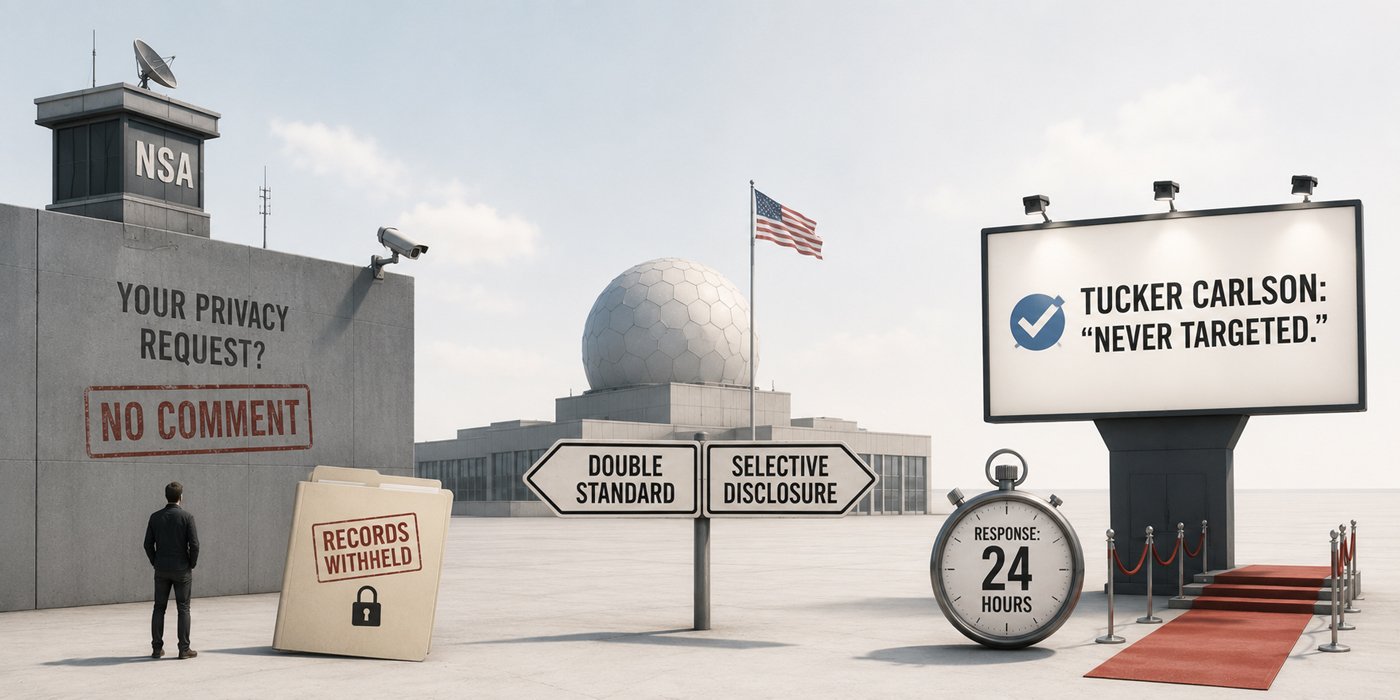
My own experience illustrates the first case. In 2019, I filed a Privacy Act request asking the NSA whether it possessed records mentioning me. Years earlier, while serving as a congressional staffer, I had worked to help free an American constituent detained by Ethiopian authorities and communicated extensively with U.S. officials in East Africa. I wanted to know whether those communications had ever found their way into NSA databases – and specifically the Foreign Intelligence Surveillance Act (FISA) Section 702 database, which sweeps up vast quantities of digital data on Americans even when the actual targets are foreign persons or entities.
The agency refused even to acknowledge whether any records existed, claiming that doing so would set a dangerous precedent. If the NSA confirmed or denied records for one requester, it argued, that would allow “a terrorist or other adversary to file a FOIA request with us in order to determine whether he or she was under surveillance or had evaded it.”It was an absurd, but typical, NSA response to a FOIA request.
In August 2025, documents uncovered during separate FOIA litigation revealed that an NSA public affairs official had attempted to spur a criminal investigation of me over an article I wrote criticizing intelligence whistleblower protection policy. After I submitted another Privacy Act request seeking records related to that episode, the agency again refused to produce them. Only after I filed suit earlier this year did the NSA release emails it had previously claimed it could neither confirm nor deny existed.
In contrast, when then-Fox News Channel host and commentator Tucker Carlson alleged in June 2021 that an unidentified alleged government whistleblower had told him NSA was “monitoring” his communications as part of a plan to “take him off the air,” the agency responded within 24 hours on X that it had never “targeted” Carlson.
Then-House Speaker Kevin McCarthy called for an investigation of NSA, which was subsequently initiated by the NSA Inspector General, not exactly an entirely independent oversight body. That report was not made public, prompting yet another Cato FOIA lawsuit that just last month finally produced the heavily redacted NSA IG investigation report.
The NSA IG backed up NSA’s claim that Tucker Carlson has never been an intelligence target, a real but carefully cabined assertion: we never pointed our collection apparatus at him as its object, the report claimed in effect. It says nothing about whether his incidentally collected communications are in the Section 702 or other NSA databases.
So, here is the question no NSA official has ever had to answer publicly: if acknowledging whether a person has intelligence records is so dangerous that it could aid adversaries, why was the agency able to state within 24 hours that Tucker Carlson he had never been an agency “target”? The agency’s explanation for these two disclosures cannot simply be that one was safe and the other was not. It must explain what principle distinguishes them.
Both cannot be true. Either the national security rationale is false—a doctrine of convenience deployed against ordinary requesters and dropped the instant a famous man makes an agency’s silence politically expensive – or it is real, in which case NSA breached it, in public, for a cable host, and owes the rest of us an explanation for the double standard.
In the age of government mass digital surveillance, neither NSA nor any of its partners should be allowed to get away with these kinds of disclosure games. Changing the law to end this sort of selective disclosure would be a great way to end it.
Patrick Eddington is a senior fellow at the Cato Institute and a former CIA analyst and House senior policy adviser.
Join the Discussion!
We welcome thoughtful and respectful comments. Hateful language, illegal content, or attacks against Antiwar.com will be removed.
For more details, please see our Comment Policy.
[ad_2]
Source link
