
[ad_1]
Photo Credit: Patrick Newman
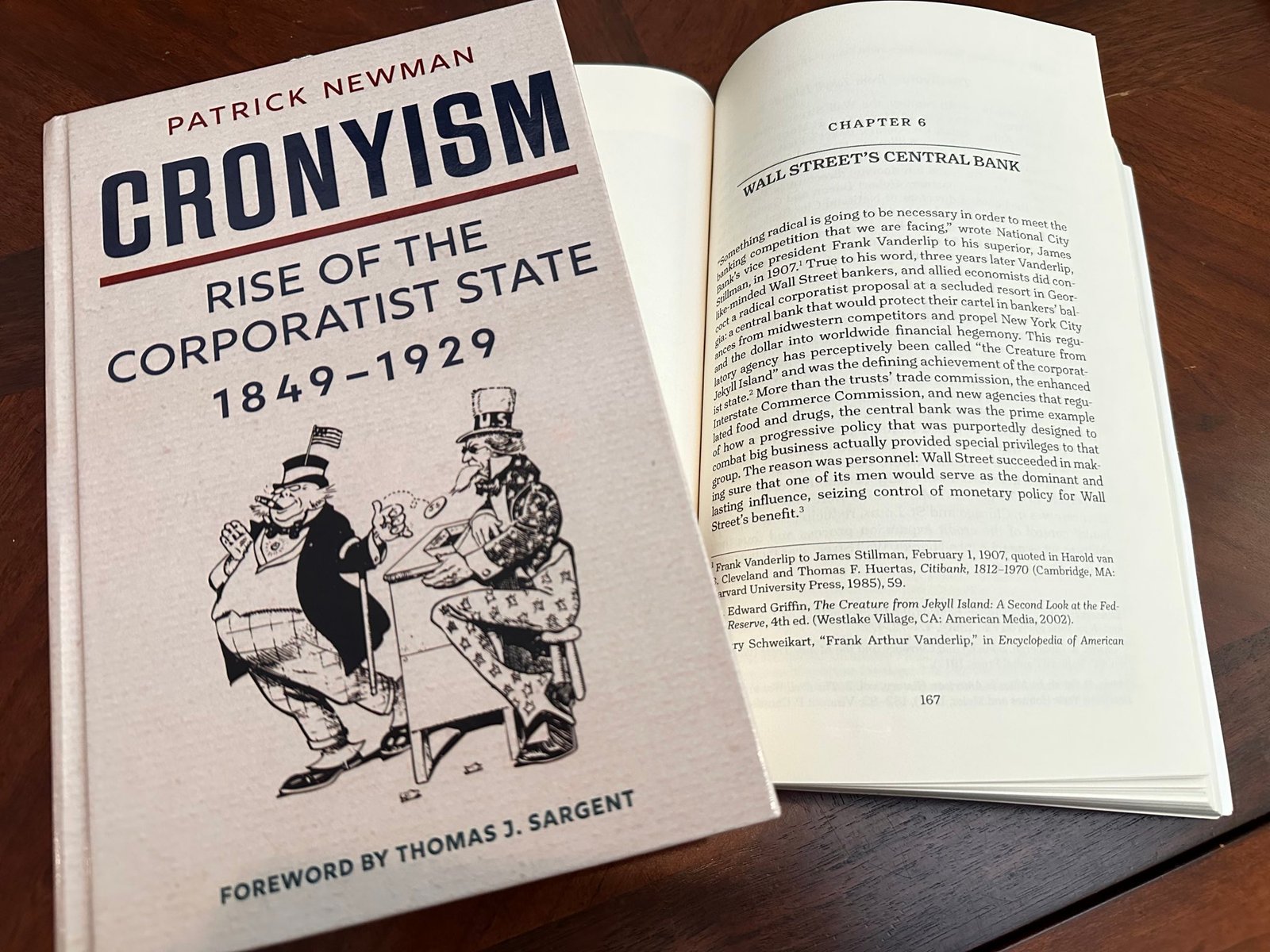
It is an exceedingly rare thing that I eagerly await the release of a book. However, Patrick Newman’s second installment in his series on the history of cronyism in the United States, just published by the Ludwig von Mises Institute, is precisely that. Indeed, ever since the release of the first installment in 2021, Cronyism: Liberty Versus Power in Early America, 1607-1849 was released, I and other similarly impressed readers have been checking regularly for updates as to the progress of the second installment. Well, it has arrived and it does not disappoint!
In Cronyism: Rise of the Corporatist State, 1849-1929 Newman succeeds entirely—and on several levels at that. For while the intertwining of public and private interests in the history of the United States has been ground well-traversed since the rise of the revisionists of the 1950s and 1960s, such as Gabriel Kolko and Murray Rothbard, the work has remained dispersed and disjointed—none had attempted to show the continuity of events, preferring to focus on a particular period, industry, or interest, et cetera. Newman gratifying ameliorates this deficiency by taking as his starting point the inception of the earliest permanent north European settlements of the Continent and proceeds chronologically from there.
With respect to method, it is here that readers receive the absolutely critical benefit of Newman’s proper interpretive framing. Unlike the New Left historians, who following in the footsteps of Kolko, were quick to discern and decry the unholy marriage of state and corporate power, they did so through a polluted framework that saw the state as a pure thing being contaminated by corporate interests. While superficially seductive, this is ultimately only half the story. Following in the footsteps of Rothbard and liberal class theory, Newman correctly presents events so that readers can see the truth: the state is in its very nature criminally extractive, that is the voluntary society versus the coercive society, and that the coercive instrument of centralized control lends itself so easily to intervening in the economy of behalf of connected interests that the thing must be seen as a feature of the institution rather than as a bug.
This is absolutely critical—the fight over narrative is central to rolling back the state, and the near-interpretive monopoly of the court intellectuals makes work such as Newman’s all the more critical.
To these twin successes of comprehensiveness and ideological correctness must be added that most enviable of successes: having made an admittedly dry subject, however interesting, eminently readable to any audience.
As to reading, Newman picks up this second volume where the first left off, at the failure of the Jacksonian revolution to beat back the centralizing forces of power in the state and the drive to use the state to favor big government policies. To that end, Newman begins with the Civil War expansion of the state—the departure of southern Democrats allowing Republicans to enact their long-held Whig program of high tariffs, a national banking system, and massive railroad subsidies (to say nothing of the wartime draft and income tax).
He then moves on to a detailed examination of how industrialists in post-war America turned to the federal government to legally restrict market competition after they had repeatedly tried and failed on their own to maintain private cartels. From there it is a short jump to the Progressive Era proper, with Wall Street and major corporations clamoring for regulations and the creation of regulatory commissions, such as the FDA and Federal Reserve. While advertised as public watchdogs, these were actually used to control market and entry and fix prices.
For those interested in the disastrous policies of the twentieth century, this was the critical period, when so much of the groundwork for the warfare-welfare state was created: the Federal Reserve, the draft, speech laws, federal police, government control of the economy, and the cartelization of key industries under government auspices. Thanks to Newman’s book, readers will arrive at these only at the end, within the proper context, seeing them not as a bolt from the blue but as the logical culmination of long-developing trends, in politics, the economy, and society.
Having left off his narrative in 1929, on the eve of what Garet Garret correctly identified in The People’s Pottage as a “revolution within the form,” we must ardently hope that Dr. Newman will find plenty of time to work on the concluding third volume of his trilogy documenting the failed fight between liberty and power in America.
[ad_2]
Source link
