
[ad_1]
How decades of attacks on Utah’s national monuments culminated in Trump’s latest attempt to erase them.

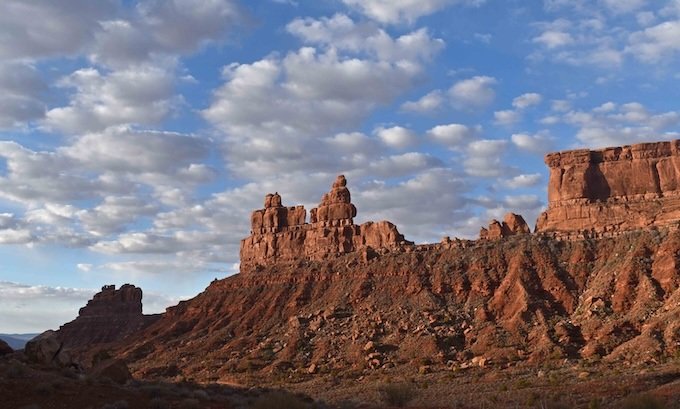
Valley of the Gods. Photo: Erik Molvar.
In southern Utah, two crown-jewel landscapes have been the subject of a political tug-of-war spanning the past 25 years. On one end of the rope, Tribes, conservation groups, and the recreating public have sought – and gotten – expanded protections for Bears Ears and Grand Staircase-Escalante National Monuments. Pulling the other end, the livestock industry, mining corporations, and Big Oil have joined forces with anti-regulation local governments to push to maximize the lands available for extractive use and minimize the protections.
This week, the Trump administration sided with the industrial interests and anti-environmental local governments to slash the two National Monuments by 90 percent, pulling the figurative rope back over to the side of exploitation.
The lands of southern Utah were wrested from the stewardship of multiple Indigenous tribes by EuroAmerican colonization, starting with Father Escalante in 1776. The modern battle over these lands started in 1996, when President Bill Clinton signed a proclamation establishing Grand Staircase-Escalante National Monument, recognizing “a geologic treasure of clearly exposed stratigraphy and structures.” “The monument,” Clinton proclaimed, “contains significant portions of a vast geologic stairway, named the Grand Staircase by pioneering geologist Clarence Dutton, which rises 5,500 feet to the rim of Bryce Canyon in an unbroken sequence of great cliffs and plateaus.” It contains paleontological features like fossils and dinosaur trackways, and cultural sites including Indigenous sites, Mormon pioneer sites, and the Old Paria townsite (a movie set, it turns out). The new Monument spanned 1.7 million acres of public land that are the traditional homelands of the Paiute, Hopi, Ute Mountain Ute, Navajo, and Zuni peoples.

Tower Cave site. Photo: Erik Molvar.
A local history recounts some of the environmental battles that have ensued since Clinton’s proclamation. Andalex Resources, Inc. held claims to potentially-lucrative coal reserves in Smokey Hollow on the Kaiparowitz Plateau, and they scrapped their plans for a strip mine after the Monument was designated. There was controversy around oil and gas drilling by Conoco on state lands within the Monument boundary. And local counties tried to create new roads within the Monument using the obscure Reserve Statute 2477 to establish that livestock trails should be reclassified as county roads. Meanwhile, Grand Canyon Trust began to buy out grazing leases in the Escalante Canyons from ranchers who wanted to retire them because the allotments were too remote, too treacherous, too full of poisonous plants, and too troublesome to be worth continuing their cattle operations.
In 1997, the Utah Association of Counties filed a lawsuit, and Mountain States Legal Foundation filed a companion suit (represented by William Perry Pendley, who later would be appointed interim BLM Director during the first Trump administration), to overturn Grand Staircase-Escalante National Monument. They argued that the century-old Antiquities Act was unconstitutional, that the National Monument was larger than the minimum area necessary to protect the objects of scientific and cultural interest for which it had been designated, and even that the proclamation violated the Wilderness Act by establishing de facto wilderness. They lost on all counts, with a decisive ruling from the District Court in 2004. It stated,
The Proclamation of which plaintiffs complain speaks in detail of the Monument’s natural and archeological resources and indicates that the designated area is the smallest consistent with the protection of those resources. The language of the Proclamation clearly indicates that the President considered the principles that Congress required him to consider: he used his discretion in designating objects of scientific or historic value, and used his discretion in setting aside the smallest area necessary to protect those objects.
Mountain States Legal Foundation appealed (the counties did not), but was found to lack standing to bring forward a legal challenge, and its case was dismissed.

Grosvenor Arch. Photo: Erik Molvar.
The dust did not remain settled for long. In 2013, Rep. Rob Bishop (R-UT) kicked off the Utah Public Lands Initiative (UPLI), a process in which environmental and conservation interests were forced to collaborate with industrial interests, in an effort to put the fate of public lands conservation under “local control.” This process culminated in a bill that proposed to designate a modest Bears Ears National Conservation Area, spanning 857,603 acres. The UPLI bill was deemed by tribes and conservation groups to give away too much public land to industrial interests, so it never gained traction in Congress and ultimately died.
In 2015, five local Tribes – the Hopi, Navajo, Ute, Zuni, and Ute Mountain Ute – abandoned the UPLI proposal and authored the original proposal to protect a National Monument at Bears Ears to protect the abundant cliff dwellings and other archaeological sites, inspiring slot canyons and buttes, and native ecosystems of the Bears Ears area. Conservation groups advocated in support of the Tribes’ proposal, which encompassed potential wilderness like the Grand Gulch Primitive Area, and landmarks like Valley of the Gods, Comb Ridge, Cedar Mesa, and the Bears Ears themselves (a pair of buttes that can be seen from afar, rising from the flanks of the Abajo Mountains). The Tribal proposal was a natural complement to other protected lands in the region, including Canyonlands, Bryce Canyon, and Zion National Parks, as well as tribally-managed Monument Valley immediately to the south on the Navajo reservation.

House on Fire ruin. Photo: Erik Molvar.
Environmental threats began to these lands began to mount, with proposals for uranium mining and oil and gas drilling adding to the chronic degradation of livestock grazing on the fragile biological soil crusts of Cedar Mesa and the surrounding canyon country.
The Obama administration sought to solve the problem while appeasing local anti-conservationists, and instead of designating all of the Bears Ears Tribal proposal, he created a smaller, 1.35 million acre Bears Ears National Monument that lopped off half a million acres to assuage concerns from local governments. Among the lands excluded were Wilson Mesa, the eastern slopes of the Abajo Mountains, and the lands between Red Canyon and White Canyon. But he did add Tribal co-management, a key aspect that the Indigenous governments were seeking. While many were privately disappointed that the resulting National Monument was smaller than it should have been, it was widely celebrated by both Tribes and conservation groups (including WWP) as a major achievement.
The anti-conservation local governments, unsatisfied with the half a million acres that got pulled out of the National Monument at their request, cried foul. But they were powerless to overcome President Obama’s Monument proclamation.
In the spring of 2017, newly-elected President Trump sent Ryan Zinke, his Secretary of Interior, to Bears Ears on a listening tour of the Bears Ears region. He wasn’t a very good listener. In fact, when was asked by an Indigenous representative why he refused a meeting with the Bears Ears Intertribal Council, he scolded, “Be nice. Don’t be rude.”

Ballroom ruins. Photo: Erik Molvar.
This slap in the face of Indigenous interests was the prelude to an even bigger slap in the face: President Trump’s December 2017 proclamation slashing the size of Bears Ears from 1.35 million acres to 121,096 acres in two isolated units. He tried to put a veneer of Indigenous legitimacy on his rescission by renaming Bears Ears the Shash Jáa National Monument. No one was fooled. Gone was Indigenous co-management, replaced by an advisory committee where white representatives would outnumber Tribal ones. Trump’s proclamation also reopened the Grand Canyon Trust’s grazing allotments in the Escalante Canyons to livestock grazing.
The rope was tugged back In 2021, when President Joe Biden issued two new proclamations for Bears Ears and Grand Staircase-Escalante, restoring the original Obama Monuments and adding 13,000 additional acres that were added during the Trump recission. Biden’s Interior developed Monument Management Plans.
Then in 2026, a Congressional Review Act bid to overturn the Management Plan by Sen. Mike Lee (R-UT) and Rep. John Curtis (R-UT) failed as the clock ran out before the resolution could come to the floor. This was a radical move, because the Congressional Review Act overturns not just the federal rule (in this case, a management plan) in question, but also permanently blocks any “substantially similar” rule from ever taking effect in the future. If the CRA had eviscerated the monument plans, the monuments could have been left unmanaged.

Cottonwood Canyon. Photo: Erik Molvar.
And then, last week, the latest pull back over to the side of extraction. According to Trump’s own Fact Sheet on the recent rescission, “One Proclamation reduces the size of the Grand Staircase-Escalante National Monument from approximately 1.87 million acres to approximately 181,500 acres. Another Proclamation reduces the size of the Bears Ears National Monument from approximately 1.36 million acres to approximately 121,100 acres.” Everything else in his Fact Sheet is pure fiction. It’s not “rightsizing” and doesn’t “reduce these monuments to appropriate sizes.” It slashes protections across 90 percent of the public lands that were designated, leaving the majority of the “objects of historic or scientific interest” for which Bears Ears and Grand Staircase-Escalante were designated, completely unprotected. Cliff dwellings. Pictograph panels. Dinosaur tracks. Ancient fossils. An entire staircase of exposed sedimentary layers marching down toward the Grand Canyon, telling the story of eons of geologic creation that took hundreds of millions of years to complete.
The new Monument Proclamations for Bears Ears and Grand Staircase wave away these historically and scientifically important objects by arbitrarily reclassifying them as “generic features and landscapes” or having “relative commonness” throughout the region. If one President protects cliff dwellings and pictograph panels and geologic features as significant, can a later President declare them insignificant? And how do we reconcile this wholesale dismissal of sacred sites?
Under the Antiquities Act, the President “is hereby authorized, in his discretion, to declare by public proclamation historic landmarks, historic and prehistoric structures, and other objects of historic or scientific interest” as National Monuments. Congress did not give the President authority to subtract from National Monuments in any way. Nor did Congress grant a sitting President the authority to second-guess the decisions of a previous President that objects deemed significant from a scientific or cultural perspective and decide that they have suddenly become insignificant. In legal parlance, yesterday’s monument proclamations are an action deemed ultra vires, or “beyond the powers” of the President under the Antiquities Act. Congress makes the law, Presidents sign the law, and future Presidents are required to follow the law.

Cedar Mesa. Photo: Erik Molvar.
But this new Trump proclamation goes even farther, promoting extractive uses within the tattered fragments of the remaining National Monuments, stating that the “Secretaries shall endeavor to authorize traditional land uses within the Monument, such as grazing, recreation, timber management, public access, and infrastructure development, to the greatest extent possible….” (Emphasis added.) It directs federal officials to “consider livestock grazing to constitute a traditional cultural place (TCP) and shall consider how proposed activities will impact that TCP….” That’s another backhanded swipe at the Tribes: The acronym TCP actually stands for Traditional Cultural Property, which refers to tribally-identified cultural sites that are given federal protection under the National Historic Preservation Act.
For more than a century, Presidents have proclaimed national monuments, many of them across very large acreages. Theodore Roosevelt was the first, setting the precedents that still apply today. Roosevelt proclaimed 808,120 acres of public land as Grand Canyon National Monument, to protect “an object of unusual scientific interest, being the greatest eroded canyon in the United States.” He wasn’t trying to appease anybody. This, after the local publication, Williams Sun editorialized that an 1895 congressional bill to protect the Grand Canyon was a “fiendish and diabolical scheme” drawn up by lawmakers “suckled by a sow and raised by an idiot,” and protesting that “the fate of Arizona depends exclusively upon the development of her mineral resources.” Sound familiar? The rhetoric coming out of Utah anti-environmentalists echoes these warped sentiments.
One year after designating the Grand Canyon NM (which later became a National Park), Roosevelt designated Mount Olympus National Monument, encompassing 610,560 acres to protect “numerous glaciers” and “the summer range and breeding grounds of the Olympic elk.” Both the Grand Canyon and Mount Olympus grew to be crown jewels of our National Park System, and economic engines of regional prosperity.
Trump isn’t half the president of Theodore Roosevelt. Not even a tiny fraction. You can tell by the size of his Monuments.

Moki Dugway. Photo: Erik Molvar.
For the Grand Canyon, monument opponents filed a lawsuit, in a case called Cameron v. United States, which went all the way to the Supreme Court. The Supreme Court affirmed that the Grand Canyon is an object of scientific interest and affirmed Roosevelt’s expansive National Monument designation.
So when President Trump trots out the tired old argument that Bears Ears and Grand Staircase-Escalante were not “confined to ‘the smallest area compatible with the proper care and management of the objects to be protected,’” and asserts an “overreach and abuse of the Antiquities Act,” he’s contradicting a century of applicable precedent for the statute.
The Tribes have been swift to weigh in. The Bears Ears Intertribal Coalition stated that this latest Bears Ears proclamation “weakens protections for a living cultural landscape and sacred ancestral homeland that has been cared for by Indigenous peoples since time immemorial.” Grand Staircase-Escalante Inter-Tribal Coalition Coordinator Autumn Gillard, a Southern Paiute, stated of that monument proclamation, “Today’s action is a direct strike against the federal government’s duty to consult with Tribes. It also profoundly disrespects our intergenerational Traditional Knowledge by destroying a framework for Tribal co-stewardship over our ancestral lands in which we invested years of effort. Today’s action cannot stand.”

Bears Ears. Photo: Erik Molvar.
Trump’s Bears Ears proclamation is seven times smaller than the UPLI legislation that was sponsored by Rob Bishop, the most famously anti-environmental Member of Congress – out of 571 in Congress – at the time. Congratulations, Mr. President, you have won the race to the bottom. We’ll see you in court.
[ad_2]
Source link
