
The Iran war has widened the gulf between the United States and once-Great Britain. President Trump threatened to withdraw from NATO in retaliation for Britain’s unwillingness to join the war. He said Prime Minister Keir Starmer is “not Winston Churchill”, and that the Special Relationship is imperiled by Starmer importing and appeasing Muslim voters “from foreign lands who hate you.” All true—but Trump has given a boon to Britain’s most hated prime minister on record, because Starmer’s decision to abstain from the war, unpopular on both sides of the pond, looks prudent.
Iran now controls the Strait of Hormuz, holding 20 percent of the world’s oil hostage, and is financing the rebuilding and rearmament of their country via a toll on commercial shipping vessels. This allows them to bypass American sanctions and impose the cost of the war on Europe and Asia. If the conflict continues, millions of Iranians, Afghans, Iraqis, Syrians, Kurds, Lebanese, and even Indians fleeing famine induced by fertilizer shortages could migrate to Europe. Should Israel continue to escalate tensions with Turkey, President Recep Tayyip Erdoğan may refuse a detention deal with the EU and let them flood through the Balkans into Germany, France, and Britain.
Thanks to Trump, Starmer has a mandate to reverse Brexit, weaken ties with Washington, and realign with Brussels. The vital work of the State Department, pressuring Britain’s government to stop mass migration and censoring critics, has been compromised. The promise of last November’s National Security Strategy, to help save Europe from forces of “civilizational erasure,” seems a distant memory. When Chris Caldwell wrote in the Spectator, “the mutual respect between [Trump] and his movement has been ruptured, and his revolution is essentially over,” he spoke as much for nationalists abroad as he does in America.
Europe’s patriotic parties are now distancing themselves from MAGA. Germany’s AfD condemned the war as “a catastrophe.” France’s National Rally said it was “carried out blindly” without considering “catastrophic consequences” for global gas prices. No wonder, perhaps, that Vice President J.D. Vance’s visit to Budapest did not seem to do much for Viktor Orban’s Fidesz, which just lost the Hungarian elections. As Carl Benjamin said, nobody wants to get “Mark Carney’d.” For nationalist movements to survive, they must divorce the platform of mass deportations from Trump’s fading fortunes.
In Britain, looking like an American vassal is electoral suicide. We have the highest energy prices in the developed world, and source most of our oil and gas from exports, because successive Labour and Conservative governments refused to frack or drill North Sea reserves. Without a national gas or nuclear company, Britain is exposed to fluctuations in global energy markets. The closure of the Strait of Hormuz hits us hardest, so any party cheerleader for the Iran war will be punished once rising fuel costs hit voters’ paychecks.
Three parties on the nominal right are fighting to succeed Starmer. The Conservatives remain irrelevant: led by a first-generation Nigerian immigrant after 14 years of record immigration, and with no credibility that they will reverse the ruinous high taxes and net zero policies they imposed. Kemi Badenoch, the party’s leader, called for the UK to strike Iranian missile sites—to which critics responded, “With what military?” The government in which Badenoch was a minister used DEI to exile “useless white males” from the armed forces, depleting reserves to their lowest level since the Napoleonic wars. While defense spending received a real-terms cut—£59.2 billion in 2010, to £62.2 billion in 2024—the welfare bill exploded from £119.3 billion to £334 billion today. Labour’s defense minister can’t say how many frigates the Royal Navy has, but the former Tory Chancellor Jeremy Hunt MP thinks we should play “the world’s policeman” without America. Their unwillingness to learn from the 2024 “Zero Seats” election wipeout renders them obsolete.
The battle before the next election will be between Nigel Farage’s Reform UK and Rupert Lowe’s Restore Britain. Previous articles in The American Conservative have mischaracterized the divide between the parties. Ian Macwhirter called Restore “far-right” and praised Farage’s efforts “to be seen as not racist and even relatively moderate on immigration.” To capture a mythical center, Reform has softened its rhetoric and welcomed Tory defectors responsible for the last 14 years of failure. In Reform, “full-fat nationalisation is out,” says the insider James Heale, and centrist “Diet Coke conservatism” is in, according to the Tory merger shepherd Mark Littlewood. This leaves Restore as a new, anti-establishment alternative.
The split occurred when Farage and Reform’s immigration spokesman Zia Yusuf banished Lowe, then part of Reform UK’s small parliamentary delegation, from the party. They even filed a false police report against him, causing his home to be raided and his firearms confiscated. Farage justified this by saying Lowe’s promise to deport the perpetrators and collaborators of Pakistani child rape gangs was “way beyond the point of reasonableness, decency, morality,” and “was the moment at which I realised we just had to get rid of him as quickly as we could.” Farage has consistently denounced mass deportations as a “political impossibility” and a “very grave, dark, and dangerous use of rhetoric”. He only made a U-turn after Trump made it clear, via intermediaries, that he would not support Farage if he countersignalled his 2024 campaign platform.
The fear of losing Trump’s favor may explain why Reform was so bellicose when the war began. In February, Farage thundered that Starmer was wrong not to “back the Americans in this vital fight against Iran!” The party’s deputy leader, Richard Tice, said that Trump’s strikes had “done the West a huge, huge favor.” In an interview for Saudi state-owned Al Arabiya, Tice called to “completely degrade and remove all military capability of Iran,” and said, were Reform in government, “we would be helping the Americans and the Israelis in any way they saw appropriate.” As the party’s energy spokesman, he dismissed the resultant rising costs of energy as “short term bumps.”
While keen to subordinate Britain’s national interest to protecting Israel, when asked what he thought about white Britons becoming a minority in their own country by 2063, Tice once responded, “It’s a long way off…. I’ll be long gone.” Likewise, Farage said demographic change in Britain is not his concern. Were Jews set to become a minority in Israel, I doubt he would be so nonchalant: Farage once said it was vital for Israel to fight Iran for Jews “to survive as a race.”
Other Reform personnel encouraged Britain to bomb Iran. Suella Braverman, the former Conservative home secretary and now Reform’s education spokeswoman, chastised Starmer for disappointing “our greatest ally.” Braverman was chair of Conservative Friends of Israel, and is now part of Reform’s Friends of Israel and Jewish Alliance groups. The former appointed Jason Pearlman, ex-advisor to Israel’s President Isaac Herzog, as its director. The latter is led by Gary Mond, who is Chairman of the National Jewish Assembly and describes himself as “fiercely Zionist.”
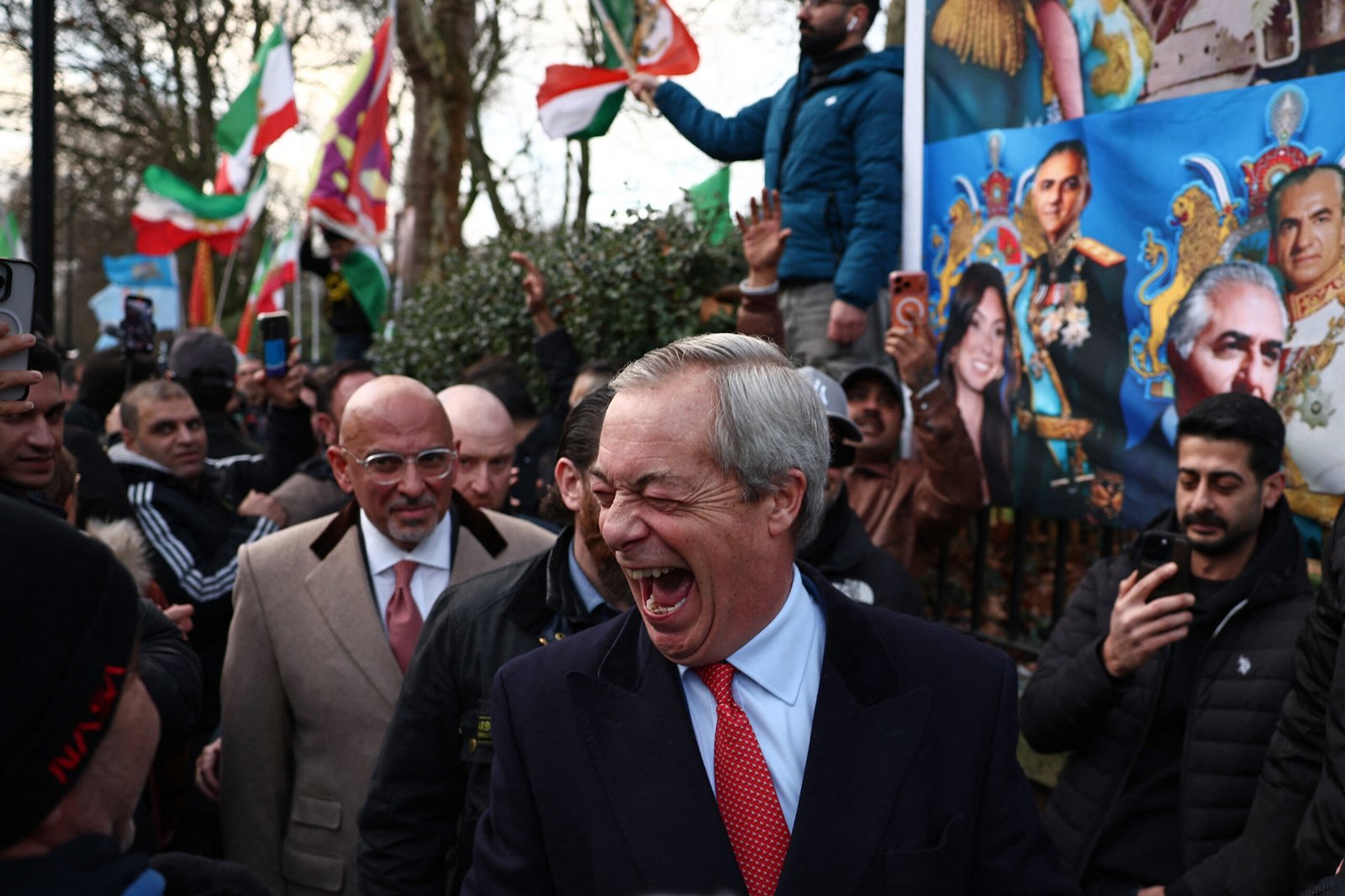
Braverman’s rival for foreign affairs spokesman, the Iraqi-Kurdish immigrant and fellow Tory defector Nadhim Zahawi, joined the party, close sources tell me, because Reform’s promise to proscribe the Muslim Brotherhood makes his business dealings in the Middle East easier. Farage made that promise to members of the Emirati government, who paid for Farage’s visit in December. Zahawi isn’t a natural fit for Reform: during his time as a minister he imposed vaccine passports, proposed amnesty for illegal immigrants, and defended legal migration so that Somalians could send money home in remittances. But in January, during the American-backed protests in Tehran, Zahawi joined the party, and attended a protest outside the Iranian Embassy in London, where Farage wept. Zahawi also accompanied Farage to meet UAE ministers in Dubai in January.
It’s clear that Reform’s senior personnel are invested in the Iran War, Israel, and the Middle East. But, when allies of Vance within Reform got wind that the war could sabotage the vice president’s chances in 2028, Robert Jenrick, the Tory defector and Farage’s would-be successor, pivoted, writing, “We have too many problems at home to be joining in foreign wars.”
“Reform’s position is simple,” Jenrick insists. “The Iranian regime is wicked, but this war needs to come to an end as soon as possible because it is making Britain poorer.” He reiterated that Farage “immediately ruled out suggestions that the UK might deploy boots on the ground” or that “British aircraft should become involved in offensive action.”
Such rhetoric is atypical for Jenrick, who, as a Conservative MP, voted for intervention in Syria throughout 2014–2015. As housing minister, Jenrick helped the Dubai-based Jewish media magnate, Conservative donor, and pornographer Richard Desmond evade £45 million in property taxes on a £1 billion housing development project. While campaigning for the Conservative party leadership in 2024, Jenrick told the audience at a Conservative Friends of Israel event that the Star of David should be displayed at “every airport and point of entry to our great country” as a “symbol that we support Israel, we stand with Israel.” If the Foreign Office or the civil servants refused to relocate the British Embassy to Jerusalem, Jenrick promised, “I will build it myself.” Jenrick also served as immigration minister in Rishi Sunak’s government, and supervised the smuggling of thousands of Afghan tribesmen, Taliban fighters, and sexual predators into Britain, describing it as “a national project.” “Invade and import” is both the worst part of neoconservatism and a summary of Jenrick’s career until last month.
The following week, however, Farage said “we should be supporting the Americans.” When asked whether he shared Reform’s Mayor of Greater Lincolnshire, Dame Andrea Jenkyns’s, desire to see “boots on the ground,” he replied, “What boots? We haven’t got any.” It seems the only thing stopping Reform from committing Britain to another war in the Middle East is our impoverished military capacity, which they promise to replenish in government. Should the ceasefire fail, or hostilities resume in a year’s time, the hands carrying Reform’s Ming vase into Downing Street will no doubt beat the drums for war in Iran again.
Reform’s instincts are liberal, counter-jihad (not anti-Islam), and Zionist. They won’t ban visas for Indian, Pakistani, or Turkish nationals for fear of jeopardizing trade deals or losing leverage in negotiations between those countries, Israel, and the Emirates.
On the other hand, Restore Britain’s Rupert Lowe responded to the war’s start by saying, “Britain has enough problems—we should not be bombing Iran.” Lowe committed unambiguously to “ZERO British troops on the ground—in Iran or Ukraine,” and wrote that “A Restore Britain Government would not spend billions bombing Iran. Instead, we would deport millions.” Lowe agrees with the postwar government that gave up the mandate over Palestine in the first place: Governing the region is a thankless task and more trouble than it’s worth.
When Tice suggested Britain should take “the good people” from Iran as refugees, Lowe said, “No more asylum seekers, from Iran or anywhere else.” While Reform contemplates sanctions on nations who refuse to repatriate their criminal nationals, Lowe has promised outright bans on legal migration from India, Pakistan, and other third-world countries. As for those already here? “Millions must go.”
Unlike Reform UK, Restore is not infested with the vested interests and members of the repudiated neoconservative establishment whom Farage welcomed with fireworks and fanfare. This fresh start has even generated interest in Washington, DC among young Trump-appointed staffers disillusioned by the administration getting distracted from its domestic deportations agenda by foreign entanglements. They want MAGA to be more like Restore.
Subscribe Today
Get daily emails in your inbox
The big question is not whether Restore is preferable to Reform, but whether the new party stands a chance at winning an election. Reminder: There is more time between now and the next election in 2029 than between now and the last. In that time, Reform has surged from 10 percent, to five MPs, to topping the polls, to dropping below the threshold necessary for a Parliamentary majority. It’s all to play for.
Britain’s demographic and fiscal straits are too dire for Farage’s carnival barking, half-measures, and bellicosity. We aren’t a piggy-bank for the Third World or a munitions factory for the Middle East. We need a nationalist party, willing to represent its native people, and which focuses on regaining our national sovereignty and demographic security rather than fighting wars for foreign states.
Restore Britain intends to do just that—and to his detractors, Lowe responds, “I don’t care.”
