
[ad_1]
America’s drift from republican to imperial law is not new, even if no one has so named it. Now — after the Supreme Court crashed out a spate of preposterously corrupt, end-of-term decisions — it is time.
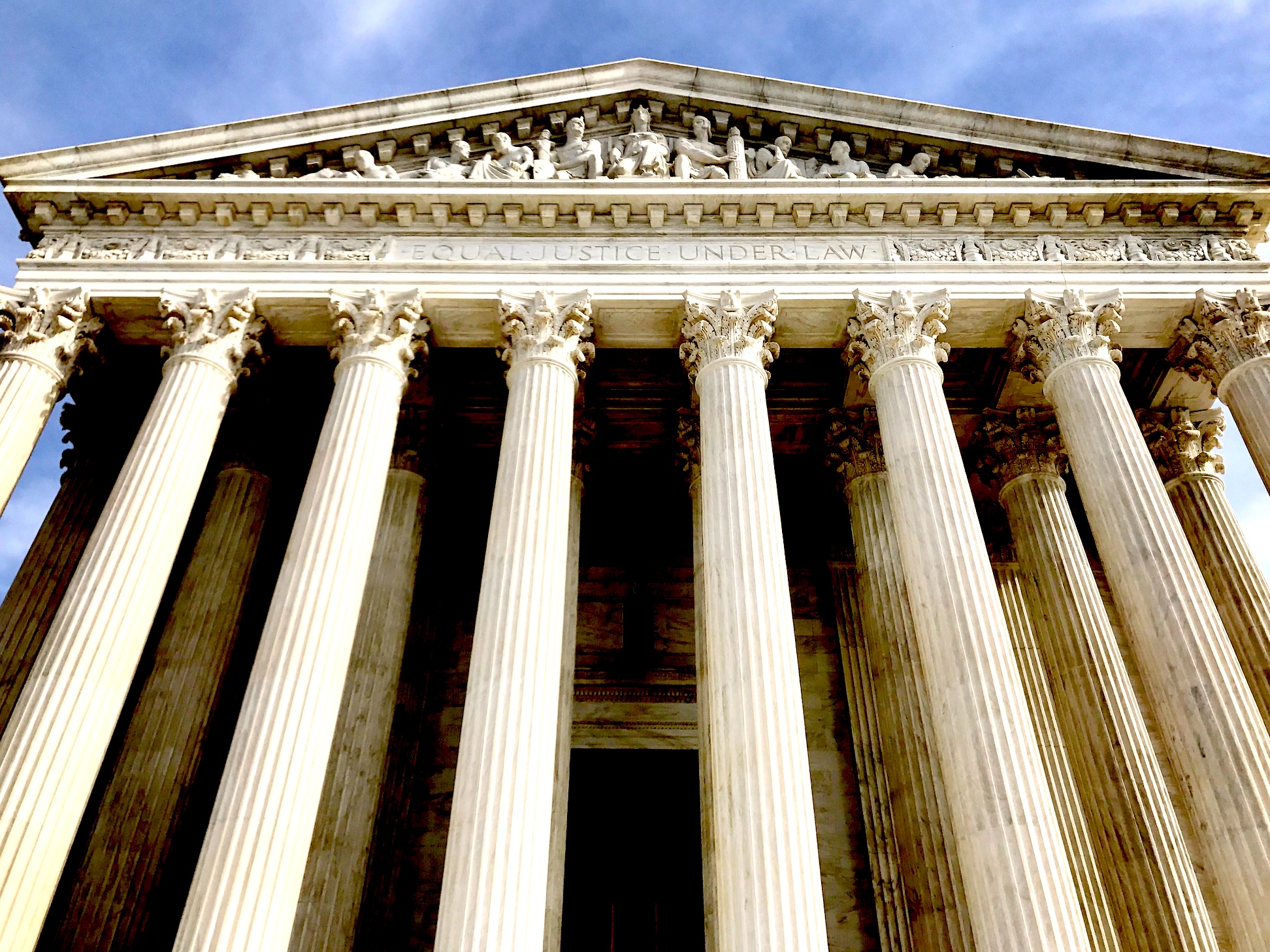
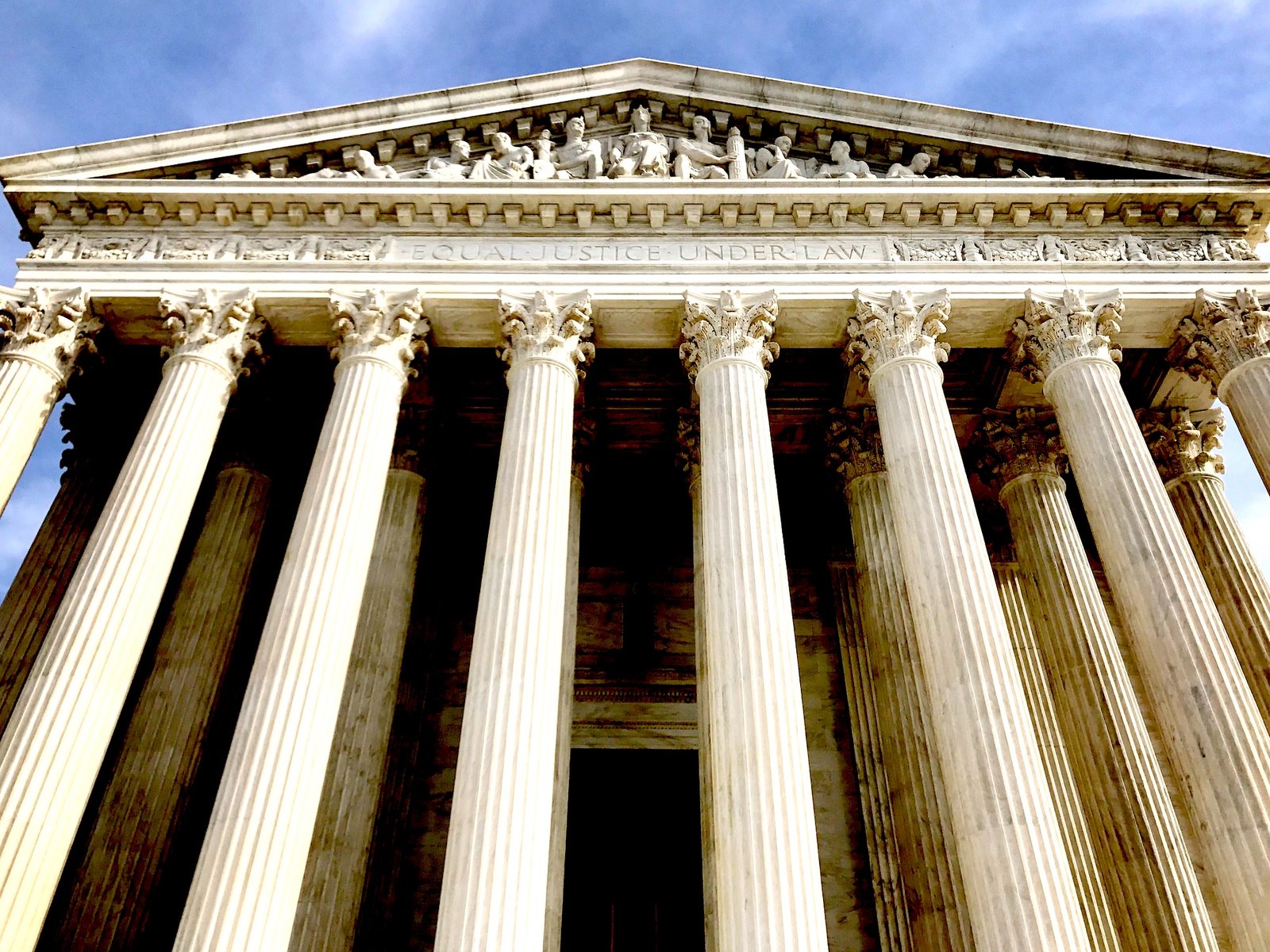
Columns of the U.S. Supreme Court building. (Ron Coleman/Flickr/ CC BY-NC 2.0)
By Patrick Lawrence
Special to Consortium News
 “The laws of a nation form the most instructive portion of its history.”
Let me share my emphatic agreement with this simple but profound assertion before I identify the citation. The law of any land, apart from its function as the basis of order and a given idea of justice, can be usefully read as a reflection of the values, purpose and priorities of said land and its inhabitants.
The same can be said of all sorts of social, economic and political institutions and practices. Regulatory regimes, tax regimes, electoral systems, welfare systems, school systems: Whatever their actual use and however they work, these are cultural artifacts. You discover who people are and what matters to them as you learn to read into how they manage themselves. It is not a complicated thought. I figured this out during my years as a correspondent in faraway places.
O.K. “The laws of a nation form…” This is Edward Gibbon in Chapter 44 of The History of the Decline and Fall of the Roman Empire, his famous discourse on jurisprudence from the formation of the republic to Rome’s descent into tyranny and empire during the reign of Augustus, the 41 years from 27 B.C.E. to 14 C.E.
It is time now to consider Gibbon’s thought as it obtains in the America of the 21st century. I am prompted to this conclusion by the recent session of the Supreme Court, a hyper-charged spectacle of ideological fervor that seemed at times to veer toward pandemonium. The United States has been running an empire, ever more aggressively and obviously, more or less since the 1945 victories. Ever more aggressively and obviously, the nation’s judicial system comes to serve an imperium rather than a republic.
This was the message the Court had for Americans, via a series of preposterously corrupt decisions, a number of them openly unconstitutional, as it concluded its annual session on June 30.
There is no surprise here, or shouldn’t be. W.E.B. Du Bois, the historian and social critic, was among the first to dismiss the prevalent assumption — this was in 1935, in his Black Reconstruction in America — that America could stay true to its democratic ideals while aggrandizing itself as a potent global power. Du Bois considered this “the cant of exceptionalism,” in the useful phrase of David Levering Lewis, his biographer.
No, the only surprise as the Court crashed out a spate of end-of-term decisions is how brazenly it broke the laws and precedents it is supposed to uphold. It was saving the best for last, you see.
The Court handed down all sorts of decisions on questions of greater or lesser importance — gun rights, the rights of transgender athletes, the death penalty, religious freedoms — that do not bear directly on the character of the judicial system and what purpose it serves. It is the judgments that shifted American law so dramatically from democratic to un– that call to mind Gibbons’s observation.
The two most offensive of these concern presidential power and the place of money in American elections. In the latter case — brought by none other than J.D. Vance four years ago — the Court lifted the limits on direct spending on political campaigns. This is the old money-as-speech charade, extending the fateful Citizens United decision of 2010. Never mind there is rarely any talk of campaign finance anymore. The phrase seems almost quaint.
Executive Power
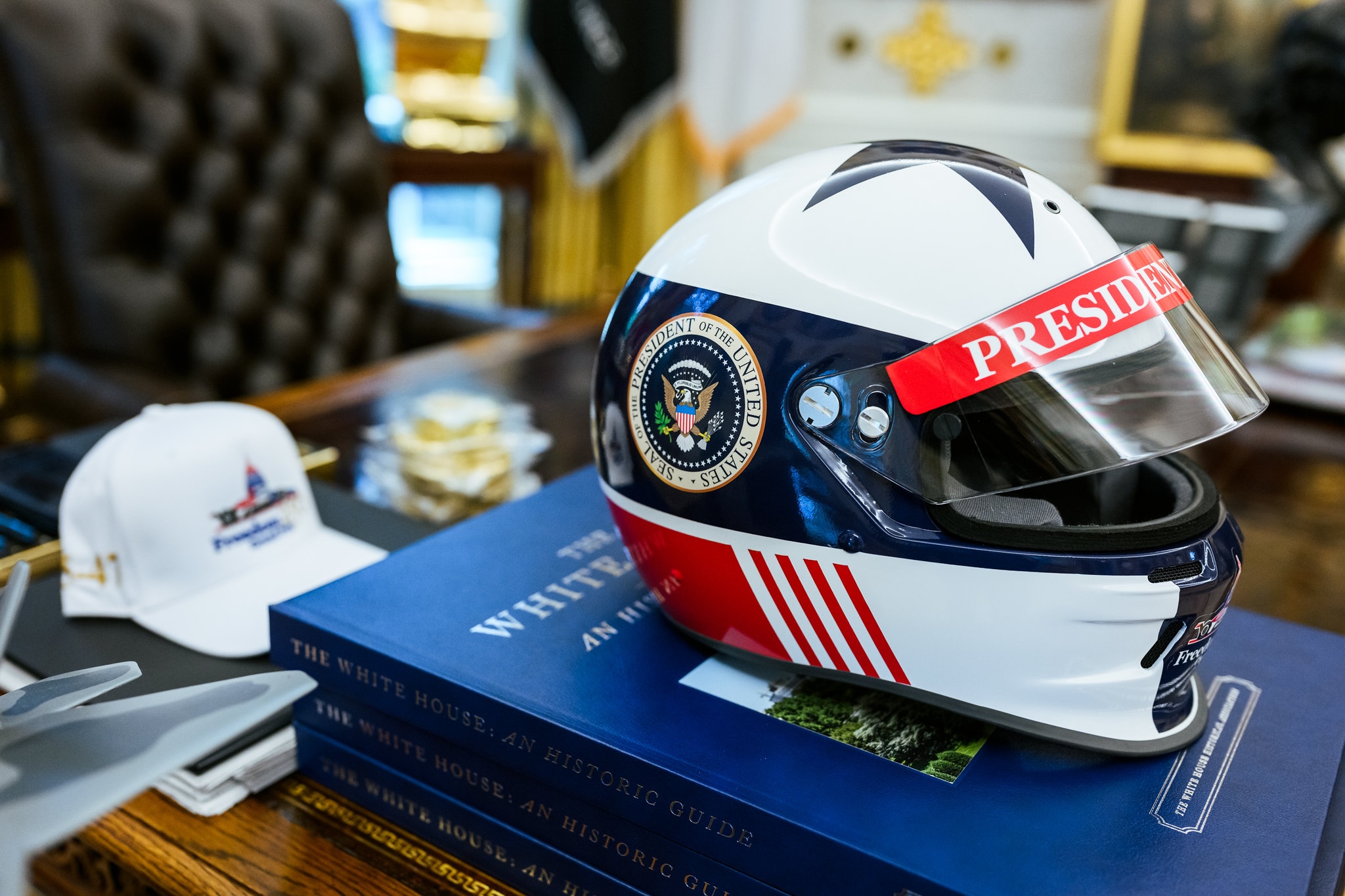
A gift for the U.S. president before a Freedom 250 Grand Prix Showcase on West Executive Avenue at the White House on Monday. (White House/Fllickr/Daniel Torok)
The ruling on executive power gives the president the authority to fire those running regulatory agencies — two dozen or so — with or without cause and for whatever reason or none. Out the window now with the independence of government officials who have heretofore been constitutionally protected from political pressure.
At issue here is the separation of powers — a founding principle, of course — a 112–year-old law limiting presidential prerogative on these questions, and a 1935 Supreme Court ruling reaffirming this law in a specific case in point.
Just what America needs with Donald J. Trump in the White House.
“Today this Court undoes centuries of political practice and concludes that all three branches of government have been acting in open defiance of the Constitution all this time,” Justice Sonia Sotomayor wrote in a dissenting opinion she read, unusually, straight from the bench. “The one thing that does appear to be clear going forward is that chaos will follow.”
Other rulings, among numerous: Those kindly people at Homeland Security will now refuse entry to those seeking asylum in the United States without even a hearing to determine their status. Nothing for these people: It is summary justice from here on out. In keeping with the Trump regime’s Draconian campaign against immigrants, Haitian and Syrian migrants, who number well into six figures, will now be subject to deportation even if they are in the United States legally.
Empty Form & Popular Delusion

U.S. Immigration and Customs Enforcement and Removal (ICE) agents during an operation in Los Angeles in June 2025. (DHS /Tia Dufour)
These last two decisions prompted outrage from Sonia Sotomayor and her liberal colleagues on the bench, including gasps in the gallery and, I am reading, “primal screams” and “incandescent anger.” All to be understood. Taken together with the radical expansion of executive power and the stripping away of what remained of limits on money in politics, these decisions fundamentally change what Americans (or anyone else) mean when they refer to “America.”
These were all or mostly 6–3 decisions, the Trump-subservient majority carrying the session against the three liberal justices. The Court ruled against Trump’s interests and preferences in a couple of cases, which I read as cover for the Court’s evident allegiance to the Trump agenda. Restricted voting rights, the rampant gerrymandering to the advantage of reactionaries: It is all there. Arthur Schlesinger published The Imperial Presidency (Houghton Mifflin, 1973) during the late-Nixon years. That era seems not quite benign but nearly, given the docket the Supreme Court just ruled upon.
As Dorothy famously told her dog as they came upon the Land of Oz, “Toto, I’ve a feeling we’re not in Kansas anymore.”
Gibbon is superb on the diabolic craft with which Augustus transformed republican law into the law of imperial tyranny. He understood, as Gibbon did, people’s givenness to delusion and their common need to think they still had what had been taken from them.
Augustus’ method rested on careful nomenclature, the naming of things so as to mislead. Let the assemblies continue to assemble, let the Senate remain the Senate, but only as empty form, for empty form will be enough to satisfy the popular need for delusion. In an exceptional turn of political spectacle, Augustus bowed to the Senate, which then voted to approve his dictatorial authority. “With its power,” as Gibbon neatly sums this up, “the Senate had lost its dignity.”
Here is the English historian in a nicely clarifying passage from Chapter 3, his account of Augustus’ rise to power:
“Augustus was sensible that mankind is governed by names; nor was he deceived in his expectation that the senate and people would submit to slavery, provided they were respectfully assured that they still enjoyed their ancient freedom.”
Brilliant — and pertinent if you ask me. And in a nearby passage that seems à propos in the Age of Trump:
“It was dangerous to trust the sincerity of Augustus; to seem to distrust it was still more dangerous.”
When a nation’s judicial system gives way to corruption or ideology or simply power, I have long argued, it stands at the precipice of failed-state status. I saw this in the course of my correspondent years. It holds as a truth. It is the American condition as I read it. America’s drift from republican law to imperial law is not new, even if no one has so named it. Now it is time.
Let us refuse the temptations of self-delusion and get our nomenclature right. America is a lot less democratic now and a lot more imperial than it was before the Supreme Court finished its yearly business on June 30. Is this to be counted anything other than a failure whose magnitude is hard to overstate?
Patrick Lawrence, a correspondent abroad for many years, chiefly for the International Herald Tribune, is a columnist, essayist, lecturer and author, most recently of Journalists and Their Shadows, available from Clarity Press or via Amazon. Other books include Time No Longer: Americans After the American Century. His Twitter account, @thefloutist, has been restored after years of being permanently censored.
TO MY READERS. Independent publications and those who write for them reach a moment that is difficult and full of promise all at once. On one hand, we assume ever greater responsibilities in the face of mainstream media’s mounting derelictions. On the other, we have found no sustaining revenue model and so must turn directly to our readers for support. I am committed to independent journalism for the duration: I see no other future for American media. But the path grows steeper, and as it does I need your help. This grows urgent now. In recognition of the commitment to independent journalism, please subscribe to The Floutist, or via my Patreon account.
The views expressed are solely those of the author and may or may not reflect those of Consortium News.
Please Donate to
CN’s Summer
Fund Drive!


[ad_2]
Source link
