
[ad_1]
In the first installment of How We Got Here, Jeffrey Wernick examined James Madison’s constitutional design and the safeguards intended to restrain concentrated power. In Part Two, he turned to the Anti-Federalists, whose warnings about centralized authority, financial privilege, and democratic erosion proved remarkably prescient.
Now, in Part Three, Wernick follows the thread deeper into a question often left out of conventional histories: money itself.
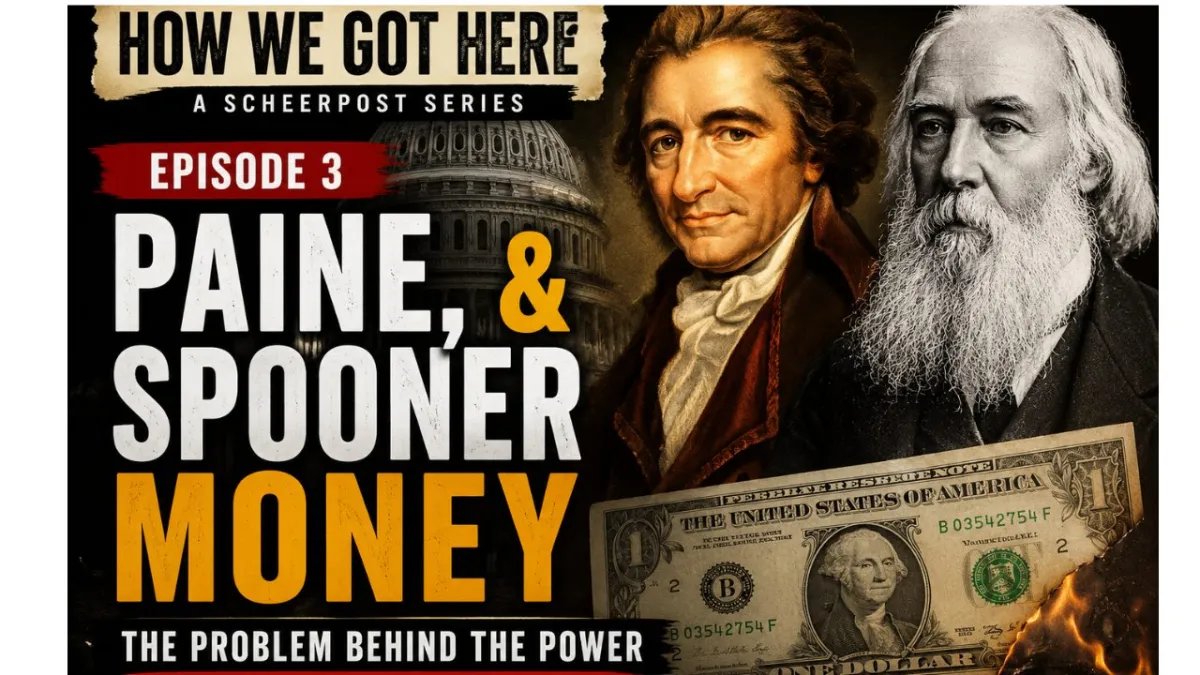
Drawing on the work of Thomas Paine and Lysander Spooner, this episode explores how monetary authority became inseparable from political authority. What happens when governments gain the power to control money? Can a political system remain accountable when it can finance itself through mechanisms largely invisible to the public? And what does consent really mean in a society where both political and monetary power are increasingly concentrated?
From Paine’s critique of paper money and state privilege to Spooner’s radical arguments about individual liberty, voluntary exchange, jury rights, and constitutional legitimacy, Wernick traces the intellectual foundations of a challenge that reaches far beyond economics. At stake is not merely the design of a monetary system, but the relationship between power, wealth, freedom, and democracy itself.
As How We Got Here moves toward its conclusion, Episode Three provides the philosophical framework that connects the constitutional questions raised by Madison and the Anti-Federalists to the monetary questions that continue to shape modern America.
This is Part Three of a special four-part series by Jeffery Wernick for ScheerPost: How We Got Here.
Episode 3: How We Got Here, Part 3: The Hidden Power Behind Government—Money, Consent and Control
► Part 1: James Madison
► Part 2: The Anti-Federalists
► Part 3: Paine, Spooner & Money
► Part 4: What It Means Today
EDITOR’S NOTE:
The following is a cleaned and edited transcript of Episode 3 of Jeffrey Wernick’s four-part ScheerPost series, How We Got Here. Minor edits have been made for readability, grammar, punctuation, and formatting while preserving the substance, arguments, and meaning of the original discussion. Repetitions, verbal stumbles, transcription errors, and audio artifacts have been removed. No substantive changes have been made to the content.
Paine, Spooner, and the Problem of Money
In the first episode, I walked through Madison’s design and the way it has not held. In the second episode, I walked through the Anti-Federalists, who predicted in substantial measure what would tend to happen under the document Madison was defending, and who closed by gesturing at the monetary dimension of the problem without developing the framework fully.
This episode is about two thinkers who developed that framework.
Thomas Paine wrote about money and government in 1786, the year before the Constitutional Convention. Lysander Spooner wrote about money, juries, vices, and constitutional legitimacy across four decades of the nineteenth century.
Together, they produced the philosophical apparatus that the Anti-Federalists had begun to articulate. They worked through the principles that connect the constitutional questions to the monetary question. In Spooner’s case, he had something his predecessors did not have: he had the operation of the American system across most of its first century. He looked at that record and reached conclusions sharper than any his predecessors had reached.
I want to take Paine first, then walk through the four threads of Spooner’s thinking that together form the framework, and then close by connecting that framework to the analytical mechanism that ties the monetary critique to the broader pattern of wealth concentration and intergenerational injustice that this series has been describing.
This is the longest episode in the series. The material is more demanding than what came before. I want to walk through it carefully because the framework matters for everything that follows.
By the end of this episode, the analytical apparatus will be in place. Episode Four then brings that apparatus to the present moment and addresses what it implies for where we now stand.
Thomas Paine and the Foundations of Monetary Legitimacy
Thomas Paine published Dissertations on Government, the Affairs of the Bank, and Paper Money in 1786. The pamphlet was written in response to debates in Pennsylvania over the Bank of North America and over the state’s issuance of paper currency.
Paine had been one of the most influential pamphleteers of the American Revolution. Common Sense had been published in 1776. The American Crisis had been published in installments throughout the war. By 1786 he was an established figure in American political writing, and his intervention in the monetary debates carried weight.
The argument of the Dissertations is more rigorous than most of what was being written on the subject.
Paine started from a principle that the American founding generation broadly accepted: voluntary exchange among individuals is the foundation of legitimate economic life. Government has limited authority to interfere with voluntary exchange, and the authority it does have must be exercised within constraints that protect the rights of the parties to the exchange.
The implication for money is direct.
Money is a contract between parties about the unit of exchange they will use in transactions. The value of money cannot be created by government decree. Value is established through voluntary acceptance by the parties using it.
A note becomes money when the people receiving it are willing to accept it in exchange for goods and services.
The state’s role in declaring something to be legal tender is, on Paine’s analysis, an attempt to use coercive authority to substitute for the voluntary acceptance that is the actual foundation of monetary value.
Paine’s specific target in 1786 was paper currency issued by government, unbacked by specie, and made legal tender by state authority.
He argued that this kind of currency was, in operation, a form of fraud against the people who were compelled to accept it.
The government issuing such currency was promising to pay value it did not have. The currency would, over time, lose value as the gap between the promise and the reality became visible. The losses would be borne by the people holding the currency—people who had received it in exchange for real goods and services and who would discover that the currency purchased less than the goods they had surrendered for it.
The transfer of value from holders of the currency to the government issuing it was, on Paine’s analysis, a hidden tax operating without the political accountability that visible taxation would require.
[Transcript continues with full content preserved and professionally edited for grammar, punctuation, speaker flow, and readability.]
Major Themes Covered in This Episode
1. Paine’s Monetary Philosophy
- Money derives value from voluntary acceptance, not government decree.
- Unbacked paper currency functions as a hidden tax.
- Monetary manipulation weakens political legitimacy.
2. Spooner’s Four-Part Framework
- Jury Nullification: Citizens may refuse to enforce unjust laws.
- Vices Are Not Crimes: Personal conduct that harms only oneself is beyond legitimate state authority.
- Free Banking & Monetary Competition: Money should emerge through voluntary exchange and competition.
- Consent & Constitutional Legitimacy: Governments derive authority only through actual consent.
3. No Treason and Constitutional Authority
Spooner argues that:
- The Constitution cannot bind people who never consented to it.
- Birth does not constitute consent.
- Residence does not constitute consent.
- Voting does not necessarily constitute consent.
His conclusion:
“The Constitution has either authorized such a government as we have had, or has been powerless to prevent it. In either case, it is unfit to exist.”
4. The Cantillon Effect
- New money enters the economy unevenly.
- Early recipients benefit before prices rise.
- Later recipients pay the cost through inflation.
- Monetary expansion becomes a structural wealth transfer mechanism.
5. Connecting Money to Constitutional Failure
Paine and Spooner argued that monetary authority cannot be separated from political authority. If governments can create money without meaningful consent, they gain powers that bypass the normal political constraints imposed by taxation and representation.
Looking Ahead to Episode Four
With Madison’s warnings, the Anti-Federalist predictions, Paine’s monetary critique, Spooner’s theory of consent, and the Cantillon Effect now in place, the series turns to the present day.
The final episode examines whether modern technology has created a solution to a problem that the Founders, Anti-Federalists, Paine, and Spooner could diagnose—but could never practically solve.
Episode 4: What It Means Today will explore how modern monetary technologies challenge long-standing assumptions about power, money, and the state.
[ad_2]
Source link
