
[ad_1]
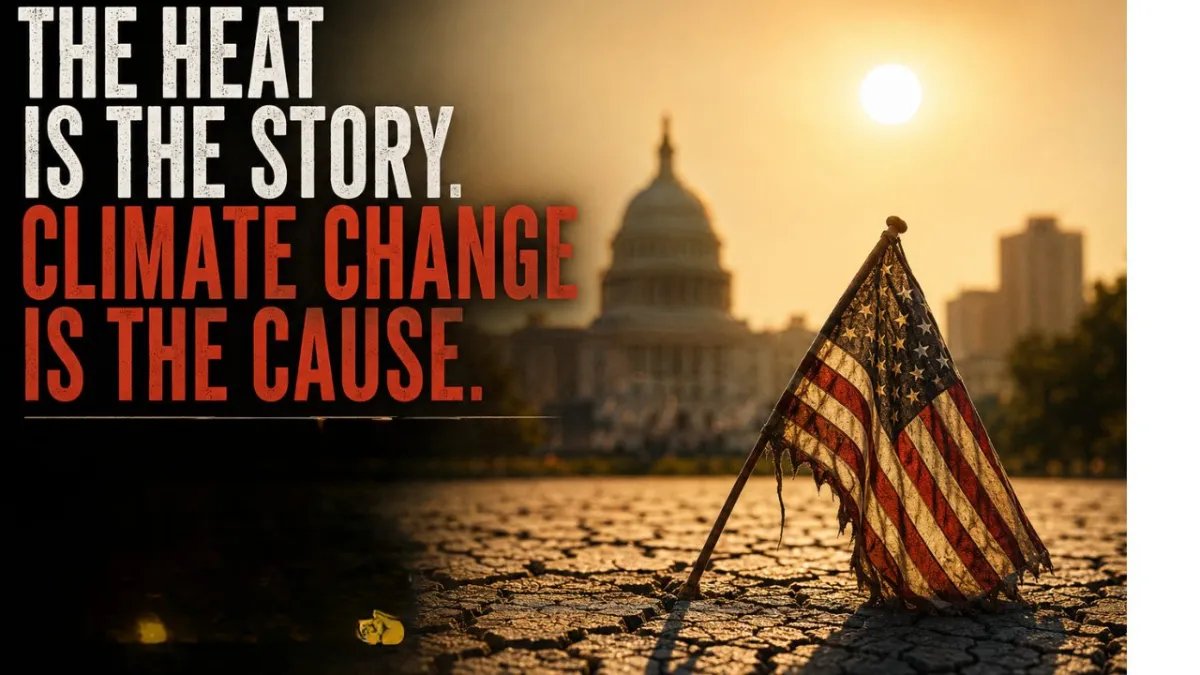
As extreme heat forces Fourth of July and America 250 celebrations to cancel or scale back across the country, the real story isn’t the weather—it’s the accelerating climate crisis reshaping American life.
Joshua Scheer
The climate crisis has become so normalized that much of the corporate media now reports its consequences while refusing to name their cause.
We recently highlighted this failure through FAIR’s incisive analysis, “Covering the Impact of Climate Change—Without Mentioning Climate Change.” This latest reporting from USA Today does exactly what FAIR warned about.
Across the United States, Fourth of July and America 250 celebrations are being canceled, postponed, or scaled back because temperatures have become simply too dangerous. More than 120 million Americans are under extreme heat warnings. Another 62 million are under heat advisories. Parades have been canceled after floats were already lined up. Historic celebrations in Philadelphia have been abandoned. Fireworks have been delayed, festivals shut down, and even events on the National Mall now require cooling tents, misting stations, hydration centers, and emergency precautions just to proceed.
And yet the story is framed as though this were simply an unfortunate spell of bad weather, It isn’t this is what climate change looks like in real time.
According to the Center for Climate and Energy Solutions, extreme heat is becoming both more frequent and more intense as the planet warms. What was once considered unusual is increasingly becoming routine. The organization notes that U.S. cities experienced an average of just two extreme heat events per year in the 1960s. Between 2010 and 2020, that number had risen to ten. At the same time, the nation’s heat-wave season has expanded by 46 days.
The trend is accelerating. The year 2024 was the hottest ever recorded globally, and the last decade has been the warmest on record. Looking ahead, the Fifth National Climate Assessment projects that much of the United States will experience 15 to 30 additional days above 95 degrees each year if global temperatures rise by 2 degrees Celsius. In some states, including Florida, that increase could reach 50 additional days annually.
Extreme heat is already the deadliest weather-related hazard in the United States, killing more Americans each year than hurricanes, floods, or tornadoes. Heat-related deaths have risen by more than 50 percent since 2000, while prolonged high temperatures increase the risk of cardiovascular disease, respiratory illness, kidney damage, and heat stroke. Older adults, children, outdoor workers, and low-income communities without reliable access to cooling face the greatest risks.
The consequences extend far beyond public health. Extreme heat strains the electric grid as air-conditioning demand surges while reducing the efficiency of power lines and power plants. It damages crops, stresses livestock, worsens drought, fuels larger wildfires, and intensifies the urban heat island effect, making many cities several degrees hotter than surrounding areas.
Against that backdrop, the cancellation of parades, fireworks, festivals, and outdoor gatherings across the country is not simply a holiday inconvenience. It is another visible reminder that climate change is reshaping everyday American life.
Yet too much media coverage still treats these events as if they were disconnected episodes of bad weather. When hundreds of Independence Day celebrations are canceled because it is unsafe to be outside, the story is not simply that it is hot. The story is why it is hot—and why these dangerous heat waves are becoming America’s new normal.
The economic costs of climate change are no longer theoretical—they are arriving in real time.
As seen by a recent July 1st Wall Street Journal analysis argues that extreme heat has become a chronic drag on the global economy, disrupting everything from construction and transportation to agriculture, public events, and energy systems. As temperatures soar across the United States ahead of the Fourth of July holiday, more than 150 million Americans have been placed under heat alerts, while Europe continues to experience deadly temperatures that the World Health Organization estimates contributed to roughly 1,300 excess deaths in a single week.
The article notes that economists are increasingly treating climate change not as a distant environmental concern but as a central economic force. George Buckley, chief European economist at Nomura, told the Journal that climate change is becoming impossible for economists to ignore, comparing it to other long-term structural challenges such as aging populations. What once appeared to be an issue for future generations is now affecting quarterly growth, inflation, productivity, and government budgets.
Extreme heat carries immediate economic consequences. Outdoor construction slows or stops altogether. Transportation systems are disrupted as rail lines, roads, and infrastructure strain under prolonged high temperatures. Schools close, public events are canceled, and businesses lose productivity as workers are forced indoors or face dangerous working conditions. While some sectors—such as movie theaters and air-conditioning manufacturers—may temporarily benefit, economists emphasize that these isolated gains are dwarfed by the broader losses.
The financial toll is already measurable. Research cited by the Journal estimates that last year’s European heat waves and floods caused approximately $43 billion in economic damage. Allianz modeling suggests that if years of record-breaking heat become the norm, some countries could lose between 5 and 7 percent of their gross domestic product over a five-year period. Those losses come not only from reduced economic output but also from mounting public expenditures to repair damaged infrastructure, strengthen emergency services, and retrofit schools and public buildings with cooling systems.
The article also highlights another consequence often overlooked in public debate: inflation. Extreme heat damages crops, reduces agricultural yields, and pushes food prices higher. One study found that Europe’s 2022 heat wave added roughly two-thirds of a percentage point to food-price inflation. As these events become more frequent, economists warn that climate-related inflation will become harder for central banks to dismiss as temporary, complicating efforts to stabilize prices and manage economic growth.
Perhaps the most significant conclusion is that climate disasters no longer arrive as isolated emergencies. Repeated heat waves compound one another. Construction projects delayed by one event are interrupted again weeks later. Infrastructure weakens under repeated stress. Emergency services remain stretched. Businesses and governments find themselves spending more simply to maintain existing systems rather than investing in future growth.
For years, climate change was framed primarily as an environmental issue. Increasingly, even the financial press is recognizing that it is also an economic one. Every canceled festival, delayed construction project, damaged harvest, overloaded power grid, and record-breaking electric bill represents another reminder that the costs of a warming planet are no longer hypothetical. They are already being paid.
When Americans can no longer safely celebrate Independence Day outdoors because of relentless, life-threatening heat, that is not merely a weather story—it is one of the defining climate stories of our time. Every article that catalogs canceled events without confronting the underlying cause helps normalize what should instead shock us.
Journalists rightly ask who is responsible after floods, hurricanes, or wildfires devastate communities. Why should record-breaking heat be treated any differently? Reporting the consequences while refusing to name the crisis leaves readers informed about the symptoms but blind to the disease.
The cancellations themselves are news. The real story is why they are becoming the new normal.
The climate crisis is no longer something our children will inherit. It is something we are living through right now. It is changing how we work, where we live, what we grow, how much we pay for food and energy, and now even how we celebrate.
The tragedy is not only that the planet is warming. It is that too many of our institutions—including much of the corporate media—continue to describe the symptoms while refusing to confront the disease. By treating record-breaking heat as another unfortunate weather event instead of what it is—a predictable consequence of decades of fossil fuel dependence and political inaction—they normalize a catastrophe that should be demanding urgent action.
Perhaps the most patriotic act today is not waving a flag while pretending everything is normal. It is refusing to accept that this is normal at all. The greatest threat to America’s future is not acknowledging the climate crisis—it is continuing to look away from it. Until we are willing to name the problem honestly, we will never summon the courage to solve it.
May we never forget this moment. And to those of us in the older generations: we cannot pretend this crisis belongs only to the young. People are already dying from extreme heat and the accelerating impacts of climate change—that is a documented fact. The greatest burden, however, will fall on those who must live with the consequences long after today’s leaders are gone.
If we continue down this path, future generations may well look back and ask why we accepted a slow-moving catastrophe that unfolded in plain sight. Nuclear war remains one of humanity’s greatest fears because of its speed and devastation. Climate change is different. It kills more slowly, more unevenly, and often out of the headlines—but it is no less real for those already suffering its consequences.
The question is no longer whether the crisis has arrived. It has. The only question that remains is whether we will finally find the courage to act before today’s warning becomes tomorrow’s irreversible tragedy.
May we never forget Zach from the DNC and the Hilary post election meeting in which he said
“Why should we trust you as chair to lead us through this?” two people in the room told The Huffington Post. “You backed a flawed candidate, and your friend [former DNC chair Debbie Wasserman Schultz] plotted through this to support your own gain and yourself.”
“You and your friends will die of old age and I’m going to die from climate change. You and your friends let this happen, which is going to cut 40 years off my life expectancy,” he said, according to the report.
While Zach was booed and repeatedly told to sit down, he refused to back down, continuing to call Brazile “part of the problem.”
It all leads back to the same moral failure we have witnessed with Gaza, the drive toward war with Iran, and now the climate crisis. On genocide, too many Democratic leaders have not merely been silent—they have been complicit. They have armed it, funded it, defended it, excused it, and attacked those who dared to call it by its name.
That same cowardice runs through their response to war and climate catastrophe. Again and again, Democratic leaders offer speeches about democracy and humanity while backing policies that destroy both. They condemn cruelty when it is politically convenient, but when real power demands a choice, too many choose donors, weapons manufacturers, fossil fuel interests, and empire over human life.
As we honor Ron Kovic, Mike Prysner, and now Zach, we are reminded that conscience rarely comes from the people sitting comfortably in power. It comes from those willing to speak the truth even when party leaders, pundits, and careerists tell them to sit down.
We need more people in positions of power with that courage. Because when leaders fund genocide, march us toward war, and ignore a climate crisis already killing people, they are not simply failing us. They are helping lead us toward death.
History will not remember their carefully worded statements. It will remember whether they stood against genocide, war, and climate collapse when it mattered.
Please share this story and help us grow our network!
Editor’s Note: At a moment when the once vaunted model of responsible journalism is overwhelmingly the play thing of self-serving billionaires and their corporate scribes, alternatives of integrity are desperately needed, and ScheerPost is one of them. Please support our independent journalism by contributing to our online donation platform, Network for Good, or send a check to our new PO Box. We can’t thank you enough, and promise to keep bringing you this kind of vital news.
You can also make a donation to our PayPal or subscribe to our Patreon.
[ad_2]
Source link
