
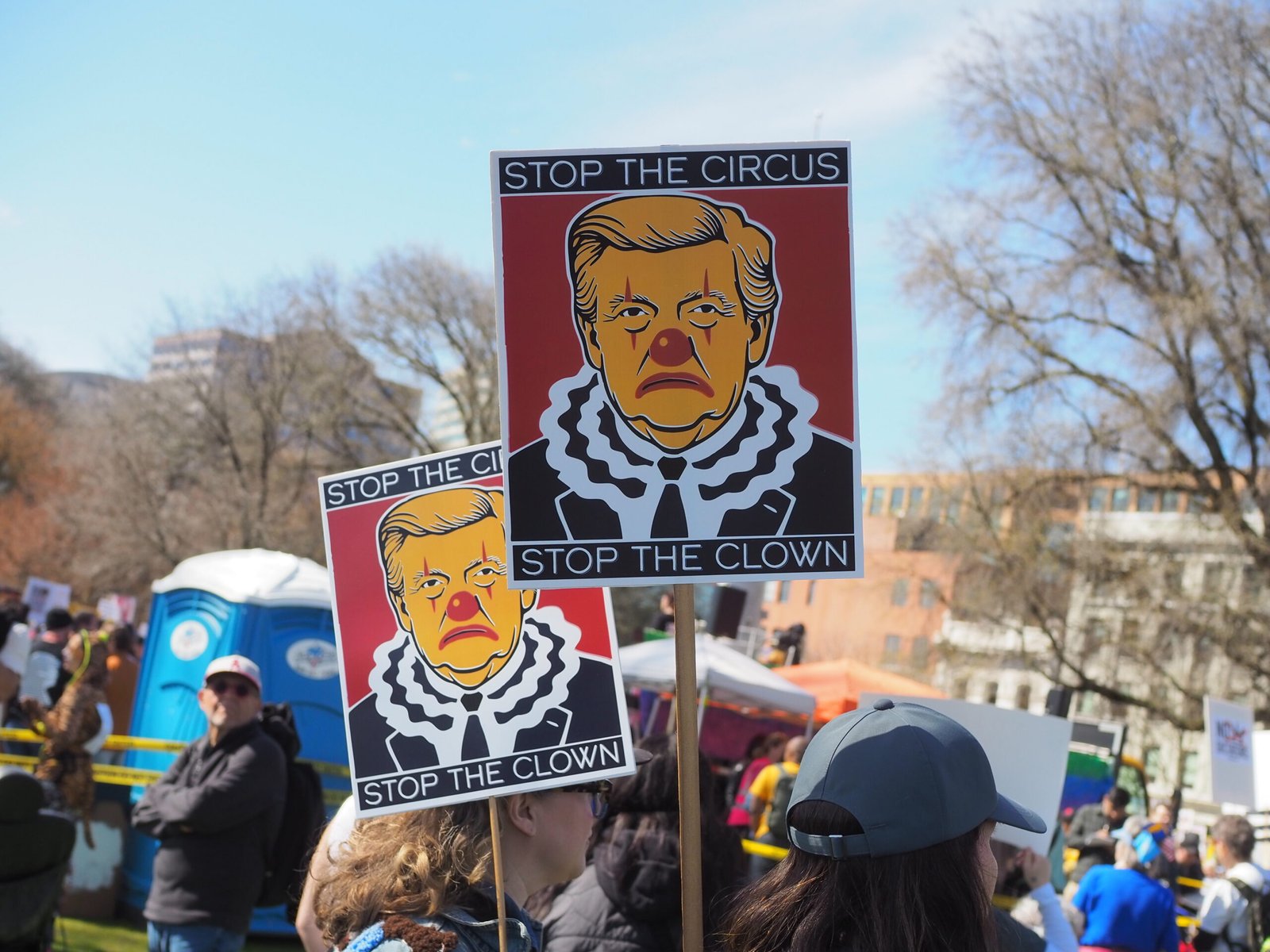
Photograph by Nathaniel St. Clair
One of the key factors in understanding Donald Trump’s foreign policy is not to view the United States as a homogeneous bloc standing united behind its president. Throughout his first term (2017–2021) and his second term, which began in January 2025, Trump has faced internal resistance on a considerable scale. This resistance has taken many forms: mass mobilisations, trade union action, election campaigns, international solidarity movements, civil disobedience and the emergence of left-wing candidates in certain major cities.
These struggles have at times succeeded in curbing, altering or delegitimising certain policies of Trump’s. They have also revealed the existence, within American society itself, of a deep-seated conflict between an authoritarian, nationalist and reactionary agenda, and democratic, egalitarian and internationalist aspirations.
Women’s mobilisations for the right to abortion
As soon as Trump arrived at the White House in January 2017, millions of women took to the streets as part of the Women’s March, organised the day after his inauguration. This movement was one of the largest mobilisations in US history. It expressed rejection of Trump’s sexism, his misogynistic remarks and his desire to undermine reproductive rights.
The Women’s March in January 2017 remains one of the largest demonstrations in US history, with an estimated turnout of between three and five million people. It immediately demonstrated that Trump’s election had sparked mass opposition, particularly amongst women, minorities and progressive movements.
The issue of abortion took centre stage when the Supreme Court – bolstered by Trump’s appointments of conservative justices – overturned the Roe v. Wade ruling in June 2022, during Joe Biden’s term of office. This ruling had guaranteed the constitutional right to abortion since 1973. This decision sparked a wave of protests across the country and contributed to a strong electoral mobilisation in favour of candidates supporting the right to abortion.
In response to the overturning of the Roe v. Wade ruling in June 2022 by the Supreme Court, which was influenced by Trump and his camp, the American electorate was called upon to vote directly on abortion in sixteen states between 2022 and 2024. In thirteen of these, the side in favour of maintaining or extending the right to abortion won the vote, including in several conservative states such as Kansas, Kentucky, Montana, Ohio, Missouri and Arizona. These results show that the desire to criminalise abortion does not enjoy uniform majority support amongst the American electorate and that it provokes significant popular resistance, including in Republican strongholds.
As such, the defence of women’s rights has become one of the main focal points of opposition to Trump and Trumpism.
Environmental and scientific protests
The March for Science, held in April 2017, was a direct response to Trump’s climate scepticism and his attacks on federal scientific agencies. Around one million people took part in demonstrations in more than six hundred towns and cities, denouncing the questioning of scientific data on climate change.
The People’s Climate March, also in 2017, brought together around 200,000 people in Washington and several hundred thousand across the country. It protested against the US withdrawal from the Paris Agreement and policies favouring the fossil fuel industry.
Protests against gun violence
Following the Parkland shooting in Florida in February 2018, the March for Our Lives movement mobilised between one and two million people, mainly young people. More than 800 demonstrations took place across all fifty states. This movement challenged Trump’s support for the gun lobby, the National Rifle Association (NRA), and helped to make gun control a major political issue.
Teachers’ strikes
The teachers’ strikes of 2018 and 2019 marked a turning point in American social struggles. More than 500,000 teaching and school staff took part in strike action across several states, many of which are conservative. These protests called for pay rises, better funding for state education and a reduction in educational inequalities.
Black Lives Matter and the fight against systemic racism
The Black Lives Matter movement, which emerged in the wake of police violence against African Americans, reached its peak in 2020 following the murder of George Floyd by a police officer in Minneapolis. The Black Lives Matter movement represented the largest wave of mobilisation in recent American history. Following the murder of George Floyd in May 2020, protests took place in over two thousand towns and cities. Some studies estimate that between fifteen and twenty-six million people took part in at least one protest, which would make it the largest protest movement in US history.
Trump responded by adopting a confrontational stance. He labelled some protesters ‘thugs’ and threatened to deploy the army against the demonstrations. This response reinforced the perception of a president who supports a militarised police force and refuses to acknowledge the existence of systemic racism.
Black Lives Matter has, however, achieved significant progress: the scrutiny of certain police practices, debates on police funding, the removal of racist symbols in several cities, and the inclusion of the issue of structural racism in the national political debate.
After 6 January 2021
The storming of the Capitol by Trump’s supporters on 6 January 2021 sparked a wave of protests in defence of democracy. Demonstrations took place in many American cities to condemn the attempt to overturn the result of the 2020 presidential election and to demand the protection of democratic institutions.
Solidarity with Palestine
The Palestinian question has become another major area of internal resistance. During Trump’s first term, the recognition of Jerusalem as the capital of Israel in 2017, followed by the relocation of the US embassy, sparked strong opposition amongst sections of American society.
This opposition intensified from 2023 onwards with Israel’s genocidal war against Gaza, a war which received active support from Joe Biden’s Democratic administration. The movement continued during Trump’s second term. Hundreds of thousands of people demonstrated in major US cities to denounce US military and diplomatic support for Israel.
University campuses have played a central role. Students have organised sit-ins, occupations and divestment campaigns targeting companies linked to the Israeli military-industrial complex. Despite often brutal repression, these protests have helped to shift the public debate: for the first time in decades, a significant proportion of American youth are openly questioning Washington’s unconditional support for Israel.
Mobilisations in solidarity with Palestine reached unprecedented levels from 2023 onwards. On the largest days of action, several hundred thousand people demonstrated simultaneously in major US cities. University sit-ins spread to over a hundred universities and colleges, directly involving tens of thousands of students and leading to hundreds of arrests.
Protests against ICE and immigration policies
Trump’s immigration policies also sparked massive resistance. As early as 2017, protests against the ‘Muslim Ban’ – which barred entry to nationals of several predominantly Muslim countries – swept through US airports.
The separation of thousands of migrant children from their parents at the border with Mexico sparked international outrage. The ‘Families Belong Together’ movement organised large-scale demonstrations to demand the reunification of families.
During his second term, protests against ICE (Immigration and Customs Enforcement) intensified in response to raids, deportations and detention centres for migrants. Solidarity networks were set up in several cities to protect people facing deportation and to document abuses committed by the immigration authorities. These actions mobilised several hundred thousand people on an ongoing basis in more than 16 major cities and hundreds of rural or suburban towns.
Thousands of actions relating to migrants’ rights and opposition to ICE have been recorded across all 50 states. If we include the No Kings protests (see below), more than 10 million people have taken part in street demonstrations to denounce anti-migrant policies and ICE’s methods.
The ‘No Kings’ movement
The ‘No Kings’ movement emerged as a direct response to Trump’s authoritarian excesses. It condemns the concentration of presidential power, attacks on democratic institutions, threats against the media and the desire to govern by decree.
The ‘No Kings’ protests brought together citizens of diverse political persuasions, united by their refusal to see the United States move towards an increasingly authoritarian regime. This movement served as a reminder that the defence of democratic freedoms remains a central issue in the resistance to Trumpism.
The No Kings movement is one of the most significant expressions of opposition to Trump’s second term. The main national days of mobilisation, particularly in 2026, brought together, according to estimates, between three and five million people in more than 1,500 towns and cities. This scale makes it one of the largest anti-Trump mobilisations since the Women’s March of 2017.
Here are three key dates in the No Kings mobilisations:
+ 14 June 2025 (No Kings 1.0): Around 5 million people across more than 2,100 locations.
+ 18 October 2025 (No Kings 2.0): Around 7 million people at over 2,700 venues.
+ 28 March 2026 (No Kings 3.0): Around 8 million people gathered at over 3,300 venues.
LGBTQ+ protests
Trump’s policies aimed at restricting the rights of transgender people, particularly in the armed forces and in certain areas of public life, have met with strong opposition. Between 2022 and 2026, protests against anti-trans laws brought together tens of thousands, and even hundreds of thousands, of people on certain national days of action.
Trade union and social resistance
We must not overlook the role of trade unions and social movements. The years 2021–2026 were marked by a resurgence of labour struggles in the United States: strikes in the automotive industry, ‘ ’ in the service sector, at Amazon warehouses, in Starbucks cafés and in the education sector.
These protests often went beyond wage demands to denounce social inequalities, job insecurity and the excessive power of large corporations. They demonstrated that a significant section of the American working class identifies with neither the Democratic Party’s neoliberalism nor Trump’s reactionary nationalism.
Electoral successes of the left: the case of Zohran Mamdani
Resistance to Trump is not limited to street protests. It is also expressed in the electoral arena, notably through the emergence of left-wing candidates in certain major cities.
The case of Zohran Mamdani is particularly significant. A member of the Democratic Socialists of America (DSA), he won the Democratic primaries for the New York mayoral election, defeating candidates backed by the Democratic Party establishment. He was elected mayor of New York in November 2025 despite threats from Trump and a campaign waged against him by 26 US billionaires who, according to Forbes magazine, spent over 22 million dollars to prevent him from being elected. Fortunately, the will and energy of the people, particularly among the younger generation, triumphed over the power of money and capital.
His campaign, centred on affordable housing, free public transport, taxation of great wealth and solidarity with Palestine, mobilised a large section of the youth and the working classes. It demonstrated that a left-wing political alternative can emerge in the United States, despite the weight of the two-party system and the influence of money in election campaigns.
Mamdani’s success is part of a broader trend, which includes the victories of figures such as Alexandria Ocasio-Cortez, Rashida Tlaib, Ilhan Omar and other progressive elected representatives. This American left remains in the minority, but it represents a growing force capable of challenging both Trumpism and the centrist tendencies of the Democratic Party.
A multifaceted resistance
Internal resistance within the United States shows that Trump’s political agenda faces deep-seated and enduring opposition.
If we take these various waves of mobilisation together, we can see that tens of millions of people have, at one time or another, taken part in protest actions against Trump’s policies or against the authoritarian, racist, patriarchal, warmongering and neoliberal tendencies of Trumpism.
These movements do not form a homogeneous bloc, but constitute a mosaic of resistance that cuts across the whole of American society: women, African Americans, Latin Americans, students, workers, scientists, academics, environmental activists, LGBTQ+ rights advocates and supporters of democracy.
These protests have at times achieved tangible victories, but they also face growing repression, the power of the conservative media and the country’s political polarisation. Symbolic of this repression, Renee Nicole Good and Alex Pretti, who were attempting to intervene during operations against migrants in Minneapolis, were both killed by ICE officers.
Nevertheless, these movements are fundamental to understanding the limits of Trump’s power. They serve as a reminder that, even at the heart of the world’s leading imperialist power, there are social and political forces that challenge authoritarianism, racism, patriarchy, militarism and neoliberal policies.
Thus, the history of Trumpism cannot be written solely from the perspective of the White House. It must also be told through the lens of the millions of people who, on the streets, on campuses, in workplaces and at the ballot box, have resisted and continue to resist his political agenda.
