
In March this year, trading standards officers in the West Midlands town of Dudley closed down a number of “rogue” businesses, mostly mini-marts and vape shops, due to links to organized criminal gangs. Their priority criterion was not tax evasion or counterfeit goods. It was the grooming threat to children.
The shops are staffed by a continuous flow of migrant workers, including men from Kurdistan and Afghanistan, many of whom arrived in the “Boriswave” of migration, the surge of non-EU immigration that took place while Boris Johnson was prime minister. In one shop, officers found a book in Kurdish which listed English chat-up phrases. At another, intelligence indicated that men were driving children as young as 12 to unknown locations.
“We get the people behind the counter to empty their pockets, and they’ve got reams of condoms” Kuldeep Maan, principal trading standards officer at Dudley Council, told a Channel 4 reporter.
This is not the grooming gangs story most British people think they know. That story has a familiar cast: Pakistani men, working-class white girls, takeaways and taxis, and authorities too frightened of being called racist to intervene. That story is true. It is also radically incomplete. And its incompleteness—the way it has fixed public attention on one pattern, one demographic, one era—has allowed the underlying problem to evolve, expand, and embed itself ever more deeply into British criminal life while the national conversation was framed in a different direction.
In the 2000s and 2010s, the grooming gangs typically operated through the nighttime economy, primarily the takeaways and taxis which subsequently became part of the known grooming gang story. In the 2020s, the shopfronts may have changed but the underlying structure is recognizable: loosely organized networks, often rooted in shared background or kinship, operating across multiple criminal markets and adapting to new opportunities as they arise. At the same time, a new wave of criminal infrastructure, imported alongside legitimate migration, has turbocharged a problem Britain always had and never fully solved.
To understand how we got here we need to start with what these networks actually are, because the term that has defined this debate for 15 years is wrong, or at least insufficient. These are not grooming gangs. They are child trafficking and slavery networks, operating within Britain’s criminal economy, structured around ethnic kinship ties, and enabled by an institutional failure that has persisted across decades and governments. Until the law, the police, and the public understand it in those terms the response will remain inadequate—and children will keep paying the price.
Let’s start with the crime itself. What is actually being described when we talk about “grooming gangs”?
The gangs first entered public consciousness with the reporting of Andrew Norfolk, a journalist for the Times. Norfolk’s focus was on crimes in the Midlands, where, he reported, groups of men were befriending girls aged 11–16 on the streets and entrapping them—he referred to the crime as “on-street grooming.”
“Most of the victims are white and most of the convicted offenders are of Pakistani heritage, unlike other known models of child-sex offending in Britain,” Norfolk reported in his first article on the matter in January 2011, setting the stage for the current understanding of what a grooming gang is.
But in the same article, he cited a 2009 report by the Child Exploitation and Online Protection Centre [CEOP] which had found that “Kurds are identified as being dominant in the North East of England, but Anglo-Asian [predominantly British-born Bangladeshi and Pakistani] groups appear to be in control in the Midlands. There are […] suggestions that in London, West Indian (Caribbean) and Bangladeshi networks are similarly exploiting […] females for sex.” What CEOP was describing was a patchwork of criminal networks forming along lines of trust and familiarity, then competing for control of illicit markets.
That distinction matters enormously. This is how organized crime works everywhere. Networks form along lines of trust—family, kinship, shared background—and then compete for control of illicit markets. The ethnicity of a network reflects who its members trust: Pakistani gangs in Rotherham, Kurdish networks in the Northeast, West Indian operations in London. Different communities, same criminal methods.
The grooming model at the heart of these networks, often referred to as the “Romeo Pimp” or “Loverboy” method, confirms this. Norfolk described older boys luring a much younger girl into a fake relationship before passing her on to others. Julie Bindel watched the scene unfold a step further in 2007, reporting in the Times that, at the Mall in Blackburn, “Well-dressed Asian [meaning of Indian subcontinental heritage] teenage boys can be found on the lookout for young white girls, following them around those stores that sell cheap jewelery and perfume. Meanwhile, older men sit on the benches, watching their workers and potential recruits in action. The older men are ‘employing’ the boys to chat up the girls and eventually hand them over.” The same year, the Journal of Aggression, Maltreatment & Trauma identified this method as a primary route into commercial sexual exploitation—sex trafficking—alongside drug addiction, manipulation, and violence.
The boys weren’t merely grooming girls to pass them around family and friendship groups. They were grooming them to traffic them into criminal enterprises. This is the reframing that is urgently needed. The failure to make it has had concrete, damaging consequences for how these networks have been policed.
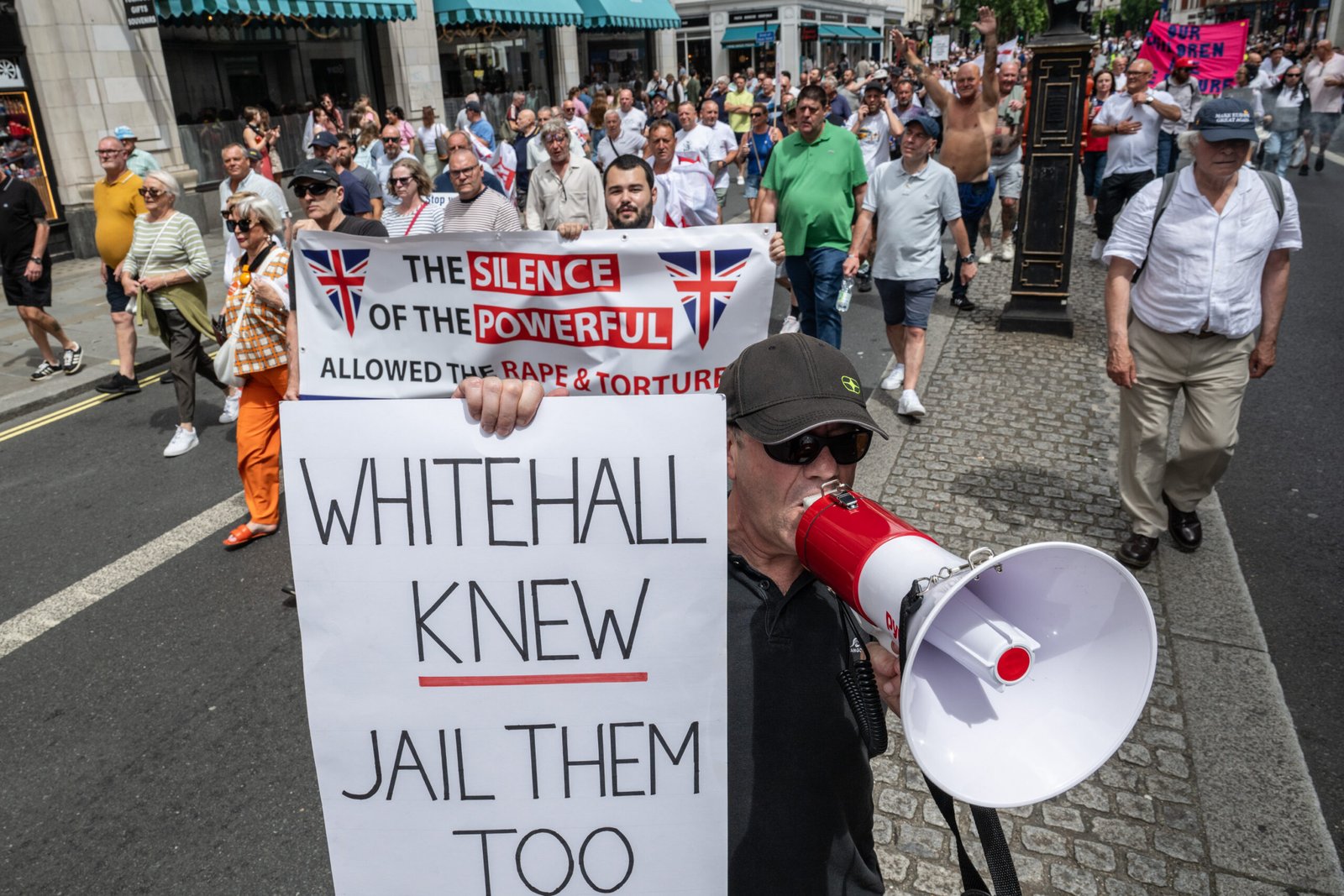
The evidence for this framing was present from the beginning. It was ignored. Norfolk’s reporting eventually forced Rotherham Council to commission Alexis Jay, the Scottish Government’s former chief social work advisor, to look into grooming gang cases in the area. In the introduction to her report, published in 2014, Jay noted: “At an operational level, the Police gave no priority to CSE [child sexual exploitation], regarding many child victims with contempt and failing to act on their abuse as a crime. Further stark evidence came in 2002, 2003, and 2006 with three reports known to the Police and the Council, which could not have been clearer in their description of the situation in Rotherham.”
The three reports in question were written by Angie Heal, a strategic drugs analyst who had been hired in 2002 by South Yorkshire Police to research drug use and supply in the area. Her investigations revealed that children were being given drugs in the grooming process. Her first report, published the same year, advised that if the grooming gangs could not be convicted of sex offences, they could be tackled by bringing drug charges. The report was widely read, but according to Heal there was a “complete lack of interest” in the link between the drug trade and child abuse.
Her second report, published in 2003, found a “significant number of girls and some boys who are being sexually exploited.” Her third, published in 2006, found “systematic physical and sexual violence against young women,” including trafficking to other towns. That report was sent to Rotherham Drugs Partnership, the district commander, and the chief superintendents, to no avail. The following year Heal left South Yorkshire Police.
Jay is scathing about the way these reports were handled, writing: “The first of these reports was effectively suppressed because some senior officers disbelieved the data it contained. This had led to suggestions of cover-up. The other two reports set out the links between child sexual exploitation and drugs, guns and criminality in the Borough. These reports were ignored and no action was taken to deal with the issues that were identified in them.”
Over a decade on and little has changed. It seems that everyone recognizes sexual slavery and child trafficking when it happens abroad, but no one spots it when British girls and boys are the victims. The distinction isn’t purely semantic. As Louise Baroness Casey noted in her 2025 audit on group-based child sexual exploitation and abuse, it “is easier for a police officer to realize a child is being criminally exploited, for example, through finding them with a significant amount of drugs or money, than it would be to spot the often subtle signs that the same child was also being sexually exploited.”
Casey goes on to say: “This audit is concerned that, because of this, patterns of child sexual exploitation may be obscured.” This is indeed a worry. But it also points to a missed opportunity: If criminal exploitation is easier to detect, and if sexual exploitation so often accompanies it, then every drug raid, every county-lines arrest, every seized stash of cash should trigger the question—are children being sexually exploited here too?
Let’s be clear: Britain’s baseline of child exploitation predates mass immigration. The Casey audit found that white perpetrators still account for a meaningful proportion of group-based child sexual exploitation cases—though it does not differentiate between White British and White Other (Albanian, for example), a gap that is itself telling. All the same, the problem was never exclusively imported; think of Oliver Twist falling into the hands of Fagin and Bill Sikes. But Britain, like other Western societies, has been through a civilizing process since the 19th century. At home, the Factory Acts of 1833 and 1842, and Elementary Education Acts of 1870 and 1880 brought children out of the work force and into the classroom, while the Metropolitan Police Act 1839 and Towns Police Clauses Act 1847 introduced a formal police force to control violence and crack down on prostitution. There was also a drive to tackle drunken and disorderly behavior in the 1880s. Abroad, the British Empire moved to eliminate barbaric practices such as sati (widow-burning) in 1829 and thuggee (ritual robbery and murder) in the 1830s, as well as imposing British ideals through Anglicanization.
But the pushback against colonial rule and all that came with it has had the unfortunate effect of mandating tolerance for foreign cultural practices, even at home. The consequences are harrowing. According to the Home Office there were 2,949 honor-based offenses recorded by the police in England and Wales in the year ending March 2025, a figure up 7 percent on the previous year. Offences included coercion, abuse, rape, forced marriage, and female genital mutilation. The Halo Project, a charity supporting black and minority women and girls suffering domestic abuse, estimates that there are 12-15 honor based killings in the UK every year. In 2022, the UK Parliament heard evidence that honor-based abuse (HBA) was an “invisible crime,” due to the fact that it has become a “culturally sensitive problem,” leading to HBA being “dismissed as a cultural issue.” The submission noted that “HBA has become a politically charged and hypersensitive issue creating obstacles to preventing [it].” Of course, not all members of ethnic minority groups exploit children. But certain ethnic minority groups, as groups, have tolerated, or failed to report to authorities, practices and crimes—including the sexual exploitation of children and honor offenses—that members of British society as a whole regard with the highest degree of moral opprobrium. The compound effect is not that Oliver Twist’s story is no longer tolerated; it’s that it wasn’t—until multiculturalism became the order of the day.
What multiculturalism has done—specifically, what decades of managed, largely unexamined mass immigration has done—is import organized criminal networks that have expanded and entrenched the market in ways that would not otherwise have occurred. The institutional failure lies not merely in fearing being called racist, but in allowing those networks to operate in order to perpetuate the founding myth of multiculturalism: that all cultures are equally civilized.
Once that piece is recognized for what it is, the mechanism loses its mystery: migration brings communities. Communities generate trust networks. Trust networks, in any society, can be exploited by criminal elements within them—and in some cases, those criminal elements migrate alongside the communities they prey on and profit from.
Take, for example, Birmingham in the early 2000s. In 2005, a Birmingham newspaper, the Sunday Mercury, reported gang violence under the headline: “RIVAL GANGS UNITE TO FIGHT; Sikh and Muslim crime lords call truce to stand against black gunmen.”
A gangland source told the paper: “The Asian gangs are increasingly taking over the drugs and prostitution trade from the black gangs. This has caused a lot of friction. They have worked together in the past but they are now both trying to establish their dominance in the market and are stepping on each others’ toes in the process.”
The report noted that the Asian gangs “were originally formed in the 1980s to counter the rising influence of the far right and to defend their communities from racist attacks. When the neo-Nazi threat diminished, the gangs continued to exist and turned into opposing crime syndicates and began turning on each other over religious grounds.”
What emerges from these reports is a picture of Britain’s urban ganglands that will be familiar to anyone who has studied organized crime in American cities: territorial, shifting, multi-ethnic, and bound together less by ideology than by the economics of drugs and prostitution. Yet while grooming gangs have become totemic of the failures of multiculturalism, the gang warfare and drugs trade that weaves through the sexual exploitation of children has largely gone unnoticed by a public for whom such matters still feel like an American problem. The result is a national conversation that has fixated on child grooming ethnicity and religion while ignoring the criminal infrastructure, which, in its current dimension, is the product of multiculturalism, and which makes the abuse possible.
Subscribe Today
Get daily emails in your inbox
The pattern is repeating itself now in a new form on Dudley’s streets, and in hundreds of towns like it across Britain. The managed importation of large populations, without adequate consideration of the criminal networks that travel alongside legitimate communities, and without the institutional capacity to police what follows, has made a preexisting problem dramatically worse. We see it in the explosion of vape shops and “Turkish barbers” even in sleepy rural market towns, as criminal networks seek to expand their territories and customer bases ever further. Added to that the ideological environment of multiculturalism—in which naming patterns was treated as racism, in which managers instructed social workers to omit the ethnicity of perpetrators from their reports, in which the charge of racism was more feared than the reality of rape—provided exactly the cover those ever-expanding networks needed to operate with impunity for decades.
Alexis Jay noted in 2014 that council workers in Rotherham had been told not to refer to the ethnic origins of perpetrators when carrying out training. She asked why the charge of racism was so feared, even in the face of clear evidence. The answer is that the entire apparatus of British public life had been built around a definition of anti-racism designed to protect the ideology of multiculturalism. That apparatus protected no one but the perpetrators.
Ethnicity is a thread in this story, not the whole cloth. The men in Dudley using a Kurdish phrase book to chat up children are not grooming gang members in the commonly understood meaning of that phrase. They are foot-soldiers in a criminal enterprise, doing what criminal enterprises do: recruiting, expanding, adapting. Until Britain is willing to name what these networks are—child trafficking operations, criminal enterprises, organized crime—and to pursue them with the tools we use against organized crime, children will continue to be left defenseless against those who seek to exploit and abuse them.
