
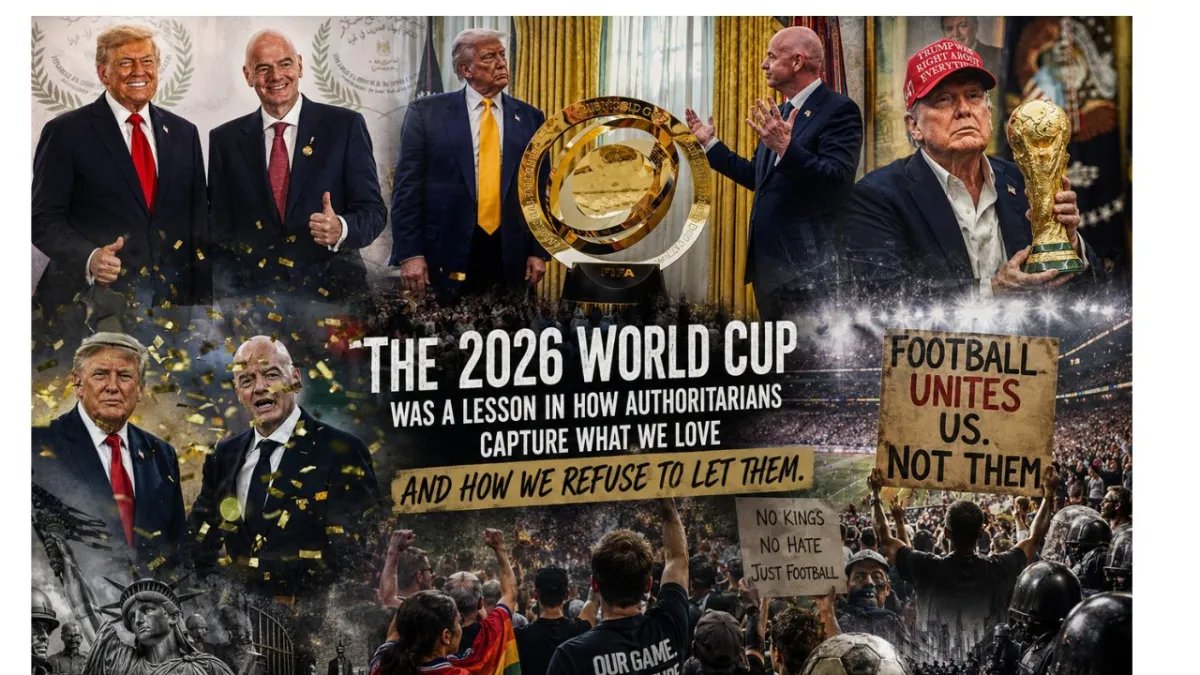
The 2026 World Cup was a lesson in how authoritarians capture what we love and how we refuse to let them.
I inherited a few things from my father, who, as the story goes, when I was a baby in Transylvania, swam across a frozen river to escape communist Romania, toward a faith that we could forge our own brave futures, free from ethnic oppression. I inherited his unruly curls, refusing control and predictability. I inherited his sometimes comic rage at injustice. I inherited his love of the beautiful game, its history, its ever-evolving, complex entanglements with state and power. His faith that people who have little can stand proudly against nations who have stolen their wealth, and refuse to back down.
He is no longer here for me to talk to about the World Cup. And this impossible and forever grief has been opened fresh as I try to imagine what he would say about what we have watched unfold in the 2026 games. There is a chip inside the ball now. It hums at 500 times a second, registering contacts no eye can see, no crowd can feel, no player can dispute. It enters the conversation as an indisputable, objective data point, asserting authority over anyone and everyone. On the third of July, in Toronto, that sensor ended Croatia’s World Cup. Joško Gvardiol had bundled home what looked like an equalizer 13 minutes into stoppage time, and for a few delirious seconds the stadium believed. Then according to officials the sensor detected the smallest brush of a teammate’s hair against the ball, on its way to the man who set up the goal. FIFA officials decided it was enough to call it offside. The goal was erased. Portugal advanced, 2-1. A machine had registered what no human present could, and in registering it, unmade a moment of collective joy.
FIFA insists the call was correct. Perhaps it was. I can’t say, the beautiful game is rife with instances when fans felt distraught by calls refs have made. But I can say that this is different. We have built a tournament where correctness is now adjudicated by inertial sensors and video rooms and it lies beyond dispute. Eduardo Galeano, the great Uruguayan chronicler of the game, warned us. “The more the technocrats program it down to the smallest detail,” he wrote, “the more the powerful manipulate it, football continues to be the art of the unforeseeable.” The chip in the ball is the technocrat’s dream: a game with the unforeseeable engineered out. It is not just that the game has been made less human under the guise of objectivity. It is that the fantasy of objectivity itself has become the cudgel.
Objectivity as Disguise
Here is what I am reflecting on, wishing I could discuss with my dad, at the close of this tournament: The promise of VAR was never really neutrality. It was the appearance of neutrality, which is a different and more useful thing if you happen to hold power. The appearance of objectivity is not a side effect of the manipulation; instead, it is the mechanism, because a decision the machine is presumed to have made is a decision no one thinks to question. A goal-line sensor cannot be bribed. But the humans who decide when to consult it, what angle to review, which foul to freeze and which to wave through, can be, and the data increasingly suggests they have been, whether by conscious design or the gravitational pull of a superstar’s fame and the money this can make for FIFA.
This World Cup has gifted us many lessons and reminders, one of them is that supposed objectivity is not the same thing as fairness.
Similarly, there are echoes of this pattern in Egypt against Argentina in the round of 16. Egypt led early. Mostafa Ziko put the ball in the net for what would have been a two-goal cushion, and VAR chalked it off for the faintest infraction in the buildup. Late in the match, with Egypt still level, a shove in the box went unpunished by the same system that had been so exacting minutes before. Argentina scored in the 90-second minute and advanced, 3-2. Egypt’s football association filed a formal complaint. Their coach made clear the issue when he said his team had suffered an injustice, and suggested that FIFA needed Lionel Messi to keep playing. Analysts who reviewed the tournament’s VAR data found that Argentina and Mexico received the most favorable review outcomes of any teams at the tournament, while Croatia and Iran received the least. From this data it appears that a system built to remove human judgment from the game continues to produce outcomes that track, with uncomfortable fidelity, who those in power most need to keep around to increase earnings.
The instances telling this story are culminating into a chorus. In an Iran-Belgium match, a goal was disallowed because VAR determined that an Iranian player’s rear end, not his foot, not his knee, but the curve of his backside, had drifted a fraction past the last defender. It was, on its face, absurd, and it was also revealing, because it showed the machine doing exactly what it was built to do: finding a violation so microscopic that no stadium, no broadcast, no human referee running at full speed could ever have called it in real time, and then presenting that finding as more true, more final, than what 40,000 people had just watched with their own eyes. Such instances, of which there are others, are leading fans and experts alike to ask whether VAR had gone too far. In this variation, football survived for 150 years on the premise that referees would sometimes be wrong, and that this was a condition of the game being played by humans, for humans, at human speed. It appears that under the guise of taking away the possibility of human error to allocate the decision to VAR, we are simply relocating the injustice somewhere less visible and giving it a machine’s alibi.
This World Cup has gifted us many lessons and reminders, one of them is that supposed objectivity is not the same thing as fairness, and a system that claims the first while abandoning the second is more dangerous than one that never claimed either, because it forecloses the argument. You cannot appeal to a sensor’s conscience. What we need, and what this World Cup has made painfully clear we are losing, is the return of human judgment, fallible and accountable and answerable to a crowd, back into the center of the game. And this goes for on the pitch and off the pitch.
Breaking the Rhythm to Cash In
If you want to understand who the 2026 World Cup is really for, watch what happens 22 minutes into each half. The rhythm is interrupted, and the play stops. Not because it is dangerously hot, though with climate change it too often is; the breaks run on schedule even in roofed, air-conditioned stadiums. They stop because FIFA decreed a mandatory three-minute “hydration break” in all 104 matches, “regardless of heat conditions.” It is the first World Cup in history to do so. Officially, the line is that this is about player welfare, but if we follow the money a different story emerges.
Soccer, alone among the major North American television products, historically offered almost no in-game commercial inventory. Ninety minutes, two halves, no timeouts to sell. The mandatory breaks changed that overnight, manufacturing 208 guaranteed advertising windows across the tournament and restructuring the game into four quarters, conveniently familiar to the American fan and the American businesses FIFA is courting. Media buyers estimate Fox Sports alone stands to reap a minimum of $250 million from these breaks, with plausible figures running to half a billion. Former England defender Gary Neville called it what it is: a “stealth advertising break.”
Heat is real, and climate change is making it deadlier. Here, a genuine safety concern has been laundered into a revenue engine, and the game’s rhythm, its uninterrupted, breath-held flow, the very thing that distinguishes it, has been sold for the price of a commercial slot. Once you see that the game’s own rhythm is for sale, the question is no longer whether other decisions are being bent, only which ones, and in whose favor.
What Lawrence Did
And yet, capitalism did not manage to buy everything. Not everyone in this tournament was for sale, and not everyone who showed up did so for the sponsors.
Algeria, making the trip to the American Midwest, chose the college town of Lawrence, Kansas as their base. And Lawrence welcomed them with open arms. The University of Kansas marching band learned and played the Algerian national anthem. A local artist built a massive Algerian flag out of organic materials. No hydration break manufactured that. It happened because people decided, without being asked and without being paid, to open a door.
That reminder of who we are is also a gift we received from this World Cup alongside everything else this tournament has shown us about who is trying to own the game. There may be polarizing narratives that cultivate a sense of suspicion about people who do not think like us or look like us, but the world is filled with people who look at the visitor and welcome them with a song that reminds them of home.
The Trump Card (vs. the Red Card)
Oh and perhaps the least surprising of all the events from this World Cup was the phone call. Folarin Balogun, the United States’ top scorer, a Black, American-born son of Nigerian immigrants, playing for a nation whose president has spent the year trying to end birthright citizenship, was sent off against Bosnia on a red card, triggering an automatic one-match ban that FIFA had repeatedly described as beyond appeal. Days later, that unappealable ban vanished. FIFA invoked a probationary loophole to suspend the suspension, clearing Balogun to face Belgium in Seattle less than 24 hours after the decision. It was the first time since 1962 that a red card issued at a World Cup did not result in a suspension.
Trump personally called FIFA president Gianni Infantino to ask for a review. He then thanked FIFA publicly for “reversing a great injustice.” Belgium’s football association said it was “astonished,” and UEFA called the reversal “unprecedented, incomprehensible, and unjustifiable.” Speaking from the White House, Trump said he hadn’t known what a red card was until this happened; once he found out, he said, “You got to be kidding,” and picked up the phone.
Trump may think he can do anything in this world, but the consequences are ours to carry and ours to refuse.
Infantino had handed Trump the inaugural “FIFA Peace Prize” the year before, an award invented, it is hard not to conclude, to flatter a notoriously fragile ego. And a supposedly ironclad suspension dissolved within days of a presidential request, reshaping how an opponent could prepare for a knockout match. When the game’s governance rearranges itself around a head of state’s preference, the fix does not have to be spoken to be real. Of course, this is all according to the script of authoritarian power hoarding that the Trump administration follows.
The United States lost to Belgium, 1-4, eliminated in the Round of 16. Balogun played, amid a firestorm no team should have to carry onto a pitch, and the US was outclassed from the opening minutes to the final whistle. There is a version of this story where I tell you the team was cursed, or simply outmatched, and maybe some of both is true. But it is hard, watching that scoreline, not to think of everything this team had earned up to that point, the grit against Bosnia, the composure that got them here, and everything Trump’s intervention cost them in return: a level playing field to lose on, if lose they had to; the dignity of an opponent who did not have cause to call the whole thing rigged before kickoff; a story about their own merit instead of a story about a president’s ego.
The team was better than the man who could not let them face Belgium without first bending the rules in their favor. He gave them a phone call. He did not give them a win. That, too, is a lesson: Intervention dressed as favor still costs the person it claims to help. Trump needed his own father to intervene to keep him afloat as a young man, bailing him out with millions he did not earn. He does not seem to understand that a team should not be, and cannot be, rescued into victory. It can only be robbed of the chance to win or lose on its own terms. Trump may think he can do anything in this world, but the consequences are ours to carry and ours to refuse.
The Public Riot of a Thing
Another thing I inherited from my father (who much like Maradona, was also a scoundrel and a genius) is my love of history. And if we look at the history of this sport we find that football never really belonged to the corporate sponsors, the technocrats, and the authoritarian strongmen. It has a dispersed history, thousands of years old; ancestors of the sport were present in pre-Hispanic American culture and in ancient Rome. Before it was standardized into the sport we know today, football was a folk practice, a public riot of a thing in which entire English villages chased a stuffed ball across open country and used the chaos as an occasion for popular justice.
What ended the people’s sport was the enclosure of the commons, when the English parliament converted collective fields into private profit and the gentry moved to regulate the festivals of people they had just dispossessed. The standardized game that followed, codified in the elite schools of the 1840s, was explicitly a tool of order: a way to discipline boys and, later, to keep factory workers fit for labor and distracted from dissent. The chip in the ball, the hydration break timed to the ad break, is only the enclosure’s newest fence, an attempt to measure and monetize the very unruliness that made the commons worth having in the first place.
And yet. Every attempt to control the game produced its own resistance. Scottish workers, migrating for wages, carried with them a “combination game” of passing and possession, a style rooted in the cooperation and solidarity of the factory floor, set against the individualist “kick and rush” of their bosses. When the First World War pulled men into the trenches, women took their places in the factories and on the pitch; the Dick, Kerr Ladies drew 10,000 spectators to a charity match in 1917, only to be shoved back into domestic invisibility once the men returned. And in Brazil, where the colonial elite first played football in whites-only clubs, Black, mixed-race, and Indigenous players took the imported game and reinvented it. Arthur Friedenreich, son of a German businessman and a Black washerwoman, fouled without protection because referees refused to blow the whistle for him, learned to weave and swerve and vanish from contact. That is where the dribble was born. The dribble developed as an act of survival and resistance, a body making itself impossible to catch in a world built to exclude it.
History has a wonderful way of exposing commercial breaks, all-knowing sensors, and presidential phone calls for the small, ridiculous things they are. The game has always been a site of capture and a site of escape. Maradona was a genius and a scoundrel, the hand of God and the man ruined by it. We should not sanctify the players or the fans or the game itself. The Egyptian ultras who helped topple President Hosni Mubarak, who stood in Tahrir Square and paid for it with their lives at Port Said, also carried their own contradictions. Everything is a story of everything. There is no pure resistance untouched by the thing it resists.
But there is always resistance. That is the point French philosopher Michel Foucault wrote about brilliantly: Where there is power, there is resistance, not outside it, but woven through it. The disciplinary schoolyard produced the combination game. The colonial clubs produced Friedenreich’s dribble. The chip in the ball, and the biases it has laundered into data, produced an Egyptian federation that stood up to corporate oligarchs, and a Kansas college town that decided, sensor or no sensor, to throw a party for a team it had no obligation to love. And this summer, a nation of half a million people produced something no sensor could measure at all.
Cabo Verde
The Blue Sharks of Cabo Verde had never been to a World Cup. Ranked 67th in the world, they drew with Spain, scored their first-ever World Cup goal against Uruguay, and clawed their way out of the group as its runners-up, the first debutant to reach the knockout stage since Slovakia in 2010. Then, in the Round of 32, they met the reigning champions, Messi and Argentina, and refused to be a footnote. Messi scored early. Cabo Verde equalized in the second half. Argentina retook the lead two minutes into extra time. Cabo Verde equalized again, in the 103rd minute, when Sidny Lopes Cabral curled a shot into the top corner that made me want to kneel on the ground in a prayer of gratitude. Then in the chaos of bodies clashing deep in the second period of extra time, mere minutes from penalties, Argentina scored to survive, 3-2. The reigning champions of the world barely avoided the biggest upset in World Cup history, against a nation smaller than most American counties.
And Cabo Verde was incandescent. They were brilliant. They played the beautiful game with joy. A tiny island nation, a former Portuguese colony, had stood on the largest stage the sport offers and refused fear, anger, and pettiness. They embodied joy. No sensor could register what that meant. No commercial break could sell it. No phone call from any president could reverse it.
Football, no matter how much authoritarians and corporate greed try to stifle it, is the art of the unforeseeable. Just as we are.
And then the final offered us an impeccable microcosm of the metanarrative. Spain beat Argentina 1-0, a tournament of collective, patient, disciplined possession culminating in a team that simply held the ball and refused to be provoked, that stayed connected until the opposition frayed. Argentina was formidable and proud, and played most of extra time a man down after a red card. This was no clean fable of virtue over villainy, only two proud teams and their contradictions. On Sunday we watched lessons unfolding on the pitch that we need to hang on to during these times of rising authoritarianism: hold your shape, keep the ball, don’t let the other side bait you into their game, and the pressure eventually tells on them, not you.
And there, lingering in the confetti where he did not belong, was Trump, booed as he took the stage, presenting the trophy and then refusing to leave it, until Infantino had to usher him aside so the winners could have their moment. Two Argentine players declined his handshake. And by the next morning, Spain’s football federation had posted its official victory photo with the president cropped cleanly out of the frame. Trump could not bully himself into the celebration of the victors. He did not earn his place on the podium. And the Spanish team preserved their joy and made sure history would center those who earned their place.
The powerful will keep trying to program the game down to its smallest detail, to meter its joy, monetize its pauses, and bend its rules toward whoever holds the most valuable tickets and the peace prizes. Yet. The ball keeps moving in ways the sensors did not predict. The dribble keeps being invented, on waste ground and back streets, by people the game was designed to exclude. Football continues to be the art of the unforeseeable. It was never theirs to own. It was always, at its heart, ours.
My father, after working third shifts at a car parts factory in the Midwest, would stay awake to watch the World Cup, screaming at judgments refs made, screaming at the striker who refused to be a team player and let others score who were in better positions.
What would he say, the man who survived torture by an authoritarian state, the man who risked everything so his children could join him eventually in the “land of the free”? I can’t say for certain. I did not inherit his gift for spicy gab; my father was hilarious, with a fantastically foul mouth and a searing sense of humor. But maybe I can tap into that sometimes-comic rage. Trump is a grifter, and state leaders and corporations regularly buy his favors. He has tried to ruin everything meaningful about this country: our excellent higher education system, our ability to coexist in diverse joy and learn and create and build together, our immigrant sisters and brothers, our trans sisters and brothers, any of us trying to survive by working hard. He has mocked our love of this world and of each other. And now, no surprise, he is trying to squeeze the soul out of this sport too.
But my dad and Eduardo Galeano are both right. Football, no matter how much authoritarians and corporate greed try to stifle it, is the art of the unforeseeable. Just as we are. They have not written our future. We are writing it. Football is just another reminder that yes, things are entangled and complicated, and our gods are also scoundrels, and a sensor can be wrong even when it insists it cannot be. But we are the ones writing what comes next, and the unforeseeable, stubborn and ungovernable, is our power too.
Editor’s Note: At a moment when the once vaunted model of responsible journalism is overwhelmingly the play thing of self-serving billionaires and their corporate scribes, alternatives of integrity are desperately needed, and ScheerPost is one of them. Please support our independent journalism by contributing to our online donation platform, Network for Good, or send a check to our new PO Box. We can’t thank you enough, and promise to keep bringing you this kind of vital news.
You can also make a donation to our PayPal or subscribe to our Patreon.
Please share this story and help us grow our network!
