
[ad_1]
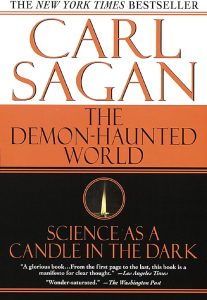 Believe it or not (I certainly have a hard time believing it!), it has been three decades since the publication of Carl Sagan’s famous essay “The Fine Art of Baloney Detection,” incorporated as chapter 12 in his The Demon-Haunted World: Science as a Candle in the Dark (1995). I therefore thought it would be a good idea for skeptics to reconsider Sagan’s essay and see how it has stood up to the passage of time and how it might be improved as we move toward the middle section of the twenty-first century.
Let’s begin with a bird’s eye view of the original. It starts out, very symbolically I think, with a long quote from Francis Bacon’s Novum Organon, published in 1620; it marked the beginning of modern philosophy of science. While Bacon’s main concern was to reject the Aristotelian approach that had been dominant during the Middle Ages (the Organon was a collection of six books by Aristotle on the topic of logic and its use in scientific inquiry), he was also preoccupied with several common errors in judgment that human beings are prone to make. The quote chosen by Sagan reads, in part: “For what a man had rather were true he more readily believes. Therefore he rejects difficult things from impatience of research; sober things, because they narrow hope; the deeper things of nature, from superstition; the light of experience, from arrogance and pride.”
You can see why Sagan thought it appropriate. His essay is roughly divided into four parts: an introduction that sets the stage, positive tools, negative tools, and a conclusion. I will focus mostly on the second and third parts, but allow me a few comments on the introduction.
Sagan reminds us that belief in nonsense is widespread. He says that close to half of Americans believe that—at some level—they’ve made contact with the dead; a quarter believe in reincarnation; another large chunk believe in astrology and UFOs; and so forth. Reasonably enough, Sagan wonders why is it that either the dead or the aliens never tell us something truly stunning that we don’t already know, such as the location of the tomb of Alexander the Great, the content of a lost book by Democritus, or a solution to Fermat’s Last Theorem (which was actually arrived at by mathematicians at about the time Sagan’s book came out). Good observations, of course.
One of the crucial points made by Sagan in the introductory section of the essay is that adjusting one’s beliefs to the evidence is the moral thing to do. He could have cited the famous paper by William Clifford, “The Ethics of Belief,” published in 1877, but he mentioned instead Thomas Henry Huxley, Darwin’s bulldog: “The foundation of morality is to … give up pretending to believe that for which there is no evidence, and repeating unintelligible propositions about things beyond the possibilities of knowledge.”
Unfounded beliefs have consequences. Sagan reminds us that purveyors of New Age nonsense make a bundle of money out of credulous customers. More tragically, distraught cancer victims go to self-styled healers in remote parts of the world, out of desperation and sometimes just to neglect science-based treatments. Credulous acceptance of baloney can cost you materially, emotionally, or in terms of health.
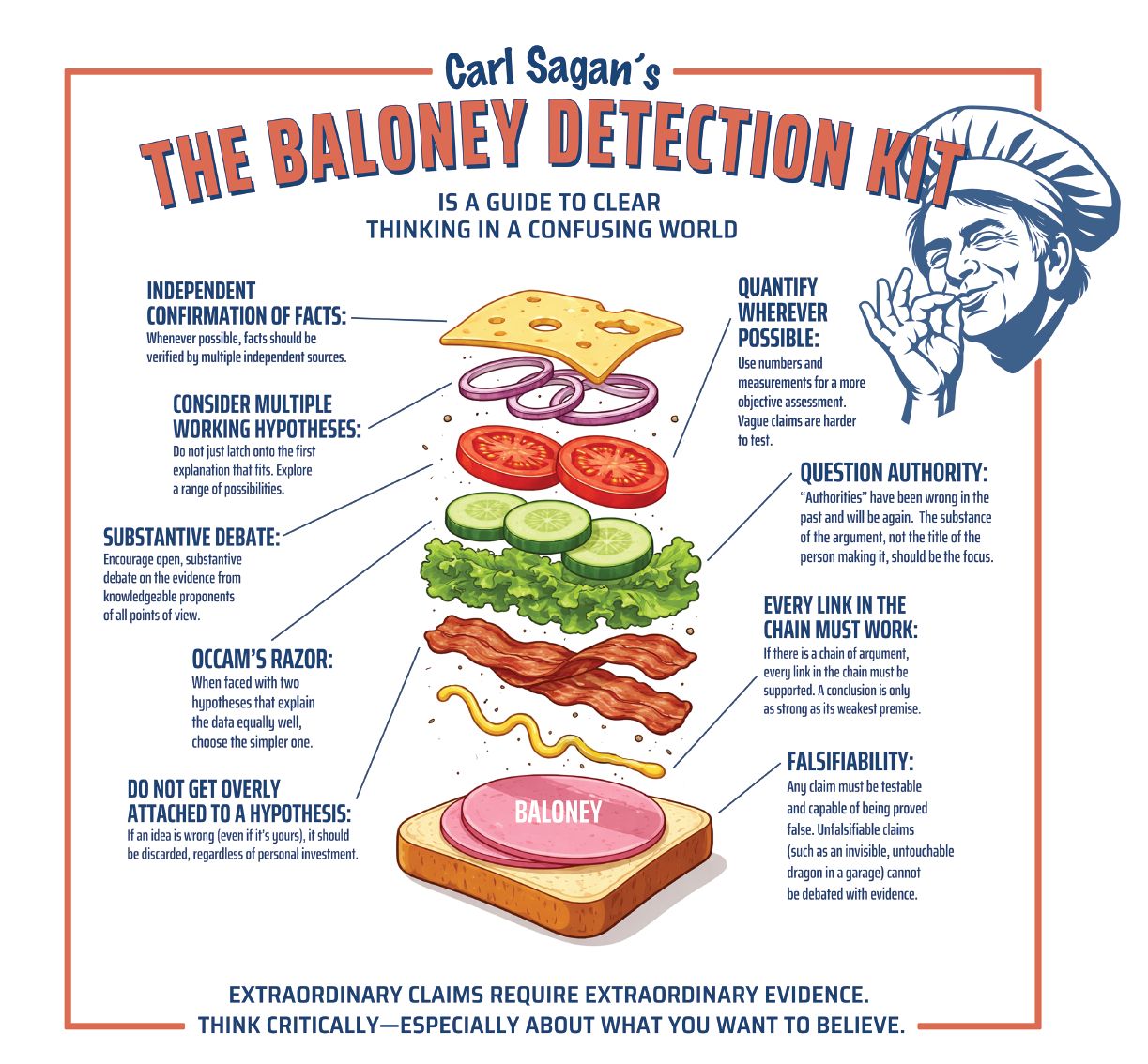
So what to do? In parts two and three, Sagan provides us with the tools of the trade—the famous Baloney Detection Kit of the title of the essay. He divides them into positive tools (things to do) and negative tools (things to avoid).
The “things to do” of Sagan’s toolkit for the skeptic and critical thinker include seeking independent confirmation of alleged facts; encouraging substantial debate regarding evidence; treating scientists as experts, not authorities; always entertaining more than one hypothesis so that the process becomes one of competition of ideas; relying on carefully designed experimental protocols; using proper controls; and, whenever possible, adopting a “double blind” approach to avoid human bias.
All the above is still very good counsel today, though we need to add some caveats. For instance, while double blinds are indeed the golden standard in scientific evidence, not even scientists can always apply such stringent protocols, and there is little chance ordinary people will be able to before making their everyday decisions.
Encouraging debate about the evidence is certainly a good idea, but in these times of social media where teenage influencers and “celebrities” have more followers than scientists and scholars, “debate” can easily turn into a heady trip into the rabbit holes offered by a variety of conspiracy theories. There is no easy solution to this problem, because of course critical thinkers don’t want to curtail debate. But Aristotle, already two and a half millennia ago, warned that it is futile to engage in discussions with people with whom not enough basic axioms are shared as starting points. I personally will engage anyone who wishes to be engaged, but only for a limited number of rounds. Once I perceive a likely violation of Aristotle’s caution, I politely withdraw and find something else to do with my limited time.
The bit about entertaining multiple hypotheses is important, but again sometimes not practical. Even in science, it works during the early stages of the process of discovery but not necessarily in later ones. At the onset of the twenty-first century, it was reasonable to entertain doubts about both quantum mechanics and general relativity. But that has not been the case for many decades (though we actually know both theories are likely incomplete, so the search for an underlying, deeper theory is ongoing). Even Sagan himself famously said that it’s great to be open-minded, but not so much that your brain risks falling out.
What about the things “not to do,” as Sagan puts it? Here he presents his readers with a list of the major informal fallacies: ad hominem, argument from authority, argument from adverse consequences, appeal to ignorance, special pleading, begging the question, non sequitur, post hoc ergo propter hoc, false dichotomy, excluded middle, slippery slope, and straw man.
To these, Sagan adds the dangers of observational selection, suppression of evidence, use of weasel words, deployment of statistics based on small numbers or generally misunderstanding the nature of statistics, engaging in inconsistencies, and asking meaningless questions.
Pointing to informal fallacies has become de rigueur in skeptic circles, but it’s a problematic practice. First, what’s the difference between formal and informal fallacies, and why do we never talk about the first group?
Formal logical fallacies are errors in the structure or form of an argument regardless of its content. They violate the rules of logical inference and can be identified purely by examining the argument’s form. These fallacies are invalid by definition, regardless of whether the premises or conclusion are true. By contrast, informal logical fallacies relate to the content of an argument rather than its structure. They involve errors in reasoning, relevance, or evidence that make an argument weak or unsound, even if the form appears valid.
So formal fallacies concern the validity (i.e., the proper structure) of an argument, while informal fallacies concern its soundness (i.e., the truth of its premises). One group is about form, the other about content. Though plenty of people make errors of both kinds, very few public discussions of science and pseudoscience are couched in the style of a formal argument, like this:
If the theory of relativity is correct, then we should observe a certain amount of gravitational bending of the light;
We do not observe that amount of gravitational bending;
Therefore, the theory of relativity is wrong.
The above argument takes the form known as modus tollens (if p then q; not q; therefore, not p). As presented, it is valid but unsound, because the second premise is wrong: we do observe gravitational bending of light; that’s how the theory was spectacularly confirmed after a famous total eclipse of the Sun in 1919. As a result, Albert Einstein became a celebrity overnight.
Informal fallacies are so common that there is a website devoted entirely to the proposition that “thou shall not commit” them (yourlogicalfallacyis.com). There is even a companion site explaining cognitive biases (yourbias.is), which are the psychological heuristics that lead us to commit the fallacies in the first place.
The problem, as I and my colleagues Maarten Boudry and Fabio Paglieri (Boudry et al. 2015) have shown, is that sometimes the so-called logical fallacies are not fallacious at all (and, correspondingly, the so-called biases are actually good practical shortcuts). Take, for instance, the first two on Sagan’s list: ad hominem and argument from authority. Sometimes, they are perfectly reasonable approaches. If you tell me that you intend to buy a car from a dealership near me and I warn you that the dealers there are known to sell lemons, I am mounting an attack on their character, but I’m also giving you a valuable warning that you would be unwise to ignore.
As for arguments from authority, we use it very often! Every time we trust our doctor, our dentist, our car mechanic, our plumber, and so on, we are deploying what officially is classified as an informal fallacy. Every time we point out to climate deniers that there is a broad consensus about anthropogenic climate change among climatologists; every time we say that the overwhelming majority of biologists agree on evolution; and so on, we are invoking an argument from authority (as well as a vox populi, just for good measure). And we are right in doing so! Not because experts are never wrong but because—other things being equal—it is wise to bet on expertise rather than against it.
There is another problem with the easy, almost automatic deployment of a “your fallacy is” kind of response (as well done as the homonymous website actually is): the other side has quickly learned to play the same game. I’ve heard plenty of defenders of intelligent design, climate change denialists, vaccine denialists, and so on saying something along the lines of: “you are committing the X fallacy!,” where “X” is whatever suits their rhetorical game. And we need to be careful with how we respond, because we can’t say that when we do it, the practice is justified but when they do it, it isn’t! That’s another fallacy, known as special pleading, which also makes Sagan’s list.
So, should we give up talk of fallacies altogether? Some colleagues in the field of argumentation schemes have gone so far as to make that very suggestion. I don’t, but I do think that we should talk about both logical fallacies and their psychological twins, cognitive biases, as tools that may or may not be used properly, rather than as absolute evils to avoid at all costs. Of course, doing so requires nuanced discourse, which is not suitable for a quick exchange on social media or to be printed on a bumper sticker.
Let’s take a look at the additional “don’t do it” items on Sagan’s list, other than the informal fallacies. Some of them, such as observational selection or suppression of evidence, actually fall under the general rubric of cognitive biases. As such, they suffer from the same problem we have just seen in the case of logical fallacies: sometimes biases are actually efficient heuristics. Any good scientist will select certain observations on the grounds that they are of better quality than others and will ignore some alleged evidence on the grounds that it doesn’t meet minimal epistemic standards. So, again, the problem is not in what we do but in how we do it, which, once more, requires a nuanced discussion, not a general “don’t do it” flag.
Another of Sagan’s important points was that we need more statistical literacy. We often talk about scientific literacy, which is of course a prerequisite for a functional democracy (together, I would argue, with historical literacy, philosophical literacy, and literary literacy). But math in general and statistics in particular are often ignored in such discussions, possibly in part due to the (incorrect!) assumption that if there is anything more boring and pedantic than science, it certainly is math. A minimal grasp of statistics, however, should be part and parcel not just of a Baloney Detection Kit but of every citizen’s toolbox for understanding and navigating the world.
A major problem here is that we just don’t do a good job, at any educational level, at providing literacy in the natural sciences, social sciences, math, and all the other disciplines that would be useful to muster for an individual who has to navigate an increasingly complex and fast-changing world. Too often what we mean by “literacy” is simply a watered-down version of intro level college courses, which are as boring as one can imagine (and then some). That’s the sort of thing that is near guaranteed to actually turn people off such subject matters, possibly making them think ill of science, math, and all the rest for the remainder of their lives.
Let us finally get to the fourth and last part of Sagan’s essay. There he does something interesting; he delves into the obfuscatory tactics used by the tobacco industry in the 1950s to hide the link between smoking and cancer from the public. Tactics that were then repeated by, among others, the oil and coal industries in the matter of climate change. The message here is clear: be very, very skeptical of corporate interests. Americans in particular have developed a cultural mistrust of their government, an attitude that certainly has some good reasons to be nurtured—in moderation. But at least the government is made of career technicians (so-called bureaucrats) and elected officials, and it is therefore accountable to the public—to a point. No such direct accountability is available in the case of national and multinational corporations, and Americans have been duped into thinking that some such corporations are “good” (and others, of course, are “bad”). They are not. They are all in it for the money, which means that it is up to the regulators and the general public to make sure that money-making doesn’t interfere with general health and well-being. This is a hard task in a country where billionaires literally buy themselves lawmakers and even presidents and where the public has been fed the fantasy that “what is good for GM (or Tesla, or Apple, or whatever) is good for the country.” It is therefore very interesting that Sagan decided to end his essay with a warning about corporate misbehavior.
So, what would an updated Baloney Detection Kit look like today? It would probably include the elements in Table 1.
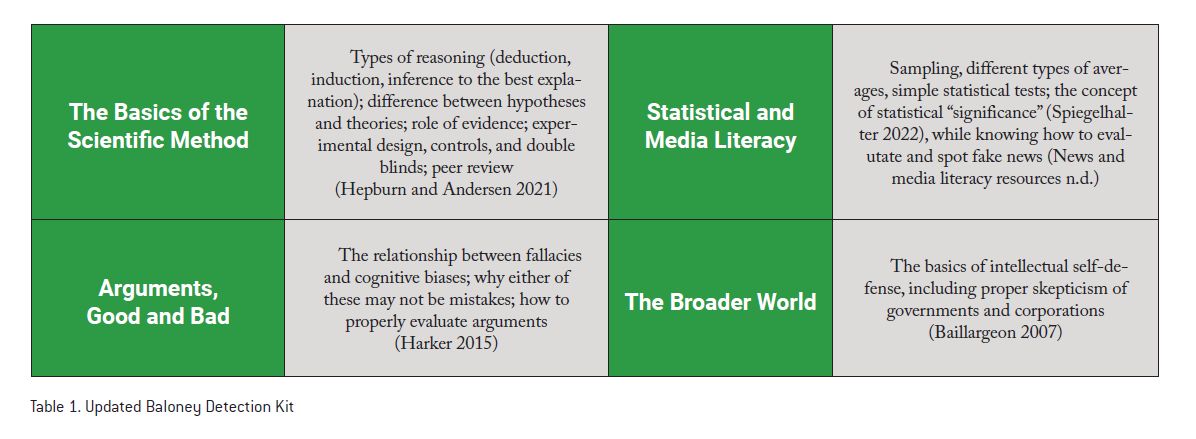
As you can see, there is much to be done. Shall we get to it?
References
Baillargeon, Normand. 2007. A Short Course in Intellectual Self-Defense: Find Your Inner Chomsky. New York, NY: Seven Stories Press.
Boudry, Maarten, Fabio Paglieri, and Massimo Pigliucci. 2015. The fake, the flimsy, and the fallacious: Demarcating arguments in real life. Argumentation 29(4). Online at https://philarchive.org/rec/BOUTFT.
Harker, D. 2015. Creating Scientific Controversies: Uncertainty and Bias in Science and Society. Cambridge, UK: Cambridge University Press. See, especially, chapters 5 (Inherent irrationality: cognitive biases and heuristics) and 6 (Thinking more clearly: arguments, reasoning and informal fallacies).
Hepburn, B., and H. Andersen. 2021. Scientific method. Stanford Encyclopedia of Philosophy. Online at https://plato.stanford.edu/entries/scientific-method/.
News and media literacy resources. N.d. BBC. Online at https://www.bbc.co.uk/teach/articles/zfjgdnb.
Spiegelhalter, D. 2022. The Art of Statistics: Learning from Data. Efinito.
[ad_2]
Source link
