
[ad_1]
As President Donald Trump moves this week to extricate himself from a conflict that a CBS News poll finds most Americans want ended now, the powerful donor-class networks that want endless war have rapidly moved to sabotage his efforts.
It is no surprise which portions of the right have mounted an emergency campaign against Trump and Vice President J.D. Vance’s recent peace efforts. Israel Hayom—owned by the Trump mega-donor Miriam Adelson—published a blistering open letter accusing Trump of signing a “surrender agreement with a murderous and cruel terror regime.” The Wall Street Journal editorial board has been carping about the negotiations almost daily since the June 17 signing of a memorandum of understanding (MOU) between the U.S. and Iran. Sen. Lindsey Graham (R-SC) is already fantasizing about another round of fighting following diplomatic failure.
But the Israel lobby is a bipartisan affair, and its influence on the other side of the aisle is even more startling under the current circumstances. The Democratic Party, funded by much of the same donor base, is working with them overtime to sabotage the agreement. This is shamelessly spitting in the face of the roughly 93 percent of Democratic Party voters who favor an exit from this conflict, most of whom opposed it from the outset.
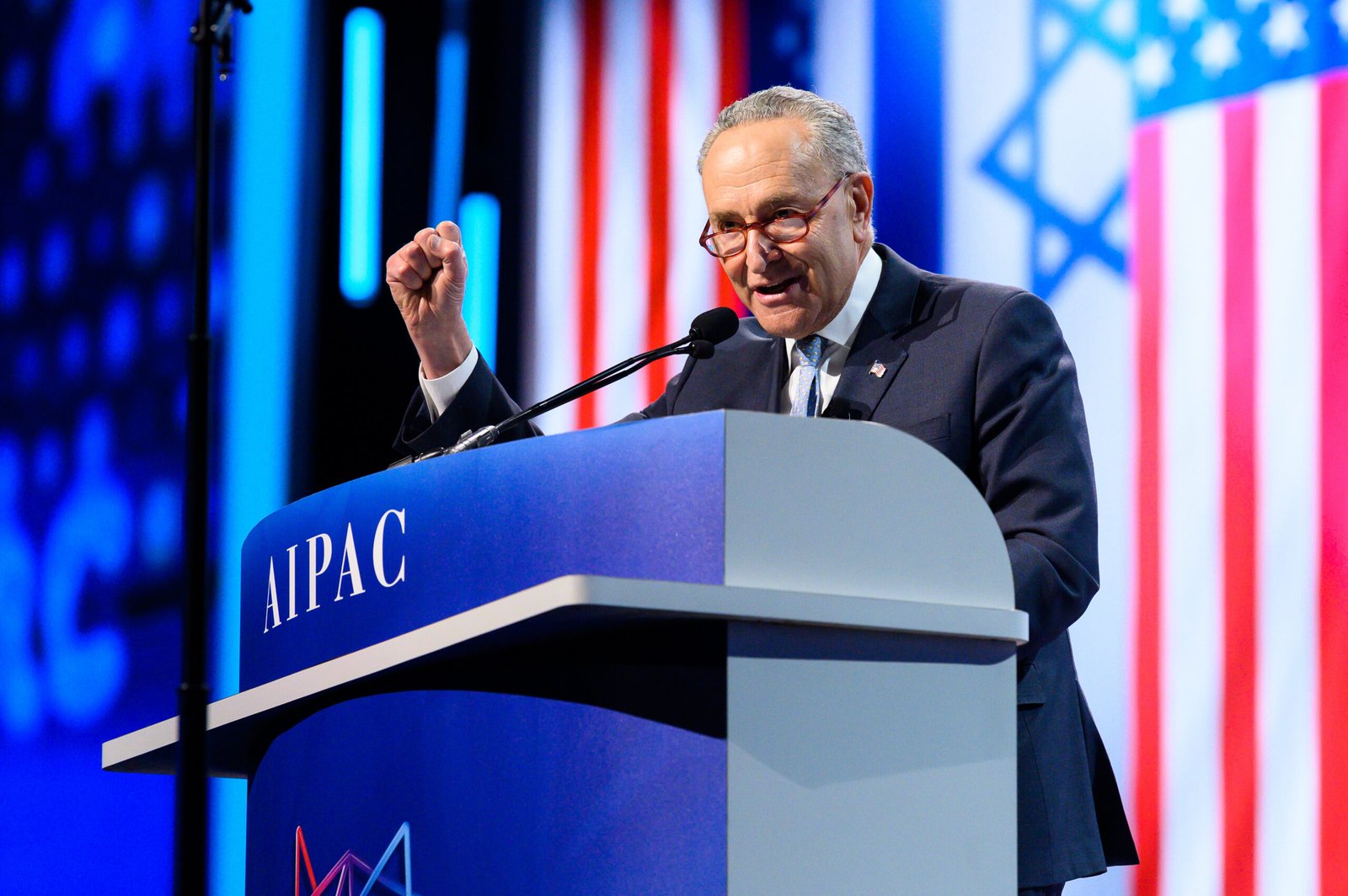
In response to the signing of the MOU, Senate Minority Leader Chuck Schumer said, “If Trump wants to send hundreds of billions of dollars to Iran, he’ll need to do it with Republican votes.”
Explicitly rejecting one of Iran’s redline conditions, Schumer defiantly declared that “Democrats certainly won’t be helping Trump send $300 billion to Iran.”
Sen. Jeanne Shaheen (D-NH), ranking member of the Senate Foreign Relations Committee, attacked the deal as “worse than the JCPOA in virtually every respect,” while criticizing the administration for “abandoning the very ‘maximum pressure’ strategy President Trump spent years championing.”
On Meet the Press, Sen. Cory Booker (D-NJ) called Trump “the biggest loser” with “egg on his face” and said the deal was “an abject surrender” that he would not support.
The talking points now wielded by congressional Democrats opposing the MOU mirror those deployed by the Foundation for Defense of Democracies, a prominent Israel lobby group. FDD is demanding that Congress embrace a poison pill to the deal and ensure any agreement “impose[s] restrictions on Iran’s ballistic missile program” and “end Iran’s support” for Hezbollah. Simultaneously, the ranking Democrats, Gregory Meeks (D-NY), Jim Himes (D-CT), and Adam Smith (D-WA), pose similar questions in a June 17 letter to Secretary of State Marco Rubio: “Will Iran be allowed to rebuild its missile program and continue to support proxies that destabilize the region?” Having abdicated their constitutional authority to declare war, lawmakers have now suddenly rediscovered Congress’s role—not to declare war, but to derail any effort to end it.
To their credit, a handful of Democrats such as Rep. Joaquin Castro (D-TX) and Rep. Ro Khanna (D-CA) have broken with their party’s hawkish establishment, urging Democrats to back the agreement.
That Democrats now play the same spoiler role for Trump’s Iran deal as Republicans did for Obama’s JCPOA is unsurprising, given the copious Israel-loyalist cash that flows into both parties’ campaign coffers each election cycle.
Based on the Democrats’ posture, it might be argued that a Kamala Harris administration would have pursued exactly the same policy against Iran and embarked on the same unpopular war of choice. Trita Parsi, vice president of the Quincy Institute, is among those who believe that’s what would have happened.
“I find that extremely likely,” Parsi told The American Conservative, describing the Biden administration’s Iran policy as “following Trump’s strategy while trying to put a happier face on it: to take Trump’s Abraham Accords and add Saudi Arabia to it.”
Noting “continuity between Biden and Trump’s first administration,” Parsi explained that though they “didn’t like that it was called a Trump deal, at the end of the day they did everything that they could” to maintain it. Parsi likewise believes that, had the Democratic nominee Hillary Clinton won in 2016, “she would have gone back to the traditional method of ‘containing Iran,’ which [would have] put too much pressure on the JCPOA” and made it collapse.
Subscribe Today
Get daily emails in your inbox
Some of this support for an aggressive Iran policy in the Democratic establishment is overt. Amos Hochstein, a senior advisor in the Biden administration and a former IDF soldier, told Face the Nation in April that he supported last summer’s Operation Midnight Hammer, in which the Trump administration struck Iran’s nuclear facilities.
“We had thought internally in the Biden administration we may have to take [strikes] if there was a second term,” he said, adding that Biden “did war games. We did some practice runs on what it would look like to look into it, because that may have had to happen under our watch as well.”
Israel, now facing the first American administration in recent memory to at least rhetorically separate its interests from Israel’s, may find its most reliable savior not in the Republican hawks it has long cultivated, but in a Democratic Party establishment whose own voters oppose the war more than almost anyone.
[ad_2]
Source link
