

[ad_1]
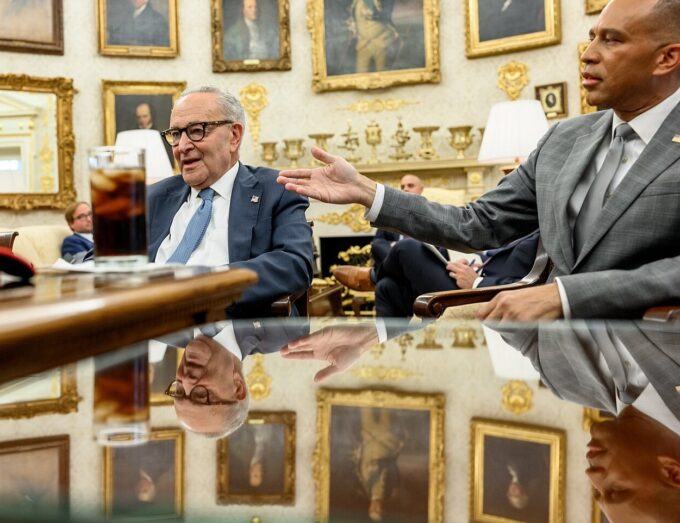
Photograph Source: Daniel Torok – Public Domain
Across New York, Florida, Michigan, Wisconsin, and Minnesota, a familiar fight is playing out inside the Democratic Party. Centrist stalwarts and Democratic Socialists of America-aligned insurgents are squaring off in primary after primary, and the press keeps covering it as though it were a simple ideological dispute, left versus center, socialism versus liberalism. It is that, but it is also something else. It is generational. And anyone who has read Edwin O’Connor’s 1956 novel The Last Hurrah will recognize the shape of the story before it finishes unfolding.
The Last Hurrah is a fictionalized portrait of Frank Skeffington, longtime mayor of an unnamed New England city modeled unmistakably on Boston. Skeffington has been reelected again and again by doing what has always worked: attending the right funerals, delivering the right eulogies, handing out the right jobs, reciting the lines of Irish American machine politics that his constituents expect to hear. When he runs one more time, he assembles the same team, performs the same rituals, and pulls the same levers. He loses. He is stunned. He cannot explain it, until someone finally tells him the single word that accounts for everything: Roosevelt. Skeffington had built his career in the years before the New Deal, when voters depended on the ward boss for jobs, for the proverbial chicken in every pot, for the personal connections that made survival possible. The New Deal replaced the machine with the federal government. It did not just change policy. It changed what politics was for, and Skeffington never noticed the ground shifting beneath him.
That is American politics today. A generational transition is underway that dwarfs the current argument over ideology. The baby boomers, and to a lesser extent the Gen Xers, are exiting the political stage, while millennials and Generation Z are taking their place. Since 2016, boomers have no longer been the largest generational voting bloc in the country, and that shift will only accelerate as boomers die off and Gen Xers age out of the electorate’s center of gravity.
American capitalism largely worked for the baby boomers, and reasonably well for many Gen Xers. Boomers are leaving the stage as the wealthiest generation in American, and arguably global, history. They lived something close to the promised American dream: college that was free or nearly so, a home with the proverbial picket fence, a car in the driveway, employer-provided health insurance, a pension or retirement account, sometimes a second home or an extended vacation. The neoliberal restructuring that began in the 1980s frayed the postwar social contract, but for most boomers the frame still held. They came of age believing the deal was real, and that belief made many of them the backbone of an establishment Democratic Party that is, by comparison to its younger and more DSA-sympathetic wing, distinctly more conservative.
For millennials and Gen Z, including plenty who call themselves independents or even Republicans, capitalism has not delivered the same bargain. Their parents lost homes, or they did. They have inherited the costs of caring for aging relatives. They are priced out of housing markets their parents could afford on a single income. A car is a luxury. Tuition has outpaced the cost of living by orders of magnitude. They are also the most racially diverse generation in American history, and they came of age watching the promise of a post-racial America, supposedly inaugurated by Barack Obama’s election, curdle not into George W. Bush’s kinder and gentler country but into something coarser and uglier under Donald Trump. Whatever their politics, this is not the America they were taught to expect: work hard, play by the rules, and the American dream is yours. It is no surprise that the old ideological categories, and the old techniques for selling them, no longer land.
Because it is not only the message that has aged out. It is the method. If Skeffington’s currency was the funeral circuit and the patronage job, the boomers’ politics ran on television, direct mail, and the telephone, supplemented by door knocking. Today’s politics runs on social media, cell phones, and micro-targeted messaging aimed at people who have never been reached by a mail piece in their lives, organized around climate change, Gaza, gun safety, housing, and health care rather than the old partisan touchstones. And yet, like Skeffington, the Democratic establishment keeps performing the rituals that once worked, unable to see that the ground has moved.
If Skeffington’s unspoken adversary was a single word, Roosevelt, perhaps this generation’s equivalent is harder to name in one syllable: insecurity, or late capitalism, or simply Trump himself. What is unfolding inside the Democratic Party right now is, in its own register, the same kind of collapse of an old order that produced Donald Trump’s hostile takeover of the Republican Party. The common thread on both sides is economic anxiety, a sense of a broken promise, and a well-founded suspicion that the establishment, like Skeffington, is doing the same thing over and over and expecting a different result. Bernie Sanders voters and Donald Trump voters do not share a platform, but younger Americans on both ends of the spectrum increasingly share a diagnosis: the old order does not work anymore, and no amount of institutional muscle memory will bring it back. New policies and new structures are required, not because the old politics failed to work hard enough, but because, like Frank Skeffington’s campaign, it was built for a country that no longer exists.
[ad_2]
Source link
