
Glen Canyon Dam. Photo: Jeffrey St. Clair.
The federal government has finalized a plan that will require California, Arizona, and Nevada to reduce water usage from the Colorado River by 16 to 20 percent through 2028. But the plan does not account for or even mention increased water usage caused by data centers in both Upper and Lower Basin states. So is there a potential path forward without tackling both?
The problem is a typical supply-and-demand issue. The Colorado River supports 40 million people, around 5.5 million acres of farmland, and vital ecological habitats in seven states. This water is supplied by reservoirs along the river, with the primary reservoirs being Lake Powell and Lake Mead. Both provide 85 percent of storage for water usage in the basin, but both reservoirs have fallen to historically low levels. As populations grow in states like Arizona, there isn’t enough fresh water to meet demand.
The US Bureau of Reclamation’s new plan focuses on Glen Canyon Dam and Hoover Dam, which form Lake Powell and Lake Mead, respectively. Structural complications for the dams will increase as water levels decline. The biggest problem is that both dams are hydroelectric power plants, providing electricity to the seven states. If the water level dips below a certain level, it renders the turbines inoperable. Hoover Dam alone generates enough power each year to serve 1.3 million people in the Lower Basin. This means there is not enough electricity and water to meet demand, and when you combine that with the basin states’ inability to come to some sort of agreement, the Bureau of Reclamation is stepping in.
The latest changes are not for a lack of trying. In 2007, the Bureau of Reclamation initiated a plan that coordinated operational changes to Lakes Mead and Powell to minimize future water shortages and avoid curtailments. These adjustments included protocols for reservoir management during prolonged drought conditions, alongside the development of Intentionally Created Surplus (ICS). This mechanism encompasses various strategies, such as implementing high-efficiency agricultural projects that result in excess supply, rigorous conservation efforts, or introducing water from external sources into the reservoirs to maintain critical surface elevations and prevent damage to dam infrastructure. Despite all these changes, low reservoir conditions continue, and the 2007 agreement expires this year.

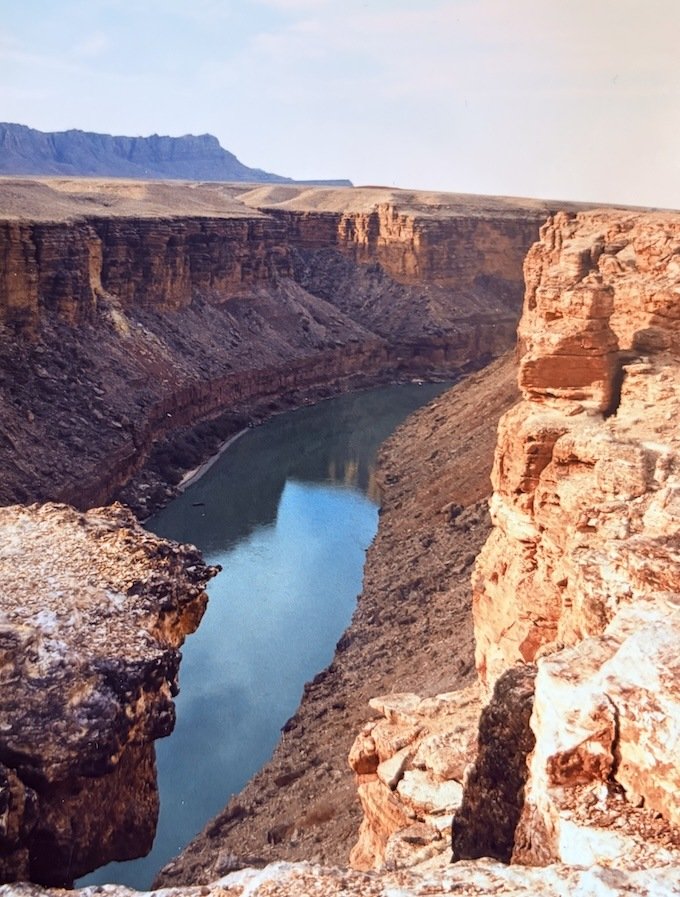
The dwindling flow of the Colorado River through Marble Canyon, a few miles below Glen Canyon Dam. Photo: Jeffrey St. Clair.
If that weren’t enough, the West is experiencing a boom in data center construction. The irony is that California and Arizona are the leading states in the Western US with high concentrations of data centers, with Utah and Nevada trying to catch up. And data centers rely on two things: water and electricity. The energy footprint of data centers in Arizona now accounts for 7.4 percent of the state’s total power, while in Phoenix alone, the water requirements for nearly 60 of these facilities reach approximately 177 million gallons daily. And shockingly — or not, if you’re paying attention — Reclamation’s new plan does not mention data centers. That’s because the administration has gone all in on AI, and that requires building more data centers.
But don’t states, not the federal government, have control over where data centers are built? Yes and no. Yes, city or county authorities control land usage through regulations, zoning, and permitting, and states can take action to curtail these efforts through environmental reviews, legislation, or regulations. New York state, for example, just recently passed a moratorium on new hyperscale data centers by pausing state environmental permits.
But the federal government also plays a role in both interstate energy management and environmental regulation. Trump has issued executive orders accelerating all federal permitting by bypassing environmental reviews. A recent Environmental Protection Agency (EPA) guidance, for example, exempts “islanded” power generation facilities — meaning they are not connected to the public grid — from parts of the Clean Air Act, allowing developers more flexibility in where they can build facilities. The administration has even offered federal land, which bypasses all the state and local zoning issues. And as local opposition has grown to the construction of data centers, the administration has directed federal agencies to review and potentially withhold federal funding from states that pass overly restrictive AI or data center infrastructure laws.
All of this brings us back to the Colorado River. Can any federal plan to prevent water shortages in the Colorado River Basin work without simultaneously banning data center development within the region? No. Using less water can only get cities so far. Las Vegas actually has the strictest and most progressive water policies in the country, with the Nature Conservancy calling the city a “water conservation rock star.” And officials in Arizona are attempting to restrict new housing developments based on groundwater availability in the Phoenix area — even if efforts recently hit a roadblock.
Localities can only do so much. And the frustrating part is that the federal government has the power to work with state and local authorities to make changes. Ideally, a plan would place a moratorium on the development of new data centers in the basin while research examines current consumption levels. If data centers’ water consumption exceeds a large percentage of the home state’s allocation, new development should be permanently halted, and data centers should be relocated or dismantled. This policy should include Upper Basin states, like Colorado, New Mexico, and Wyoming, which have typically been excluded from mandatory curtailments.
But when the administration has two policies that are at odds with each other, the one that always wins out is the one that benefits corporate interests. And right now, that’s AI — leaving the millions who rely on the Colorado River to face the consequences.
This first appeared on CEPR.
