
[ad_1]
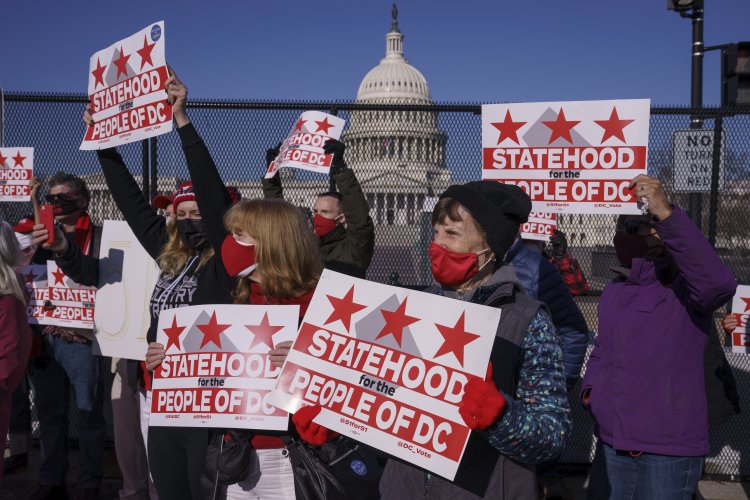
It’s been 250 years since calls for “no taxation without representation” led to the Declaration of Independence, which started the fight and founding of the United States. The people living in the center of the celebration of this feat tell a different story: The call for democracy is incomplete.
“We cannot call ourselves a democracy while hundreds of thousands of people are living on U.S. soil without the full rights of other citizens,” said Aparna Raj, the Democratic Socialist who recently won Washington D.C.’s Democratic primary election for Ward 1 and has lived in the city for 11 years.
She and Elissa Silverman, an independent who first moved to the city 30 years ago and recently won the at-large special election for the D.C. city council, both acknowledged that the fight for D.C. statehood, which has been going on for decades, will be a long one.
Currently, D.C. has one congressional delegate who doesn’t get a vote on the House floor. “There are district residents who are members of our armed forces and who have been asked to sacrifice their lives in the most extreme case, yet, they do not have the right to vote to go to war or on any expenditures, let’s say, for the Defense Department as part of the vote that a member would have in Congress,” Silverman said.
But how do states form? What are D.C.’s options? Raj and Silverman each explained a couple of possibilities.
One of the options is for Congress to approve the “Washington, D.C. Admission Act,” which would admit the District of Columbia as a new state, called “Washington, Douglass Commonwealth.”
The bill, sponsored by D.C. delegate Eleanor Holmes Norton, doesn’t include the Capitol, White House, Supreme Court, federal monuments and federal office buildings by the National Mall in the state. Instead, that land would become a new territory to fulfill the Article 1, Section 8, Clause 17 of the Constitution, which creates a stateless government: “The Congress shall have Power …To exercise exclusive Legislation in all Cases whatsoever, over such District (not exceeding ten Miles square) as may, by Cession of particular States, and the Acceptance of Congress, become the Seat of Government of the United States…”
The other option is much more improbable. A new amendment could be added to the Constitution to make D.C. a state. This would require Congress to propose an amendment and three-fourths of the nation’s state legislatures to ratify it.
“I think whichever path that brings us to statehood is going to be the one that people really, really try to fight for, but I think at the end of the day, it’s going to require not just the people of D.C., but people across the country, recognizing that the question of D.C. statehood is a question of democracy and freedom for our whole country and being willing to push their senators and push their congresspeople to be willing to recognize us as a state,” Raj said.
Silverman and Raj both view the local government as a key component of the endeavor’s success. Silverman wants D.C. residents to vote for people who will prioritize statehood. Raj also sees national organizing as crucial to victory. Raj hopes the local government can build relationships with people who come to D.C. from across the country so that when Democrats are in power, less convincing will be needed to pass a statehood bill.
Why Not?
While in 1790 states required at least 50,000 people to form, a number D.C. has now surpassed, at its founding the city only had 3,000 residents. At this point lawmaking and voting were split between Maryland and Virginia. In 1963, however, the 23rd Amendment granted D.C. residents the right to vote for president and vice president. By the end of 1970, residents had obtained the ability to choose a school board and have a non-voting delegate in the House of Representatives. Soon after, in 1973, the Home Rule Act passed, giving the city a mayor and council, though it ensures Congress oversees all legislation and budget activity and that the president exclusively appoints judges. In 1980, the constitution for what would be the state of New Columbia was passed, though actually statehood was not passed with it.
One problem facing the process is a lack of enthusiasm. A Gallup poll revealed that an overwhelming majority of D.C. residents support statehood, but most Americans outside Washington are opposed to the idea. In 2022, however, a poll by The Economist/YouGov of 1,500 U.S. adult citizens found that 36% opposed and 41% supported D.C. statehood if the residents of D.C. voted for it. Over time, it has also become a starkly partisan issue, with Democrats favoring statehood and Republicans against it. One obvious reason for GOP opposition is the near-certainty that full statehood would immediately produce two more U.S. senators from the Democratic Party.
Silverman sees it as an “education campaign.” She wants people to know the United States is the only democratic country that denies voting rights to citizens living in its capital. She also worries people think D.C. gets compensated for not being a state, an idea that used to be true until the Revitalization Act of 1997, which exchanged government money for government responsibility.
Despite having more people than Vermont or Wyoming, the city was shortchanged to the tune of $750 million in emergency funding given to states for the pandemic in 2020 (Every state was allocated $1.5 billion – the district only received half that amount).
“One of the major reasons why D.C. doesn’t have statehood is because of an attempt to suppress Black political power,” said Raj. “D.C., especially during the Civil War and after, was sort of like a haven for free Black people.”
Zack Smith, senior legal fellow at conservative think tank The Heritage Foundation, frames the issue in terms of neither partisanship nor history. The question of D.C. statehood, he said, is a constitutional issue. For Smith, D.C. statehood is a clear no. For it to even be possible, he argues the Constitution would need to be amended.
Smith writes that the 23rd Amendment, which gives D.C. residents the right to vote for president and vice president, was made with the rejection of statehood (and retrocession to Maryland) in mind. Retrocession to Maryland is also blocked because after Virginia took its land back, bills were passed stating the retrocession had been unconstitutional. To further complicate matters, the District Clause irons it out so that the government sits in a stateless space. The language of the Admissions Clause would require Maryland to consent to D.C. statehood: “[N]o new State shall be formed or erected within the Jurisdiction of any other State; nor any State be formed by the Junction of two or more States, or Parts of States, without the Consent of the Legislatures of the States concerned as well as of the Congress.”
“Sadly, some supporters of D.C. statehood have claimed that opposition to this idea has racist roots,” he wrote. “But that’s just not true. This claim is nothing more than a ploy to stifle debate and smear anyone who raises long-standing historical, practical and constitutional objections to D.C. statehood.”
The reasoning behind the struggle
The debate over statehood also concerns how much authority D.C. residents should have over their own government, particularly when the city’s political priorities conflict with those of the federal government.
That tension has become more visible under President Trump, who has criticized the city’s leadership and said the federal government “wouldn’t put up with” Democratic Socialist Janeese Lewis George, who is set to become D.C.’s next mayor.
“We’ve been a testing ground for the Trump administration,” said Raj. “We have had the National Guard on our streets for almost a year. We’ve had ICE disappearing our neighbors and what happens in D.C. doesn’t stay in D.C. Other cities and other people are really threatened for as long as D.C. doesn’t have statehood.”
Because D.C. does not have a governor, authority over its National Guard rests with the president. That arrangement drew renewed scrutiny after the Jan. 6, 2021, attack on the Capitol, when critics argued that the response might have been faster if the mayor had possessed the same authority as a state governor.
Congress also retains the power to overturn D.C. laws and supersede the city’s budget.
“We are a district that has operated independently for over a hundred years. We have our own identity. We have our own laws, we have our own elected officials, and we’ve been able to govern ourselves just fine – even despite all of the interference we’ve seen from the federal government,” Raj said. “We effectively just need the right to be able to do so.”
Republicans, along with many Democrats, simply disagree with the “govern ourselves just fine” description. This reality became painfully clear to D.C. progressives in 2003 when Joe Biden issued the first veto of his presidency. It came when the more left-leaning City Council members passed a criminal justice measure that would have significantly lowered jail and prison times for people convicted of a wide array of violent crimes, including carjacking, armed robbery, and rape.
Coming at a time when the city was experiencing a raft of carjackings, Mayor Muriel Bowser, a Democrat, vetoed it – and was promptly overridden by the City Council. On Capitol Hill, the reactions ranged from bafflement to rage. Among the victims of carjacking was a Democratic congressman. Months earlier a congressional aide from Minnesota was held up at gunpoint.
A Republican-backed bill to set aside the D.C. law passed the Senate on a lopsided bipartisan 81-14 vote – and was signed into law by President Biden.
“I support D.C. statehood and home-rule — but I don’t support some of the changes D.C. Council put forward over the mayor’s objections — such as lowering penalties for carjackings,” the president tweeted on March 2. “If the Senate votes to overturn what D.C. Council did — I’ll sign it.”
And he did.
This episode underscores how difficult D.C. statehood will be to achieve. It’s certainly true that younger, more progressive voters – the Democrats with the most passion these days – have brought new energy into the campaign for statehood. It’s also true that the lenient criminal justice policies being pushed by the DSA are among the chief arguments advanced by statehood’s opponents.
[ad_2]
Source link
