
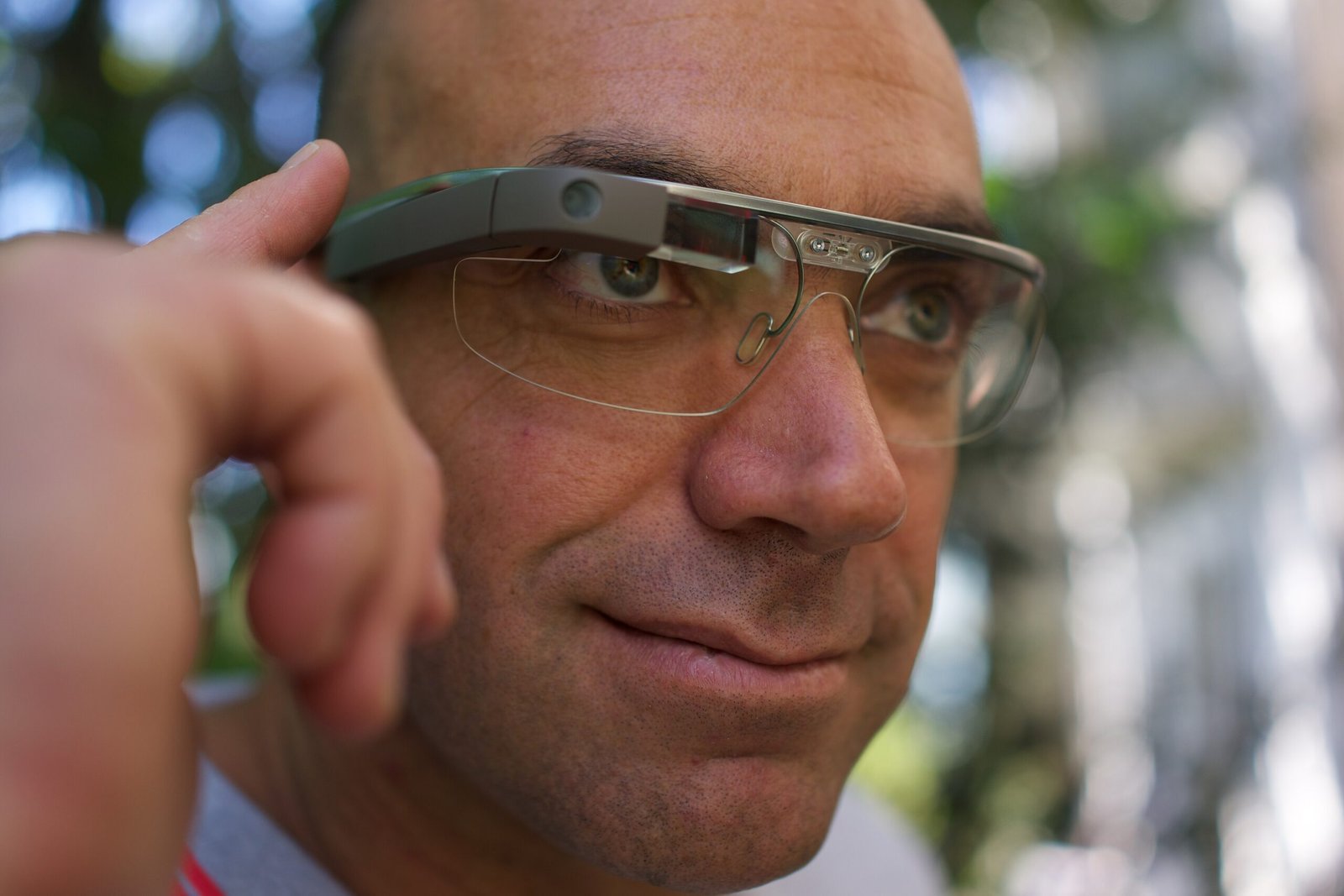
Photograph Source: Loïc Le Meur – Flickr: Loïc Le Meur – CC BY 2.0
Welcome freshman! This is your introduction to art history class. Please unpack your Google glasses and charge them up. And check the plane tickets, which will take you to China, Egypt, Italy, and India, and also France, New York, and South America. To study art history, travel is necessary. (And fortunately ours is a very well-endowed university.) You will have an exciting semester!
When you visit these great art historical sites, you will use your Google glasses to read the commentaries the faculty have assembled while looking at the artworks. As you view this art, you can view these learned commentaries at the same time. And so, you are in the right position to check whether these written accounts are correct. What has always defined art history, for the ancients as in the Renaissance and up to the late twentieth century, is that there is a distance between art writing and the visual artifacts that it describes. Whether we’re concerned with the readers of Vasari, who took his printed texts on their travels in Italy; with the readers of Baudelaire, who carried his Salons to the French galleries; or the Americans who hefted Clement Greenberg’s collected essays into American museums.
This tradition remains of live importance. When I was writing my book on Neapolitan baroque churches, I carried the commentaries into the pew, and turned from one to the next, from text to image, moving back and forth between reading and looking. Now, however, that gap in experience has been eliminated. You can see imposed on the art the commentary about it. In my books in progress on Naples, and more recently, on Venice, I have found the vast array of YouTube materials online immensely helpful. San Marco is a very complicated and looking just at the isolated images, it’s extremely difficult to get a feel for the organization of the whole. How helpful it would be to have a model presenting the organization of all these images. Already, you can refresh your memory of the setting of nearly every church and almost all paintings by looking at the YouTube commentaries. Designed often for touristic purposes, they provide very valuable information for the art historian. And now the materials in this class develop that way of thinking. Obviously this procedure doesn’t solve all of our interpretative problems. The analysis you are reading may be misleading, mistaken or even entirely wrongheaded. But the elimination of any gap between the interpretation and what we are seeing surely makes it easier to identify problems. If there is a discrepancy between what you read and what you see, then you know that the problem lies with the text, which is not inaccurate.
+++
This pedagogic novelty is, I regret to say, is still just a fantasy. So far as I know, no such classes are as yet being conducted. And I have not yet seen the Google Glass technology, which is still expensive. The reported worry was that using these glasses would eliminate privacy. But all of the necessary technology is, so I believe, at hand. And in Naples, at the display of Caravaggio’s Seven Acts of Mercy already a couple of years ago there was a primitive version of this computer technology. And so I am almost certain that better versions will very soon appear. The matching of text to picture is such a basic art historical concern that the computer technology is sure to be developed.
Currently I am much concerned with Giorgione’s The Tempest (1507), which is in the Academy in Venice. The basic scholarly dilemma involves asking what interpretation can describe the man, the woman, the child, and the landscape. This picture looks simple, and so very many competing interpretations are proposed. Maybe it is a scene from Scripture; perhaps it depicts contemporary political events; possibly it is a free play of fantasy. In your study, you can consult Salvatore Settis’ Giorgione’s Tempest: Interpreting the Hidden Subject, which lists 38 interpretations. How helpful it would be to read all of those accounts in the museum gallery while looking directly at the painting.
Here I have only considered the viewpoint of my students, whose experience of art museums will be dramatically changed. But what about art history research- -how will it be affected? Just as the replacement of internal combustion engines by electric motors is about to change how automobiles look, are manufactured, and are maintained, so I expect that these new technologies will transform how we understand visual art. This will be an exciting moment, if only we scholars can get financial support for our research. Recently, the ready availability of high-quality images online has changed the everyday practice of art history writing. And so I believe that other potentially beneficial changes are sure now to come quickly.
