
Ten Years On: The Untold Story of Brexit – Reflections on a Life of Campaigning, by Matthew Elliott
“Even now, people call the Brexit vote a victory for right-wing populism … They are right that Brexit was a victory for populism; they are wrong to think it was for the right-wing kind,” says Matthew Elliott in Ten Years On, which is certain to be the most insightful and honest telling of how Brexit happened. The referendum’s 10th anniversary passed in June; the day before, the prime minister, Sir Keir Starmer, resigned. This will mean that in 10 years we’ll have had seven heads of government.
So has Brexit broken Britain or did a broken Britain produce Brexit? Elliott was the chief executive of Vote Leave, the official campaign to get us out of the EU (I was a director), and we of course say that however Brexit happened, it’s a thoroughly good thing that it did. As now at least we can solve our own problems, and it won’t be the fault of furriners if we don’t. The age of political excuses is over, the time of finding out is begun.
Elliott’s book shows, with more candor and precision than anything I have seen anywhere else, how it was a generation of right-wing failure that brought us to this point. Failure of tactics, strategy, personnel, and even principles. I don’t know whether the idea that a vast conservative settlement, capable of sustained electoral success, but in fact being rotten to the core, is something Americans can appreciate, but let us see how Brexit over here looks over there.
***
Starmer’s departure was heralded by your president canvassing it on social media. Such are the ties of blood and comity between us that we were merely Truth Socialed, rather than Maduro’d. But even here, the departure of yet another lackluster PM is just what Jack Womack was aiming at in his dystopic sci-fi novel, Random Acts of Senseless Violence; his 12-year-old prep-school protagonist is as blithely oblivious about that year’s fifth presidential assassination as any of the grown-ups are.
Adult indifference is the hallmark of the British state currently. When Starmer stood in front of Number 10 to resign, his words were drowned out by a fool called Steve Bray playing amplified music (in this instance, Beethoven’s “Ode to Joy,” aka the EU’s national [sic] anthem). Bray has been a serial bore in Westminster since, you’ve guessed it, the referendum a decade ago.
Why can’t the British state stop a lout outside the Downing Street gates from disrupting prime ministerial press conferences? You’re maybe tempted to say, and in that precise tone of voice, “nobody knows.” But of course everyone who cares does. It’s because although we’ve left the EU, we’ve remained welded to something called the ECHR, which was a piece of paper we wrote after the war to see if the Germans would mind awfully being slightly less so. We don’t need it, we shouldn’t be in it, the Tory Party now pretends it wants to quit it, but here we still are, after decade upon decade of Conservative failure to do anything conservative.
In short order, our next prime minister, a lackluster Scouser called Andy Burnham, who lost two Labour leadership elections, but won his third attempt in July because there wasn’t a contest, came to London on the train.
It might have surprised Americans to see just how little security there was for the PM-elect when he left Manchester, where he had been mayor, or on the train to the big smoke, or at Euston, the London station he arrived at, or for the humble black cab he took to parliament. Burnham, I regret to say, wears black tee-shirts, a la Ricky Gervais. This is a kind of faux-populist uniform for progressive time-servers here, and as such, unknown garb for Lord Elliott, as Matthew now is.
Three men were indispensable to winning the referendum 10 years ago: Elliott, who drew the Leave campaign together, and perhaps still more important, kept it more or less united; Boris Johnson, then the outgoing mayor of London, and at the time, the country’s most popular celebrity, never mind politician; and Jeremy Corbyn, the IRA-loving, antisemite-enabling leader of Her Majesty’s Loyal Opposition.
Of these three, the greatest, in the cause of Brexit winning, was Corbyn, then Labour leader and a longtime skeptic of the EU. As Elliott rightly notes, any other Labour leader would have wanted Remain to win, and, unlike Corbyn, who polled dismally, would have had the popularity to add something to the pro-EU campaign. But God decided that what Britain needed in 2016 was a Marxist crank who would do that final piece of heavy lifting the British right would have been quite incapable of doing on its own.
So that’s how the referendum was won, but how did we get to having one in the first place?
***
Britain does a good trick in politically seeming ancient and rooted, when in fact we’re trivial, untrue to ourselves, and—I say this clinically—spastically reckless.
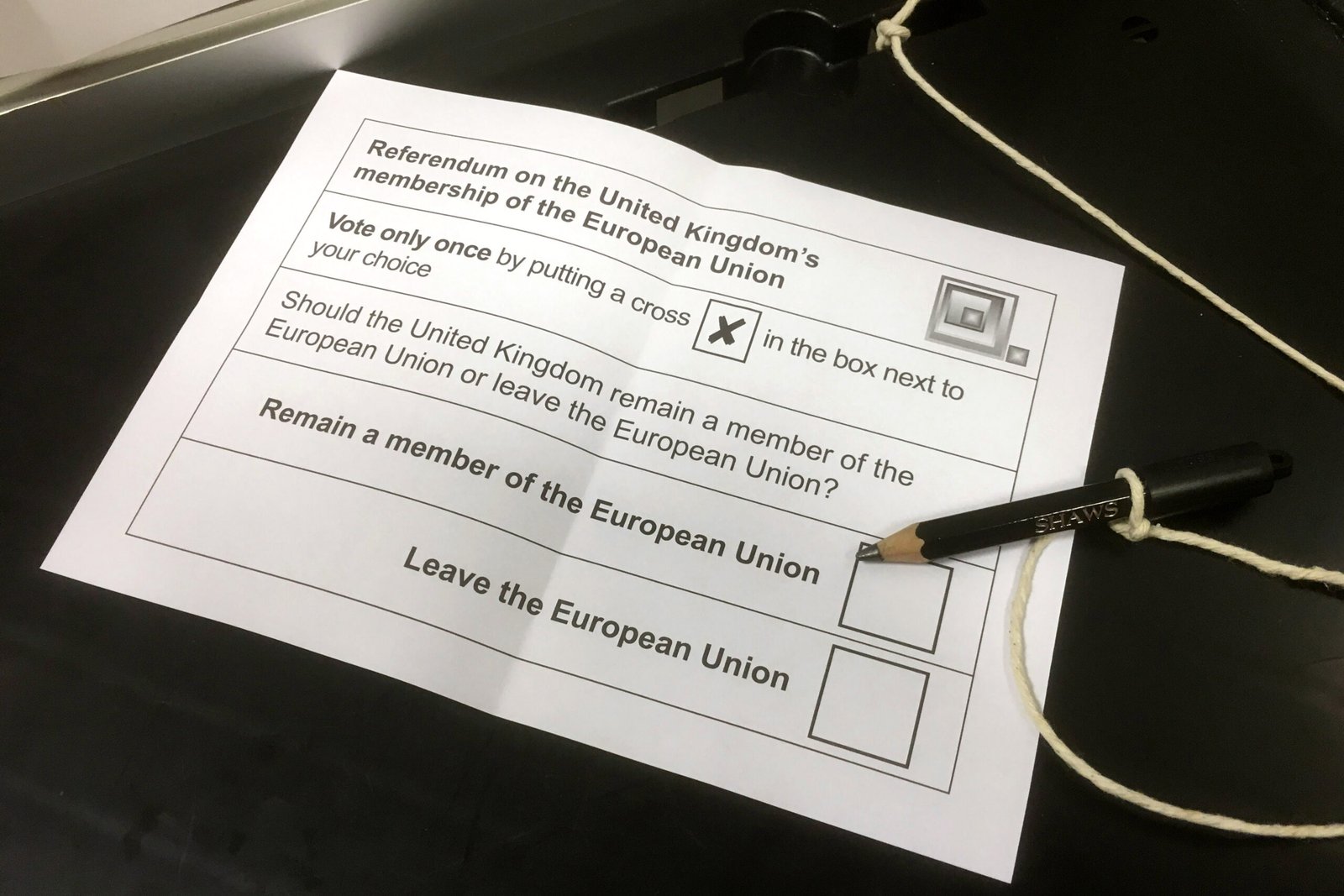
That the referendum on British membership of the EU happened at all was one such instance. It was our third national referendum—the first had been in 1975, as a device by the wily then Labour PM, Harold Wilson, to keep the UK in the EEC, to which it had acceded in 1973, and manage his own party, which mostly disliked that fact.
Our second national referendum was in 2011, on whether we should fundamentally change our voting system, from majoritarian first-past-the-post single-member districts being the basis of our parliamentary system of government to a dismal thing called AV. This was the coalition price Liberal leader Nick Clegg demanded of his coalition-partner David Cameron, after the latter failed to win the 2010 general election (against Gordon Brown, the most unpopular PM in history up to that point).
As a sidebar, I was first introduced to the joys of redistricting by my late friend Ed Lipman at university 30 years ago (the mad stuff you get up to when you’re young). Ed, whose father Sam was Commentary’s music critic, the New Criterion’s publisher, and a sometime Reagan appointee to the NEA, was a whirlwind in early-’90s Cambridge, where he had come after a first degree at Columbia.
A self-professed “Upper West Side nationalist,” Ed had no time for pious Brits like me muttering about how unseemly your racialized congressional districts were. “But Ed, they’ve been created solely on the basis of the color of people’s skin!” To which this great and corrosive cynic replied, “And fantastic news for the GOP it is! It makes their majorities top heavy and our districts far more competitive.” There was to be no such conservative hard-headedness on whether Britain’s voting system should be changed in 2011.
It’s impossible even 20 years on to contemplate just how selfish and shallow the leadership of “the right” by Cameron, and his mainstays George Osborne and Michael Gove, was. But an American, much attached to his constitution, might reasonably ask, “What, you were casually going to junk how the House of Commons happened, and everything that flowed from that politically, just because some dicks signed up to this simply in order to get into office?” We sure were! But thankfully the No to AV campaign was run by—Matthew Elliot, who won it, and, by his own reckoning, used this experience to determine how he would go about running a campaign to leave the EU, should ever the opportunity arise.
Elliott was no cradle Tory—his father, a social worker, was out on strike for a year under Thatcher—but he was certainly a juvenile autodidact, self-dosing on Milton Friedman and whatever other truthiness came his way.
Musical—a dab hand with the church organ to this day—his political formation left him with the traits which were to be so indispensable in the winning of Brexit, even in the face of everything its keenest supporters did to try and lose the referendum. Namely his preternatural ability to stay unflaggingly calm and polite.
It’s a mark of how self-effacing the man is that when his parents saw him on the television news during the AV referendum, they vaguely knew he was involved, but had no idea on which side.
AV was no walk in the park. Prominent Cameronian Tories like Michael Gove promised support, then welched, and the actual winning of the campaign required securing a substantial proportion of natural Labour voters. Once again, the gifts of Elliott were on display here.
“After I awkwardly explained our strategy,” Elliott relates of one trade union baron he cajoled to join up with the opponents of AV, the Labour heavy got to the point: “I think you’re a Tory c*nt,” he said. “But on this campaign, you’ll be our c*nt, and win the f—ing referendum”.’
All of which meant that Elliott, although a committed Leaver, was congenitally allergic to the self-harming histrionics too many other of his fellow long marchers self-indulgently engaged in. Given that, even come the referendum itself, most Tories didn’t support Leave, and mere years before, the handful who openly did were in single figures in parliament, the triumph of gaining Brexit against the official right, which did not want it, is all the more remarkable.
***
Each step in Elliott’s career, as a political entrepreneur, was, one way or another, assisted by the failure of the right’s formal leadership. He set up, ran, and, critically for the British scene, secured funding for a campaign group called the Taxpayers’ Alliance (the TPA). It did what it said, but was only able to do so because of market failure—namely the official Tory party, in the form of its finance spokesman, latter minster, George Osborne, who was no friend to the ordinary tax victim.
His inspiration for the TPA naturally owed much to Grover Norquist’s Americans for Tax Reform. In due course he’d also get Sarah, his delightful American wife, from the same place.
One precocious lesson Elliott took from the American scene wasn’t from his natural conservative allies, but from the Obama campaign. Latinos for Obama, Croatian-Americans for Obama, Republicans for Obama—whatever the peripheral group was, their campaigning utility to the overall project was immediately apparent to Elliott. This was to be of crucial importance come 2016 when dozens of such campaigns—“vapers for Leave”—spontaneously emerged.
The lesson that Elliott took from both sides of the Atlantic was that true believers mustn’t be allowed to throw away their thing. His analysis of why Leave lost in 1975 was the conventional one: The No campaign, which wanted Britain out, was composed of unappealing misfits from the fringes of British politics. Given the depth of establishment resistance to any serious effort to leave, the attempt to do so would have to look above all else professional and reasonable. Disciplined pursuit of this strategy would cause much sorrow and end many friendships—worst of all, ones forged in foxholes, given how few in number the longtime Leavers had been and were.
***
That there was a referendum was of course because of yet more official Tory failure. Cameron failed to win the 2010 general election on his own, and to govern had to go into coalition with the Europhile Liberal Democrats. Doing so negated much opportunity even for Euroskeptic posturing, and, parliamentary politics being what it is, each Lib Dem MP who was a minister meant one less Tory backbencher who got a red box and a Whitehall office. Thus bitterness and belief fused nicely to build up internal Tory opposition to Cameron (whose lack of love for his party’s more lumpen followers was snobbishly transparent).
From the outside came the threat of UKIP, led by Nigel Farage,and fuelled by decades of what he portrayed as Tory betrayal on so much, not least on the EU, which the Tories talked about, but never did anything about.
Cameron, having alienated too many of his own MPs, and not having won anything like a large enough majority in the 2015 general election to safely ignore them, rashly, bumptiously, gave in to the demand for a referendum. He expected to manage his political problems by winning this battle. Why he didn’t is the story of Ten Years On.
Elliott, and others, were able to frame the pitiful “negotiations” Cameron conducted with Brussels as being so much pabulum. But, as Elliott was at pains to point out to the never fully convinced Euroskeptic base, this trick was only possible by having been—truly or otherwise—openminded in the first place. Thus, when Cameron didn’t bring home the bacon, the disappointment hit home, and hard.
None of this would have happened if the Leave campaign’s eventual campaign director, Dominic Cummings, had been right in his polling, which scientifically “proved” that there was no chance the Tories could win the 2015 election and thus be in no place to concede any sort of plebiscite—but there you go.
I shan’t mention here how much the referendum campaign cost. It would simply be too, too embarrassing as a Europoor to admit that. In so many ways, British politics is unbelievably cheap. Yet the campaign still had to be paid for, however reluctant British donors are to give. And, before the short, official campaign started, we lacked any of the charms Remain enjoyed, such as government patronage, or, indeed, taxpayers’ spondulicks. Easily three quarters of the lolly we raised was due to Elliott’s donor network.
In America this man would make presidents, or at least their campaigns, if there is a difference—I do not know enough about your politics to be sure.
Not everyone wanted to win. And I don’t just mean the people hardcore leavers habitually accused of that, such as our front men Boris Johnson and Michael Gove. Farage very clearly bought into the overwhelming political consensus that Leave wouldn’t win, and aimed, perfectly reasonably, to be King of the Losers.
After all, since he failed to gain control of the official Leave campaign, Farage could, entirely plausibly, blame its eventual failure on the Tories who ran it, and foolishly didn’t put him front and center on the telly every evening. But they didn’t lose, and for that we have to turn to David Cameron.
An overrated electoral asset (failing to win in 2010, only just scraping by in 2015), Cameron was clapped out electorally. His right hand-man George Osborne was still more unpopular: for a certain sort of Tory, no greater joy exists than watching, and rewatching, and rewatching him being booed at the Paralympics.
Cameron further lacked a popular, actually pro-EU Labour leader to compensate for his own failings, as Corbyn was none of these things. And as Elliott notes, Cameron was still so confident of victory, he alternated between pulling punches, so that the Tories could all the more easily be reunited after his inevitable referendum victory, and lazily allowing the lamest Remain campaign imaginable. The result ludicrously, and therefore counterproductively, threatened us with everything up to and including World War Three.
Indeed, in one of the most important passages in Elliott’s book, he demonstrates with painful clarity that all Cameron had to do was showily reject the pitiful terms the EU had offered him in its most recent “renegotiation” and then there was every chance he would have won the referendum, as the Leave campaign would have fallen apart, destroyed from within by Cummings, Elliott’s choice as campaign director.
From potentially failing to keep on side the MPs whose support was necessary to pass into law a referendum bill which was at least not actively unfair to Leave, to spouting contradictory bollocks such as the need for not one but two referenda (i.e., giving Remain two chances to avoid defeat), so much of Vote Leave’s efforts seemed curiously self-sabotaging.
Unfailingly kind, Elliott still insists that Cummings was vital to Leave’s success. As too, he says, was the backbench Tory MP Steve Baker, who did so much to rally Tory MPs to risk their political futures by going against their seemingly all-powerful leader. Baker’s role is a testament to how important it is to actually do stuff, because no one can believe just how idle Tory MPs are when left to their own devices.
That Steve, a freshman MP, achieved so much was, once again, the consequence of how much Cameron, Osborne, and Gove had failed politically, with opposition to them being a legacy above all else of the hated coalition with the Liberals (which they championed and obviously benefited from).
This then was the political problem Cameron was trying to solve with the referendum: not the epochal matter of Britain’s postwar national strategy, but the mere fact that his, and his faction’s, ascendancy over the Tory party was as weak as the electoral results he achieved as leader deserved it being. Cameron no more cared whether the Conservatives were in or out than the Number 10 cat did.
Whereas the people Elliott marshalled in the Leave campaign cared so painfully much.
***
Subscribe Today
Get daily emails in your inbox
Once the campaign was called, and once Farage was stopped from running the Leave side, it was never going to be lost. Or so it seems to me. That the campaign was called was because of David Cameron’s ineffable arrogance and political incompetence. In this the despised Osborne was entirely correct: The Tory leadership could have got away with avoiding a referendum until the point at which Leavers could win control of the party, then Parliament, then the public. These variables were all a long way off, if even realizable.
This then is the difference with Trump. He, from here, does look very like what Kissinger said he was: “One of those figures in history who appears from time to time to mark the end of an era and to force it to give up its old pretences.” But that’s the thing: He did that. Brexit, in contrast, was needlessly conceded as an opportunity by weak men gambling. Those of us who wanted it had decades of failure behind us in getting it, and could have suffered for many more years, had Cameron held his nerve, or delivered the political goods for his party.
But he didn’t, and the referendum happened, and the right side won because that was the side Matthew Elliott was running. We had enough petty egomaniacs trying to capsize the boat, thank God we had him to steady it. Inevitably various Tory Number 10s could have had him, with multiple PMs asking him to come and work for them. Thank goodness, for Brexit, they failed there too.
