

[ad_1]
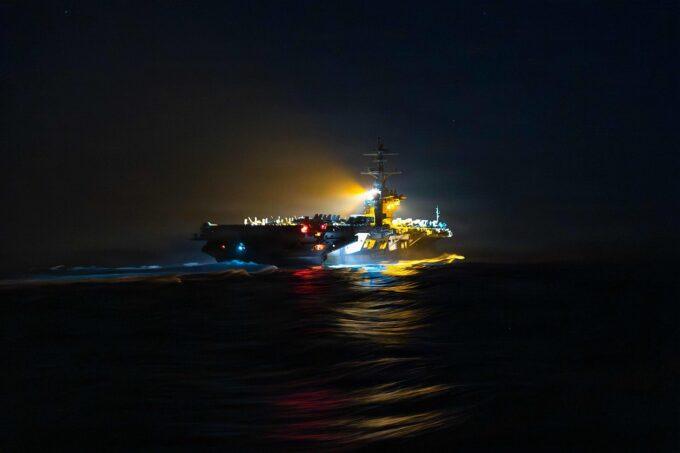
Photograph Source: NAVCENT Public Affairs – Public Domain
The unprovoked joint U.S.-Israeli war launched against Iran on 28 February 2026 will manifestly change West Asia. When it ends, Arab despots, who allowed their countries to be used as platforms for aggression against Iran, will confront a new reality.
The safety and stability they thought was theirs based on fealty to the United States and its Israeli proxy was shattered as Iranian missiles and drones were en route to destroy the U.S. military and intelligence installations they had allowed on their soil; a subordination they falsely believed would protect them.
The Arab world is learning the hard way what the late-Secretary of State Henry Kissinger, in his cold logic, implied decades ago about American foreign policy: “The word will go out to the nations of the world that it may be be dangerous to be America’s enemy, but to be America’s friend is fatal.”
On the other hand, it is clear that Iran does not abandon its allies, having supported the just cause of the Palestinians for 47 years. And during the current war, Tehran has refused to abandon its Lebanese Hezbollah allies as well. It has adopted a “peace for all or no peace” stance, refusing peace negotiations/accords that would not include its regional allies.
Deep-seated militarism and distrust, hallmarks of the region, are directly linked to a legacy of foreign intervention: the post-WWI breakup of the Ottoman Empire; the 1948 imposition of the Zionist colony in Palestine; and America’s unwavering support for its killing machine.
From the Truman Doctrine to the Carter Doctrine, the Persian Gulf and its natural resources have been regarded as “vital interests” of the United States, to keep riches in the hands of wealthy Americans. Every U.S. president has declared a willingness to use “any means necessary” to dominate the region.
To “protect its interests” and its Israeli proxy, the United States has operated 19 military bases across roughly 10 countries in West Asia, housing 40-50,000 military personnel. Of that number eight were considered permanent installations, while the others were temporary or forward-operating sites. It also deployed several naval ships to the Mediterranean; with the headquarters of the anti-Iran naval armada, the U.S. Navy’s Fifth Fleet, anchored in Bahrain.
Prior to the latest Zionist instigated war on the Islamic Republic, these sites had been used by America to spy on, destabilize and attack Iran as well as other Muslim countries.
For example, the drone that killed Quds commander, General Qassem Soleimani and several others, including Abu Mahdi al-Muhandis, deputy commander of Iraq’s Popular Mobilization Forces, in 2020, was flown from the Al-Udeid air base in Qatar, home of U.S. Central Command. It is worth noting that the Iraqis assassinated in the attack were Qatar’s fellow Arabs; Soleimani was the lone Persian among them.
It is important not to forget that the presence of U.S. bases in Saudi Arabia was identified by al-Qaeda as a primary reason for the attacks of 11 September 2001; this in addition to Washington’s unconditional support for Israeli atrocities against the Palestinians.
When the Arab states outsourced their security to the United States, believing they had purchased safety and security, they essentially relinquished their sovereignty; this is especially true of the six Gulf Cooperation Council (GCC) member states that border the Persian Gulf: Bahrain, Kuwait, Oman, Qatar, Saudi Arabia and the United Arab Emirates (UAE).
Beyond military bases, the U.S. has dominated these Gulf regimes through economic ties, security partnerships and massive arms sales, which have created dependence on American military technology, training and maintenance.
As Washington built up its military in the region and increased its threats to use force if Iran did not surrender to its (essentially Israeli) demands, the Islamic Republic, in an official letter to the United Nations (19 February 2026), reaffirmed once again that if subjected to military aggression, it would:
“respond decisively and proportionately in the exercise of its inherent right of self-defense under Article 51 of the Charter of the United Nations. In such circumstances, all bases, facilities, and assets of the hostile force in the region would constitute legitimate targets in the context of Iran’s defensive response. The United States would bear full and direct responsibility for any unpredictable and uncontrolled consequences.”
Soon after the joint U.S.-Israeli strikes and targeted assassination of 86-year old Supreme Leader Ayatollah Ali Khamenei and his family on 28 February, Iran launched retaliatory attacks on U.S. bases in the Gulf; installations used to strike the country.
Ironically, the Gulf monarchies have based their security on the primary source of regional insecurity. Washington’s unconditional support of Israel has made the entire region a target.
Despite warnings of the risks to the economic and structural stability of its Gulf partners, the Trump administration, with Israel, escalated its attacks on Iran. Forced to the forefront of a war they did not want, Gulf rulers have learned that they are expendable in the eyes of Tel Aviv and Washington.
The disparity between the vast economic wealth of the Gulf states and their limited political agency is largely a legacy of their historical evolution.
The modern oil-rich monarchies of the Persian Gulf evolved from ancient maritime trading hubs and tribal confederations. Until the late 20th century, the Gulf states, except Saudi Arabia, existed as British protectorates and their boundaries were primarily shaped by colonial officials.
Most of the current ruling families are descendants of leaders maintained in power by the British during their 150-year domination of the Gulf (1820-1971).
To support its strategic interests, primarily in India, Britain legitimized existing hereditary leaders and installed local hand-picked rulers that were willing to accept British authority. Those who refused “supervision” risked being deposed and replaced with a more compliant family member.
Interestingly, Britain’s hegemony over the Gulf began in 1820 over its refusal to pay tolls to pass through the Strait of Hormuz. At that time, the powerful Qawasim maritime tribe (the Al-Qasimi family) controlled the waters of the Gulf and levied tolls on all trade that passed through the strait. The British refusal led to confrontations between the two sides and the destruction of the entire Qawasim fleet.
Today, the descendants of the Al-Qasimi family, continue to rule two Emirates (Ras El Khaimah and Sharjah).
If the Gulf monarchs survive the war, their populations may—for the first time since both world wars—decide their futures free of tyrants, profligate sheiks and foreign domination. They can look to their own history, traditions and cultural heritage instead of relying on and mimicking the West, building one more alien useless skyscraper, sponsoring LIV golf tournaments and drag racing in the desert.
For nearly five decades, Zionist regimes have focused on a strategic goal: the election of a U.S. president compliant enough to wage war against Iran on their behalf. They found their cat’s-paw in the current occupant of the Oval Office, Donald J. Trump.
Born at the barrel of a gun, Israel secures its place in the region by fostering chaos and conflict. By deliberately sowing inter-Arab and Iranian-Arab division, it has reaped enormous profits through a booming arms and intelligence industry. And by keeping its neighbors at odds and concentrated on Iran, it ensures no unified front arises that can challenge its existence.
The war on Iran has forced evolution, if not a revolution, upon West Asia. This shift could alter the geopolitics of the region, triggering U.S. independence from Israel and enabling regional transformation free from U.S. and Israeli domination.
With these stirring words, “The blood of the slain, the weeping voice of nature cries, TIS TIME TO PART,” Thomas Paine (Common Sense) called on the American colonies to sever ties and declare independence from Britain. His call for a complete break from imperial power in 1776 is more timely than ever.
For America and the Arab states, severing ties with Israel is the only sensible path to take in order to finally end the chronic destructive cycle the region has known since Israel was forced upon it. Yet, owing to Washington’s strategic myopia and Arab leaders’ historical deference, it is doubtful that they will make such a fundamental and necessary shift in regional politics.
Although our days are filled with grief and uncertainty because of yet another U.S.-sponsored Israeli war against its neighbors, one thing, however, is certain there will never be peace in West Asia until there is justice and self-determination for the Palestinians.
[ad_2]
Source link
