
[ad_1]
Media Manipulation, Institutional Decay, and the Strategy Behind Trump’s Grip on Power
Nolan Higdon Substack
“I don’t think there was an Iranian cyberattack. I think Minnesota ought to get its act together” exclaimed President Donald Trump at a July 31, 2026, Cabinet meeting. Trump was responding to reports that numerous United States (U.S.) water systems, including one in Minnesota, were hacked by Iran. Although evidence was not provided that Iran was behind the attacks, Trump broke with official reports to claim that Minnesota, and one of his favorite targets, its Governor and the Democratic Party vice-presidential candidate in 2024 Tim Walz, were behind the water distribution issues.
In addition to this baseless claim, later that week Trump claimed that the Iran-U.S.-Israel conflict was slowing down because Iran had agreed to enter negotiations only to be contradicted by Iran 24 hours later. During that same week, the Trump administration maintained that the deteriorating paint following the reflecting pool renovation stemmed from intentional “vandalism,” despite internal contradictions from administration officials who attributed the issue to substandard workmanship by Trump’s chosen contractors. In the very same week, the Trump administration faced accusations of censorship when ABC News charged that the Federal Communications Commission (FCC) was threatening its broadcast license to compel favorable media coverage. This single week lays bare the deliberate media strategy that has anchored Trump’s decade-long grip on American politics.
Trump’s media dominance is not a failure of corporate journalism and digital platforms, but a feature of their business models. His political trajectory demonstrates that he is not the root cause of American democratic decay, but its most visible symptom. In 2019, Mickey Huff and I analyzed his media strategy in United States of Distraction: Media Manipulation in Post-Truth America (And What We Can Do About It). While Trump has continued many of the pathologies we described, he has refined, organized, and executed them far more effectively across his subsequent campaigns and second presidential term. What is most striking is that after a decade to adapt, corporate news outlets still regularly fall prey to these tactics, proving that corporate profit interests consistently override the duty of journalists. What follows is an examination of the media strategies Trump has deployed throughout his career, concluding with an analysis of where this playbook is currently breaking down.
Media Saturation & Agenda-Setting Strategy

“President of Ukraine Volodymyr Zelenskyy met with President of the United States Donald Trump” by President Of Ukraine is marked with Public Domain Mark 1.0.
“This is going to be great television, I will say that,” exclaimed President Donald Trump during a White House meeting with Ukrainian President Volodymyr Zelenskyy. Trump had surprised his guest and the press by allowing reporters to stay as he argued with Zelenskyy. Vice President JD Vance chided Zelenskyy, noting, “I think it’s disrespectful for you to come to the Oval Office to try to litigate this in front of the American media.” However, ever intent on leveraging the media to amplify his narrative and frame events, Trump pushed back, saying, “I think it’s good for the American people to see what’s going on. I think it’s very important. That’s why I kept this going so long.”
Despite regularly attacking the press as “fake news” and an “enemy of the people,” Trump holds a shrewd appreciation for the news media. Reporters frequently note that while he acts adversarial on camera, he is friendly and engaging off camera. This charm is not born of respect, but of pure utility. Operating on the belief that all publicity is good publicity, Trump views journalists as tools to serve his own interests, relentlessly saturating media coverage with stories about himself.
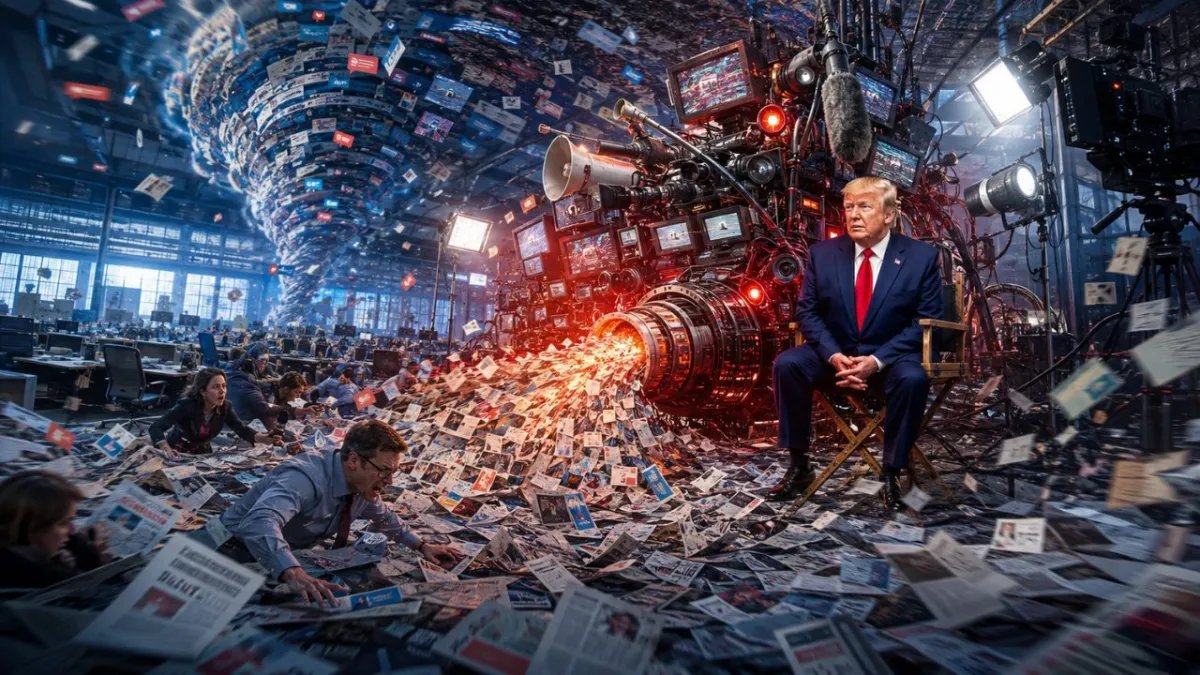
Trump’s agenda-setting strategy relies on nonstop, high-volume communications to elevate specific narratives to the top of the public’s mind while completely obscuring competing news stories. This approach originated with one of Trump’s former advisers and host of the wildly popular War Room podcast, Steve Bannon, who advised Trump to overload the news ecosystem with continuous shockwaves in a practice commonly called “flooding the zone.” The strategy adopts the “Gish Gallop” debate tactic to overwhelm opponents and journalists with rapid-fire false or weak claims, locking the media into perpetual defense and severe fact-checking fatigue. This approach proved remarkably successful during the 2016 campaign, when Trump generated an estimated $2 billion in free earned media coverage, compared to $746 million for Democratic Party presidential candidate Hillary Clinton. Network coverage reflected a similar imbalance, with Trump receiving 327 minutes compared to 121 minutes for Clinton and a mere 20 minutes for Democratic runner-up Senator Bernie Sanders.
Corporate news media and modern digital algorithms depend on a steady stream of sensational, polarizing, and outrage-inducing content, the exact currency Donald Trump provides. Decades of consolidation have reduced the 50 corporations that owned 90% of news media in the 1980s to just six profit-driven giants today, resulting in stripped-down newsrooms (a 79% drop in press jobs since 2000) and widespread “news deserts.” The internet promised an alternative, but quickly hyper-consolidated under tech mega-corporations (known as the FAANGs or MAMAA or “Magnificent Seven”) that conditioned audiences to expect news for free. To survive, both legacy outlets and engagement-hungry algorithms replaced public-interest journalism with sensationalism, hot takes, confirmation bias, and lower human emotions such as fear and outrage. Relatedly, studies show that false information travels further and faster on social media than truth. Trump did not invent this infrastructure; he simply feeds it the polarized noise it requires to remain profitable.
The sensationalism-rewarding news media and algorithms produce an environment that is custom-built for someone like Trump, who is eager to create a spectacle, invite controversy, and appeal to lower human emotions. As a candidate, Trump drew constant coverage through manufactured spectacles, such as using a campaign press conference to market his branded steaks, inviting former President Bill Clinton’s accusers to a presidential debate against Bill’s spouse, Hillary Clinton, and orchestrating viral photo opportunities at McDonald’s or inside a garbage truck. The news media simply could not look away. During the 2016 primary season, major news outlets famously chose to broadcast an empty podium waiting for Trump to speak rather than air Senator Bernie Sanders’ live primary victory speech.
Beyond campaigning, Trump’s agenda saturation operates as a strategic lever to divert focus away from stories he wants the press to avoid while amplifying narratives he prefers to highlight. For example, Trump has made it clear in his second term that he would prefer the news media refrain from covering the White House corruption and the Department of Justice (DOJ) releasing its investigative files into sex offender Jeffrey Epstein. The Epstein files reveal a corrupt web of influence spanning politicians including Trump, higher education, Big Tech, high finance, legacy media, and foreign intelligence networks across Russia, the U.S., and Israel. On the corruption front, Trump has amassed $2.2 billion in office through crypto schemes, insider trading, hosting a UFC event he invested in on the South Lawn, accepting a Qatari jet, and more.
In order to avoid deeper coverage of these topics, Trump frequently diverts news media attention by making non-executable proposals, such as buying Greenland or amplifying false information, such as fraud in Minnesota. In late 2025, content creator Nick Shirley posted misleading videos alleging ongoing pandemic childcare fraud in Minnesota. The actual fraud cases from that era had already been reported by The New York Times and prosecuted under the Biden administration. Nonetheless, Trump seized on the viral claims to distract from the Epstein saga and justify deploying thousands of Immigration and Customs Enforcement (I.C.E.) agents into the state. The sight of armed and masked men seemingly acting with impunity drew media attention and shocked the nation. While the shift to immigration initially succeeded in displacing media coverage of the Epstein files, it quickly backfired after the killing of two U.S. citizens by I.C.E. agents in Minnesota in January 2026 sparked intense national backlash. To distract from the mounting Minnesota controversy, Trump abruptly redirected public attention toward his war with Iran. Although the administration failed to offer a coherent justification for the war, floating contradictory claims ranging from Israeli pressure and nuclear nonproliferation to regime change and opening the Strait of Hormuz (which was open prior to the war), the tactic ultimately succeeded in forcing the news media to pivot their attention once again.
This “flooding the zone” tactic has largely insulated Trump from sustained media scrutiny regarding his self-enrichment and ties to the Epstein saga. Instead of detailing Epstein’s network of power or holding the president accountable for overt corruption, corporate news outlets reduced coverage to superficial “he said, she said” drama, bouncing from disputes with Minnesota officials to escalating tensions between the U.S. and Iran.
Pardon the interruption: If you’re enjoying this article, please consider hitting the subscribe button! If you’re able to become a paid subscriber, it goes a huge way in supporting the launch of new podcast episodes and bringing on more voices to share the truth. If you can’t chip in financially right now, no worries—liking, commenting, subscribing, and sharing on social media helps immensely. Thank you for your support!Subscribe
Subcultural Pipelining (or the “Meme-to-MAGA Funnel”)
“They’re eating the dogs. They’re eating the cats. They’re eating the pets of the people that live there,” said Trump regarding immigrants living in Ohio during a 2024 presidential debate with Democratic Party nominee and Vice President Kamala Harris. For many watching, the baseless conspiracy theory seemed to come out of nowhere. However, immigrants eating pets was a conspiracy that had captured right-wing digital spaces in the weeks prior to the debate. Especially in his second term, Trump has used his administration to systematically replace traditional journalism with narratives drawn from internet echo chambers in a strategy known as subcultural pipelining.
Subcultural pipelining refers to the process of taking apolitical or loosely political online subcultures, such as gamers, cryptocurrency enthusiasts, fitness communities, the “manosphere,” or digital meme boards, and gradually directing them toward a specific political party. This strategy relies on a narrative framing deeply rooted in digital culture, validating audience grievances and cultural anxieties while using internet subcultures, memes, and recognized digital tropes to frame “the establishment” as an “elite conspiracy” running failing institutions with failing policies.
Rather than building a single unified message for a large portion of the electorate, Trump taps into online echo chambers to legitimize fringe beliefs, ranging from rumors of immigrants eating pets and support for Robert F. Kennedy Jr.’s Make America Healthy Again (MAHA) movement to fringe theories regarding QAnon, extra-terrestrials, the moon landing, Jeffrey Epstein, the Pizzagate shooting, and the assassinations of John F. Kennedy, Martin Luther King Jr., and Robert F. Kennedy. Trump directly engaged with popular purveyors of these narratives, appearing on “manosphere” programs hosted by figures such as Tucker Carlson, Alex Jones, Joe Rogan, and Theo Von, reaching audiences in digital spaces largely ignored by the traditional political class.
The goal was to make these audiences feel not only that Trump heard and believed them, but that he was the personal embodiment of their grievances. He positioned himself to go after the establishment entities that had long ignored or dismissed their online subcultures. Consequently, whether facing legal, personal, or political challenges, his base increasingly viewed Trump’s battles as their own, creating a dynamic of collective political martyrdom. Even as his national approval numbers decreased in March 2026, MAGA supporters continued to offer near-unanimous approval.
Epistemic Populism
“I love the poorly educated,” Trump exclaimed at a 2016 campaign stop. While lampooned by liberals, the phrase, repeated in many forms throughout the campaign, was part of a broader media strategy known as epistemic populism. Epistemic populism frames truth as an ongoing fight between ordinary people’s common sense and corrupt elite gatekeepers such as scientists, journalists, and judges.
Epistemic populism thrives on the severe erosion of trust in institutions. Currently the U.S. is experiencing a record-low confidence in news media, dropping from 32% in 2016 to 28% in 2025–2026. Public distrust has been fueled by major coverage failures—including 2003 Iraq WMD reporting, Russiagate, COVID-19 coverage, and then-President Joe Biden’s cognitive state—alongside a sharp economic disconnect where stock market growth contrasts with working-class economic reality.
This skepticism extends directly to broader political and educational institutions. Decades of foreign and domestic missteps, from the War on Terror and Hurricane Katrina to President Barack Obama’s inspiring “hope and change” messaging delivering an economic agenda where 95% of post-recession income gains flowed to the top 1%, exhausted the public’s faith in government. Faith was further damaged when the Democratic Party undermined the 2016 and 2020 Presidential primary campaigns of Senator Bernie Sanders, which had attracted new and younger voters. This institutional decline was capped by massive Covid-19 pandemic wealth disparities where the top 10 richest individuals doubled their fortunes while global incomes for the bottom 99% fell. Indeed, during the pandemic, billionaire wealth surged by 62%, representing an increase of $1.8 trillion. These systemic institutional failures provided the exact raw material required for a wide-scale populist revolt, helping explain why public trust in government remained near historic lows of 31% by 2025.
Also reaching record lows are the educational institutions that Trump lampoons. Concurrently, public confidence in higher education plummeted from a high of 57% expressing a “great deal” or “quite a lot” of confidence in 2015 down to 36% in 2023 and 2024 according to Gallup polls. This drop reflects a growing partisan divide where roughly 60% of college-educated voters support Democrats compared to just 25% supporting Republicans, contextualizing the political backdrop of Trump’s declaration, “I love the poorly educated.”
While Trump is not the primary cause of this institutional decay, he expertly extracts political capital from weaponizing and contributing to the public skepticism. He frequently mirrors the deep-seated grievances Americans hold toward traditional power centers of media, education, or government (the “deep state”), offering his own candidacy as the sole authentic remedy. By capitalizing on this distrust, Trump encourages the public to bypass traditional institutional authority entirely and position him as the primary arbiter of truth. Indeed, he has said “I think I’m the most honest human being perhaps that God ever created, perhaps,” “I’ve proven to be one of the most honest and innocent people ever in our country,” and “All I do is say the truth.” Polling data from YouGov reveals that this resonates with MAGA voters as a greater share of the American public places trust in Trump than in the news media to deliver the facts.
Adversarial Framing as Counter-Branding

“Fox Business / WSJ GOP Debate Lineup” by DonkeyHotey is licensed under CC BY-SA 2.0.
“When crazy people have nuclear weapons, bad things happen,” said Trump of Iran in 2026. This remark followed numerous insults in which he referred to the Iranian people as “sick people,” “mentally ill,” and “crazy bastards.” These epithets are more than schoolyard-level insults that most potty-trained individuals would avoid. Instead, they represent a unique media strategy where Trump utilizes adversarial framing to counter-brand his perceived opponents and enemies.
Adversarial framing as counter-branding is the practice of unilateral negative branding designed to permanently define an opponent or institution before they can define themselves. Because commercial news media inherently prioritize conflict, outlets consistently cover the spectacle generated by these insults and attacks.
Opponent branding relies on pejorative monikers attached to political figures across the spectrum. General election targets were systematically labeled with terms like “Crooked Hillary” and “Sleepy Joe” for Hillary Clinton and Joe Biden. Both labels stuck and played directly into voter perceptions regarding Clinton’s alleged corruption and Biden’s cognitive decline. Trump also utilized these methods in the primary, referring to his opponents as “Lyin’ Ted” for Senator Ted Cruz, “Little Marco” for Secretary of State Marco Rubio, “Low Energy Jeb” for former Florida Governor Jeb Bush, and “Ron DeSanctimonious” for Florida Governor Ron DeSantis. When they fall out of favor with Trump, former friends such as Steve Bannon and Michael Cohen are referred to as “Sloppy Steve” and a “rat.” World leaders are also branded, such as when he called North Korean leader Kim Jong Un “Rocket Man.”
Trump has also used adversarial framing to deepen mistrust in news media. This includes macro labels such as “fake news,” “enemy of the people,“ and “corrupt“ press, which effectively reclassifies critical journalism as bad-faith or “illegal“ activity. This macro framing is routinely supported by targeted ad hominem attacks, including physical and gendered insults, such as comsments regarding CNN’s Kaitlan Collins’ smile, alongside direct insults aimed at journalists who are publicly referred to as “stupid,” “dumb,” “piggy,” “third-rate,” or “nasty.”
Trump seeks to control audience perceptions of institutions, rivals, and opponents through catchy names that appear to speak to some element of truth, feeding public cynicism toward those entities while reinforcing faith in Trump himself.
Epistemic Authoritarianism / Information Autocracy
“Just remember, what you’re seeing and what you’re reading is not what’s happening” bellowed Trump to a crowd in 2018. In this single statement, Trump established himself as the sole authority over what is real, executing a textbook display of epistemic authoritarianism. This strategy, an offshoot of media saturation, relies on dominating the media ecosystem with continuous shockwaves of noise, outrage, and competing narratives to silence legitimate truth-tellers. By destroying faith in independent institutions and reducing rivals to caricatures, Trump effectively engineers a reality where his word alone dictates the facts.
A core mechanism of this approach relies on the continued influence effect, a psychological phenomenon where initial narratives persist in shaping public reasoning and judgment even after they have been thoroughly debunked. Particularly during his second term, Trump has cultivated the continued influence effect by moving swiftly to establish early narratives around key events through rapid administration statements, tailored messaging, and official state communications. By deploying these initial frames, the administration shapes public perception in its favor well before verified facts can catch up. This process was clearly demonstrated in the official response to the killing of Renee Good by Immigration and Customs Enforcement (I.C.E.) officials in January 2026. Administration officials immediately framed the event as a “domestic terrorism” vehicle attack to shape initial public perception; however, documented video evidence later showed the driver actively steering away from federal personnel. Similarly, following the assassination of activist Charlie Kirk in September 2025, official statements quickly primed the public to view the killing as an attack orchestrated by coordinated “radical left” networks. This narrative persisted even after law enforcement investigations confirmed that the perpetrator had acted completely alone. A parallel dynamic unfolded in the case of Alex Pretti, an intensive care unit nurse who was shot during a demonstration in January 2026. Official reports swiftly framed Pretti as an active “assassin“ to justify the use of force. Yet bystander footage contradicted this baseline narrative, revealing that the subject had already been disarmed and was being restrained on the ground when shot to death. In each instance, the administration utilized aggressive initial framing to establish a controlled narrative before objective reality could intervene.
When the press debunks a government narrative, it confronts both widespread public skepticism and manufactured state evidence. Rather than relying solely on rhetoric, the Trump administration actively produces synthetic material to reinforce its claims. In one instance, Trump shared an AI-generated photo depicting fake gang tattoos on Kilmar Abrego Garcia while in I.C.E. custody to legitimize the administration’s assertion that Garcia belonged to a gang. Beyond generating synthetic media, Trump weaponizes official agency fact-checkers to insulate these narratives. Releasing official statements under headlines such as “DHS Debunks False Claims About Federal Emergency Management,” these government outlets cite their own reports and select press clippings to manufacture an echo chamber of official truth.
In his second term, Trump’s media strategy has increasingly utilized leaps in logic to rapidly tether unrelated breaking events to his immediate legislative and executive priorities. Rather than evaluating incidents based on emerging evidence, his administration swiftly constructs pre-packaged narratives designed to advance specific policy goals before initial news cycles conclude. For example, following a shooting incident near the security screening area outside the White House Correspondents’ Dinner, Trump and his supporters claimed that constructing his proposed White House ballroom would prevent such security breaches. In reality, the White House Correspondents’ Dinner is an independent media event traditionally hosted at a private hotel rather than a government-sanctioned function, making the controversial, costly, and historically intrusive ballroom proposal entirely irrelevant to the event’s security setup. Similarly, following the unexpected passing of Senator Lindsey Graham, Trump immediately urged Congress to pass the Safeguard American Voter Eligibility (SAVE) Act in his memory, claiming Graham had called him hours earlier to urge its passage. Billed by the administration as a vital security measure to enforce strict citizenship requirements for voting, the controversial legislation has drawn sharp criticism from opponents who argue it functions primarily as a voter suppression tool. By reflexively linking unrelated security threats and personal tragedies to stalled legislation, Trump continually weaponizes breaking news to force momentum behind his broader political agenda.
Trump’s epistemic authoritarianism also utilizes the “Big Lie” propaganda technique, where an outrageous falsehood is repeated continuously in the belief that the public will eventually accept it as truth. This is aided by algorithms that feed people the same lie repeatedly. Because constant screen time causes cognitive fatigue, people rely on mental shortcuts, often mistaking sheer familiarity for veracity. Persistent repetition convinced roughly 28% of the public in 2026 that the 2020 election was stolen, despite over 60 failed court cases and the Dominion legal judgment which found that conservative Fox News Channel had lied about the election being stolen. This is why Trump repeats false allegations of Venezuela hacking elections, the baseless conclusion that his administration’s 2025–2026 boat strikes “saved 25,000 lives each,” misleading and exaggerated assertions that he single-handedly ended six to ten wars, and fabricated claims of geopolitical surrenders by Iran. He assumes that eventually, people will come to believe it.
Censorship
“No longer will our government label the speech of our own citizens as misinformation or disinformation, which are the favorite words of censors and those who wish to stop the free exchange of ideas and, frankly, progress,” said President Trump at a 2025 World Economic Forum meeting. However, this statement stands in sharp contrast to Trump’s aggressive censorship tactics during his second term. In the United States, a free press functions as a crucial check on state power, preventing institutions from hiding information from the public. Trump systematically undermines this democratic role by weaponizing censorship, suppressing communication deemed harmful, offensive, or politically inconvenient to his administration.
Under the current administration, legacy press credentials have been systematically replaced with MAGA influencers, resulting in the removal of major news organizations—including CNN, The Washington Post, NBC News, The New York Times, NPR, Politico, and The Hill—from traditional press areas such as the White House and Pentagon. Access restrictions have gone so far as to ban outlets like The Associated Press from pool coverage, dismantle White House Correspondents’ Association rotation systems, exclude Bloomberg News, HuffPost, and Thomson Reuters, and ban all credentialed journalists from “Upper Press” workspaces in the West Wing adjacent to the Oval Office. Furthermore, Pentagon policies now impose mandatory pre-approval requirements, demanding defense official sign-off before military reporting can be published.
This structural control over media access is reinforced through state-sponsored legal and regulatory intimidation designed to chill investigative journalism. For example, federal agents were sent to arrest Don Lemon and Georgia Forte for reporting on an anti-I.C.E. protest. Similarly, in July 2026, federal agents were dispatched to the homes of New York Times reporters to force grand jury testimony regarding confidential leaks about Qatari Air Force One security flaws. On the regulatory front, the F.C.C. has been weaponized to threaten the broadcast licenses of networks covering foreign conflicts, such as the U.S.-Israel war with Iran, by labeling critical coverage as “unpatriotic“ or “hoaxes.” This regulatory coercion is paired with total blackout mandates in conflict zones around Iran that severely restrict access to satellite imagery and casualty tracking during military operations.
Beyond regulatory threats, the administration leverages economic friction to force media capitulation or corporate surrender. By deploying merger approvals, antitrust threats, F.C.C. licensing power, and predatory civil litigation, Trump creates severe financial strain on media entities until they yield to political demands or sell to political allies. Some of the lawsuits are without merit and serve as an effort to scare news outlets with litigation such as a $475 million suit against CNN over “Big Lie” commentary, which was dismissed by a federal judge as protected opinion and appealed; lawsuits against Bob Woodward and Simon & Schuster over The Trump Tapes audio releases, dismissed for lack of legal harm; a suit against The Guardian by TMTG over reporting on Russian loan probes, dismissed in Florida; a $3.8 billion suit against The Washington Post by TMTG, dismissed in July 2026 for failing to prove “actual malice”; and a $10 billion suit against The Wall Street Journal over Epstein reporting, dismissed in April 2026 and refiled.
In other cases, the financial pressures result in strategic corporate payouts and forced settlements. ABC News settled for $15 million, directed to a presidential library fund, over on-air phrasing by George Stephanopoulos. Paramount and CBS News similarly settled for $16 million to cover legal fees and presidential library contributions over 60 Minutes editing disputes, while the BBC issued public apologies and pulled a 2024 documentary from airing following speech editing claims. There is also an ongoing $15 billion suit against The New York Times for defamation in 2024. Trump does not care if these lawsuits prevail in court, their primary purpose is to create an immediate chilling effect where media corporations, fearing astronomical legal costs or reputational damage, proactively avoid publishing content that might anger the administration.
In addition to lawsuits, the Trump administration leverages news media conglomerates’ need for federal approval of licenses and corporate mergers to exact economic and ideological concessions. For instance, before its Skydance merger was approved, Paramount paid a $16 million settlement regarding CBS and its Kamala Harris interview, an outcome that led to the installation of internal oversight allies and the shelving of sensitive investigative pieces, such as 60 Minutes deportation reports. Similarly, mega-consolidation moves between Warner Bros. Discovery (CNN) and Paramount/Skydance funded by political allies have been leveraged to reshape long-term editorial direction through state court litigation. Meanwhile, TikTok U.S. restructuring efforts initiated under the Biden administration were carried forward with Trump allies to alter corporate ownership and algorithmic delivery.
By instilling a profound chilling effect, altering corporate ownership, and leveraging government regulatory power over profitability, Trump successfully mitigates criticism across the press landscape. The impact of this strategy is evident in the visible shift of high-profile media figures, as former vocal critics like Mika Brzezinski and Joe Scarborough of Morning Joe, and Bill Maher have all made high-profile visits to Trump and subsequently softened their public commentary.
Conclusion
The dismissive commentary that greeted Trump’s accusations against Tim Walz reveals that his media strategy, now a decade old, has in many ways jumped the proverbial shark. Observing politicians like California Governor Gavin Newsom attempt to mirror his provocative online style or rely on profanity comes across as a poor imitation. These imitators fail to grasp how such actions fit into a cohesive broader strategy, and they overlook why it originally succeeded. Trump’s approach worked because his initial opponents were entrenched institutions, such as the press and government, and establishment figures like Hillary Clinton, Joe Biden, and the Bush family, whom the public had already come to distrust. His seemingly off-the-cuff, raw rhetoric (though less authentic populist expression and more the calculated performance of a skilled con man) felt refreshing compared to the scripted speeches of politicians who only parroted what donors, consultants, and pollsters told them to say. A decade later, that novelty has worn thin. The strategy has grown tired, frequently emulated but never truly replicated.
Furthermore, the approach is increasingly showing its limits. Trump has been unable to suppress the Jeffrey Epstein saga as investigations and revelations continue to come to light. Even the process of getting an Attorney General approved by his own party was tainted by the administration’s efforts to manage and withhold information related to the case. A similar dynamic surrounds the war in Iran, where the administration finds itself unable to define victory, let alone achieve it, or convince the public that the war is worth fighting. Indeed, only 34% of voters support the war. Most critically, the economy—historically one of Trump’s strongest political talking points—presents a reality that cannot be altered through rhetoric alone; voters cannot be persuaded that their dollars are stretching further than they actually are. Half of voters claim they are worse off today than they were a year ago. Only 32% approve of Trump’s handling of the economy. It serves as a reminder that an effective media strategy cannot overcome cold, hard economic reality. Ultimately, the core question is not which media strategy Trump will turn to next to reshape perception, but whether the press can still uncover the truth and persuade the American public to face it.
Nolan’s Book MAGA Academy
Uncover the systemic hollowing of higher education through a compelling blend of deep research and personal narrative that exposes the corporate capture of our universities. By purchasing The MAGAcademy via this link, you’ll gain access to a radical roadmap of solutions for reclaiming the Civic University while directly supporting the non-profit investigative mission of Project Censored.
Get your copy here: https://www.project-censored.org/shop/p/magacademy
Editor’s Note: At a moment when the once vaunted model of responsible journalism is overwhelmingly the play thing of self-serving billionaires and their corporate scribes, alternatives of integrity are desperately needed, and ScheerPost is one of them. Please support our independent journalism by contributing to our online donation platform, Network for Good, or send a check to our new PO Box. We can’t thank you enough, and promise to keep bringing you this kind of vital news.
You can also make a donation to our PayPal or subscribe to our Patreon.
Please share this story and help us grow our network!
[ad_2]
Source link
