
[ad_1]

The following remarks were delivered on receiving the Milton Friedman Award at the Pacific Research Institute in New York City June 16, 2026.
It is a special honor to receive an award named for Milton Friedman, pathbreaking economist, friend and advocate for liberty, fierce debater and intellectual combatant – a man whose ideas have shaped the modern world. It is not an exaggeration to say that we live today in the Age of Friedman, an era shaped by his ideas about the importance of monetary policy in the performance of modern economies, and the role played by central banks in managing money supply.
That was not all, not by any means. Milton Friedman was a fierce advocate of market economies not only because they worked, but because they promoted liberty, which was to him the most important principle of all. One of his early books, Capitalism and Freedom, published in 1963, which I encountered in college, made this case from historical and philosophical points of view, much as Hayek did in The Road to Serfdom. Along the way in that book, Friedman set forth numerous applications of free market principles that are influential today: school choice and school vouchers, a negative income tax to replace welfare programs, and private accounts in social security, among them. He was the rare academic economist who could speak to the public as well.
He advanced those ideas in other forums as well, including in his award-winning television series, Free to Choose, and in a regular column for Newsweek magazine, in which he expressed many controversial ideas, for example: that the welfare state increased poverty, public unions were harming schools and student achievement, and government regulation was responsible for inflation, unemployment, and stagnation. Free to Choose reached millions of viewers, in the same year as Ronald Reagan was poised to win the presidency – and to put some of those ideas into practice.
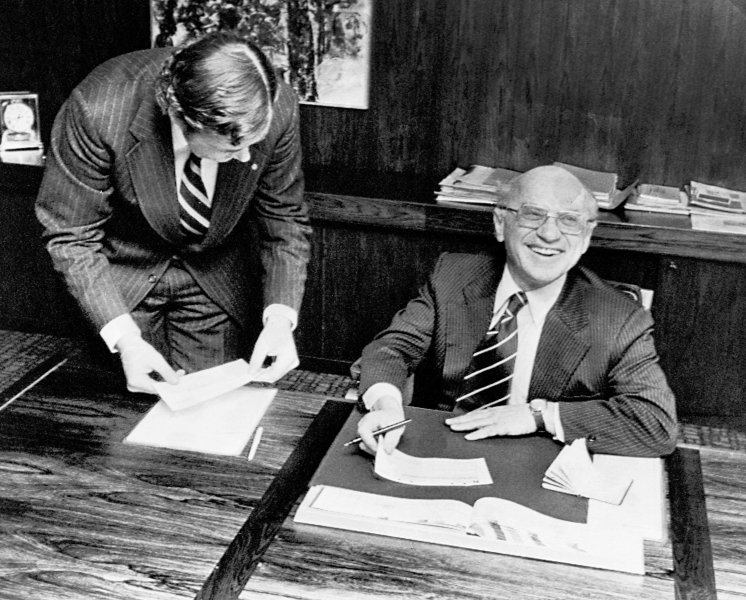
Milton Friedman was a small man, a shade under five feet in height, and weighed all of 120 pounds. His wife, Rose, was tinier, still. His adversaries towered over him. John Maynard Keynes was 6 feet, 6 inches in height; John Kenneth Galbraith, Keynes’s American expositor, stood 6 feet 8 inches tall. Fortunately, intellectual strength is measured in other ways: that small frame was packed with intellectual dynamite, and a willingness to take on all comers.
He was an equal opportunity debater: he would debate anyone, at any time. His ideas about free markets, along with his policy proposals about vouchers, unions, and the welfare state, shocked the sensibilities of liberal adversaries. In Free to Choose, it appeared that some of those adversaries were about to pounce on him physically when he expressed those ideas. Friedman was unfazed by those reactions; indeed, he appeared to enjoy them. His son, David, once remarked that he was “brought up with the feeling that the normal way of conversation was to argue with people.” Listening to his father, one can understand why.
I grew up, long ago in the 1960s and 1970s, at a time when John Maynard Keynes was the dominant figure in economic thought, and his theories about fiscal policy and carefully managed deficits were ruling public doctrines. President Kennedy brought in Keynesian economists to manage economic policy. We read books with titles like The Age of Keynes, The Keynesian Revolution, and Keynes and the Classical Economists. Keynes’s photo was on the cover of TIME magazine in 1965. Richard Nixon said, “we are all Keynesians now.”
In history courses, some of us read Keynes’s Economic Consequences of the Peace, his critique of the Treaty of Versailles. His theories about aggregate demand, fiscal policy, and government borrowing both explained the Great Depression and pointed to ways out of it. His successors reasoned that if fiscal policy can get us out of depressions, then it can prevent them in the first place – a significant leap from that premise, and one that has caused much damage (including, today, a $40 trillion government debt and the long term erosion in the value of the dollar).
Friedman, along with his co-author, Anna Schwartz, offered an alternative to this doctrine in A Monetary History of the United States, 1867-1960, (published in 1963), albeit without directly attacking Keynes or his followers. This remarkable work, for which Friedman was cited by the Nobel Prize committee, established several important themes that were fundamental to economic and financial debates in the modern era.
The authors demonstrated, for example, that a contraction in the money supply had preceded nearly every recession during that era. Perhaps more importantly, the authors, citing historical data, showed that there is no regular connection between economic expansion and rising prices, in contradiction to the widely held view that there is a trade-off between economic growth and inflation. The Great Depression, they showed, was due to the misguided policies of the Federal Reserve Board. The governors of the Federal Reserve, whose members were deadlocked about what they should do to stem the recession that began after the stock market crash in 1929, allowed the money supply to collapse between 1930 and 1932, thereby turning a recession into a full-fledged depression. The book also established the principle for which Friedman is widely known, namely, that inflation and deflation are always and everywhere monetary phenomena, caused by excesses or deficiencies in money supply.
He urged central bankers to increase the money supply at roughly the level of long-term economic growth – a formula central bankers have sometimes tried to follow, though less so since the 2008 financial crisis. Indeed, during the Biden years, the Fed’s governors were distracted by political causes like climate change and structural racism that have nothing to do with its mandate. It is likely that even Milton Friedman might have been surprised at how far the central bank strayed in those years from its central mission of preserving price stability.
It should be noted that Friedman was not necessarily critical of the financial policies of the New Deal. The book credited deposit insurance for helping to stabilize the banking system. Friedman was also sympathetic to new banking rules that brought state-chartered banks into the Federal Reserve System. FDR also began the process of taking the United States off the gold standard, a move that Friedman generally supported in retrospect, as he was known in the 1970s for endorsing the concept of floating exchange rates among major currencies. Though he was a free market man, he argued that markets needed a framework of stable monetary policy to function in peak form.
These themes, in combination with the mix of inflation and unemployment experienced in the 1970s, established a new framework for using monetary policy to control inflation and to create the conditions for stable economic growth. Paul Volcker, as chairman of the Federal Reserve Board, followed that formula in stemming the high inflation of the 1970s, and creating the conditions for low inflation and low interest rates in the period that followed. It was through monetary policy, re-capitalizing banks, expanding the money supply, reducing interest rates, that the United States dug itself out of the financial crisis of 2008 (though flawed monetary policy also played a role in causing the crisis.) It is in this sense, then, that today we live much more in the Age of Friedman than in the Age of Keynes – that is, in an age that recognizes the crucial importance of monetary policy, central banks, and central bankers.
It is said that the master economist must possess a rare combination of gifts: he must be mathematician, historian, statesman, philosopher, in some degree. He must study the present in light of the past for purposes of the future. He must be disinterested, incorruptible, and independent, like a scholar or artist. He must understand politics, the art of the possible. This describes our late mentor, Milton Friedman – not only a master economist, but someone who thought for himself, cherished his independence, loved to debate and express unconventional ideas, and shaped the views of a generation.
Thank you.
[ad_2]
Source link
