
[ad_1]
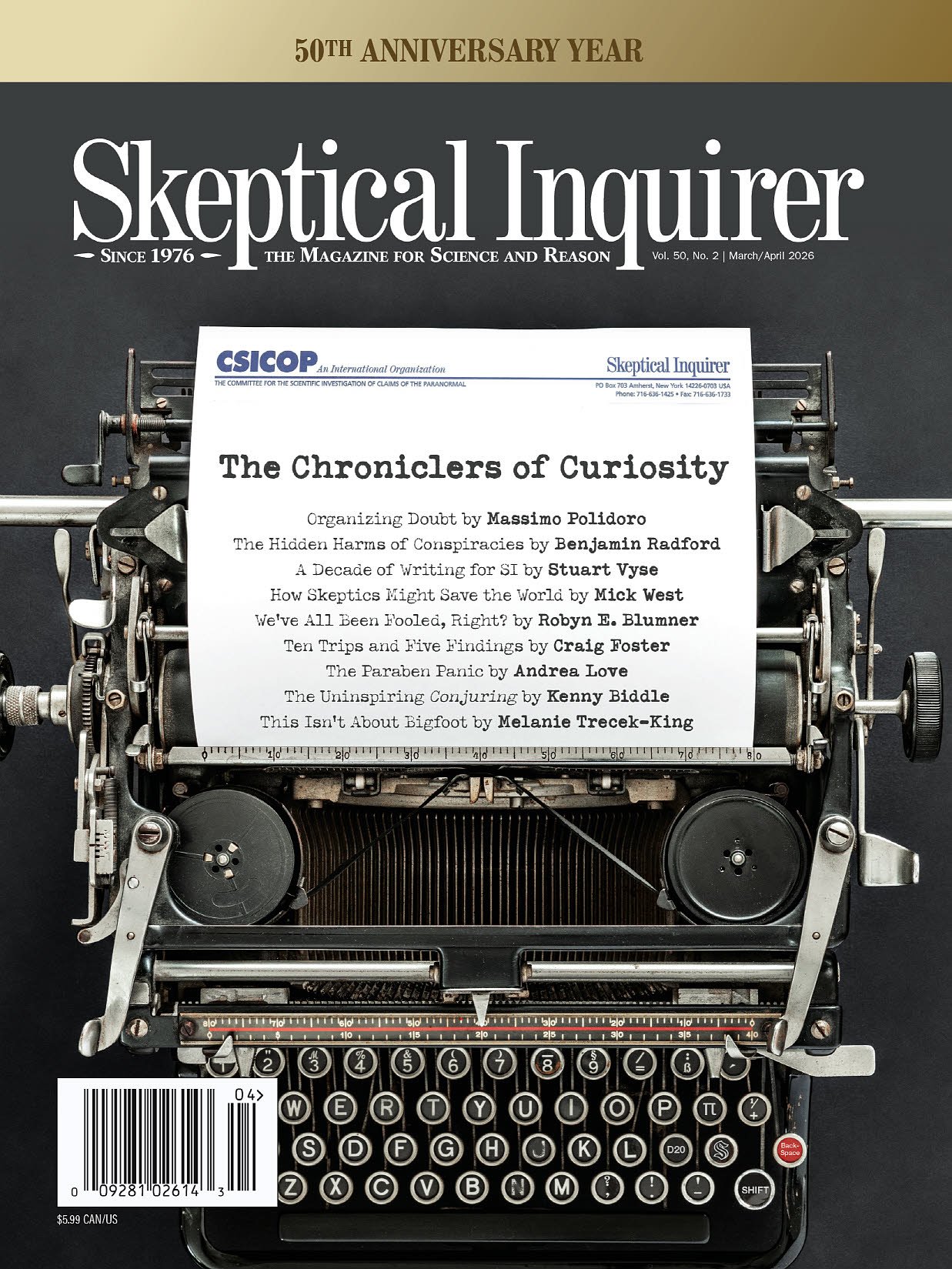
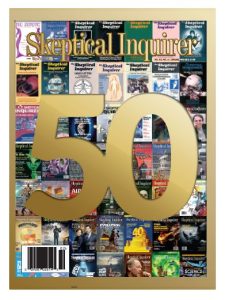
Welcome aboard, friends! On this occasion, we aren’t going anywhere. We’re using the fiftieth anniversary of Skeptical Inquirer to reflect on the adventures we’ve had so far.
Imagine what we’d learn about skepticism if we could time travel to 2076. Skeptics, and their critics, could suddenly access the next fifty years of evidence. How warm is the planet? Is creationism still a thing? Did anybody find Bigfoot?
Obviously, there’s no known mechanism for traveling to the future, other than waiting, but we can use fifty years of Skeptical Inquirer to play the future observer to skepticism of the past. This type of retrospective analysis provides two advantages over temporally static study. First, it allows us to examine whether historic skepticism was supported across future decades. Where has skepticism succeeded? Where has it failed? What can we learn to make skepticism better? Second, research suggests that increasing psychological distance from a problem can improve critical thinking about that problem (see Kross and Ayduk 2017). Examining skepticism versus credulity from long ago presumably increases that psychological distance.
These advantages inspired “The Time Warp” column. We’ve taken ten trips so far. Here are five fundamental findings:
Skepticism Has Not Changed Since 1976
When the founders published The Zetetic in 1976, their stated goal was to address widespread belief in the paranormal. Contemporary skepticism embraces the same fundamental mission. Many of the specific topics that skeptics addressed fifty years ago are still being addressed by skeptics today.
Skepticism’s stability occurs because skepticism addresses an ongoing social problem: Communities promote pseudoscientific or pseudohistorical claims using a set of persuasive arguments that do not stand up to more careful examination. These types of promotions are costly, harmful, and sometimes fatal.
That social problem leaves an ongoing niche that skepticism continues to fill.

The Argument from Ignorance Is a Big Freakin’ Problem
A lot of support for unreasonable claims comes down to the argument from ignorance—sometimes called the appeal to ignorance—which involves promoting a claim as true on the basis that the claim has not been proven untrue. The argument from ignorance shifts the burden of proof from claim supporters to claim detractors. The argument from ignorance is misleading because claims are more easily substantiated than they are discredited.
Case in point: Astrology supporters have had centuries to provide a model that works. Every astrological model that has been tested so far has failed; astrology has no sensible physical mechanism. Astrological models nevertheless persist in large part because any model could be legitimate, even though there is no reason to believe that any of the models are legitimate.
The early years of SI demonstrate the magnitude of this basic problem. It’s possible to obtain credible evidence for parapsychology, ancient extraterrestrial visitation, contemporary extraterrestrial visitation, dowsing, non-predatory cattle mutilation, and paranormal explanations for the Bermuda triangle if these concepts truly exist.
People still promote these claims without meaningful supportive evidence.
Skepticism-Friendly Arguments Frequently Miss Their Mark
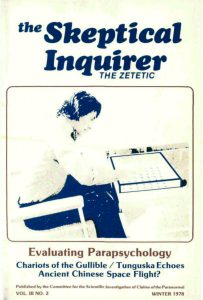
Skeptics express a lot of concern about how to argue with people who promote credulity. That concern is often irrelevant, because skeptical inquiry never reaches the people promoting woo. Consider an article from the Winter 1978 (Volume 3, number 2) issue of SI: An ancient aliens theorist claimed that ancient Chinese symbols described a lightning-carrying shapeshifting bird-man-like extraterrestrial visitor who departed in a rocket. David Keightly, a history professor at University of California Berkely, used legitimate historical context to eviscerate this claim.
Keightly’s analysis exemplifies the way real historians discredit wild tales about ancient alien visitation. Ancient alien theorists might be persuaded by such historical analyses if they encountered them—which they rarely if ever do.
Paranormal Claims Do Not Become Normal Claims
Claims that are broadly criticized by skeptics generally remain unsubstantiated. In fact, I haven’t yet found an example of skeptics broadly criticizing a claim only to find themselves clearly on the losing side later.
I’m confident I’m not being defensive. Skepticism doesn’t need to be correct 100 percent of the time. A big skepticism fail might be good for the skepticism community.
I think skepticism rarely gets embarrassed in this way, because skepticism characteristically addresses popular claims that are so untenable they fall outside of legitimate scientific or historical debate.
Skepticism is sometimes criticized on these grounds—that is, for going after obviously weak claims. That criticism of skepticism is shallow and naive.
Fifty years of SI show that the promotion of costly and harmful pseudoscientific or pseudohistorical claims is its own vexing problem. To my knowledge, nobody, and I mean nobody, has identified a robust method for diminishing these types of promotions.
Skepticism Is Optimism and Disappointment
Skepticism isn’t just an academic enterprise. Skepticism is fueled by a belief that society can save time, money, and lives by becoming more reasonable. Unfortunately, this optimistic approach contributes to enduring dissatisfaction.
Contemporary skeptics probably feel like we live in credulous times. Trips to the early years of SI remind us that being disappointed by the ubiquity of bunk is part of being a skeptic.
The first issue began like this: “This journal, the official organ of the Committee for the Scientific Investigation of Claims of the Paranormal, is intended to communicate scientific information about the many esoteric claims that have shown a growing influence upon the general public, educational curricula, and scientific institutions themselves.”
Fifty years of SI likewise document a lot of discontent, frustration, and worry about the influence of ridiculous claims.
I particularly loved an English professor’s description of credulity: “You don’t have to look for it. You just stand in one place, and it rolls all over you” (Volume 3, number 1, p. 8).
Are people more credulous today than they were fifty years ago? I’m not sure. Considering the prominence of misleading claims today, it sure feels like they are.
But 1976 wasn’t a high point for skepticism either. That year provided enough flim-flam to inspire an official committee and journal devoted to addressing paranormal claims.
SI has served in that capacity for fifty years.
Looking Ahead
Looking at the next fifty years, I’m reminded of a saying among psychologists: “The rat is always right.”
The phrase means that the rat is going to do what rats do. Hoping that the rat will behave differently isn’t going to accomplish anything. The rat’s behavior will change when the conditions around the rat change.
Obviously, credulous claims are promoted by people, not rats. Plus, credulous claims aren’t even promoted by a distinct group of credulous people. People are typically skeptical in some domains and credulous in others.
Fifty years of skepticism demonstrate that people have trouble finding our skeptical cheese. If we want society to be more skeptical, then we must do something different.
Personally, I see two major issues.
First, we need more people involved in skepticism. Ancient astronaut theorists might not read SI, but they might bump into somebody who does. Those moments where skeptics respectfully offer a different perspective represent a vital component of skepticism. Every skeptic matters.
Second, we need to educate children differently. Primary and secondary educators already focus on ways to improve students’ critical thinking. We need to improve those existing practices by methodically teaching students how to (1) maintain healthy levels of intellectual humility, (2) seek different perspectives, and (3) identify and interpret an explicit set of misleading arguments.
Time will tell what the world looks like fifty years from now. From a skeptical perspective, things could be worse, but they could be better too.
Reference
Kross, E., and O. Ayduk. 2017. Self-distancing: Theory, research, and current directions. Advances in Experimental Social Psychology 55: 81–136.
[ad_2]
Source link
