
[ad_1]
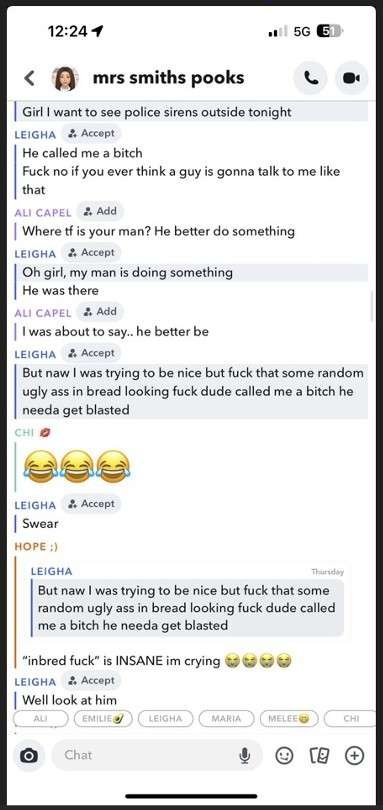
The record reflects that, at the conclusion of the September 11 meeting, HGTC accepted Lemoine’s explanation of the Snapchat comment. The September 20 conduct decision later recounted that Lemoine had been told there was then no evidence to find her in violation of the Student Code and that the College had accepted her explanation for the Snapchat comment. Plaintiff further contends that Sawyer communicated internally that there had been “no direct threat to others,” and that Batten and Sawyer reached the same conclusion after speaking with students. Defendants contend the matter remained under review and that HGTC was required to continue assessing safety and disruption concerns….
On September 13, 2024, HGTC discovered a video posted to Lemoine’s Instagram account about a year earlier, in which Lemoine fired a handgun at a target while wearing western-style attire. Plaintiff contends the video predated her enrollment at HGTC, was taken on private property, did not involve HGTC, and did not refer to any HGTC student, employee, or campus. Defendants contend the video caused them to question Lemoine’s prior explanation of the Snapchat message and her statements concerning firearms.
Batten requested authorization from Fore for an interim suspension. Fore authorized the interim suspension. Plaintiff contends that, before authorizing the interim suspension, Fore was presented with both the Snapchat message and the Instagram video. Defendants contend Fore acted reasonably based on the safety concerns presented to her.
On September 17, 2024, Lemoine again met with HGTC personnel, including Batten and Sawyer, to discuss the Instagram video. Lemoine acknowledged that she was the person in the video, stated that the video was from around Thanksgiving 2023, stated that the gun did not belong to her, and stated that it was the only time she had fired a gun. She also offered consent for HGTC to search her belongings, which HGTC declined. At that meeting, Lemoine received an interim suspension and no-trespass notice….
On September 20, 2024, HGTC issued a conduct decision suspending Lemoine from HGTC and imposing a no-trespass order. The decision identified two matters as the basis for discipline: the Snapchat message using the term “blasted” and the Instagram video of Lemoine firing a handgun. The decision stated that the Instagram video caused HGTC to question Lemoine’s explanation of the term “blasted,” and that, “[i]n today’s climate,” Lemoine’s “failure to disclose the existence of the video” together with her use of “blasted” caused concern about her ability to remain in the cosmetology cohort. The letter further stated that the two facts caused “a significant amount of apprehension related to the presence and use of guns” and had impacted the learning environment because students and employees expressed that they felt unsafe.
The September 20 decision concluded that Lemoine violated the Student Code provision prohibiting conduct that disrupts the educational process, interferes with the rights of others, or adversely interferes with normal college functions and services….
The court concluded that Lemoine’s speech was protected by the First Amendment, and thus granted Lemoine summary judgment on that issue:
The Snapchat message was sent while Lemoine was off campus. The message appeared in a private Snapchat group that included some HGTC students, but it did not arise from school-sponsored activity, did not involve coursework, did not address HGTC personnel, and did not refer to any HGTC campus or event. The message concerned an off-campus interaction involving Lemoine’s boyfriend’s roommate, who was neither an HGTC student nor an employee. Lemoine wrote that the roommate “needa get blasted.”
The phrase was crude, angry, and capable of causing concern if read literally or in isolation. But the First Amendment does not permit a public college to treat every intemperate or ambiguous phrase as unprotected speech. Context matters. The message was not directed to the roommate or to HGTC, and did not identify any HGTC student, employee, classroom, or campus as a target. When Batten and Sawyer interviewed Lemoine on September 11, Lemoine denied that “blasted” referred to physical harm and explained that she meant the roommate should be called out or held accountable for his behavior. The September 20 conduct decision letter acknowledged that HGTC had accepted Lemoine’s explanation and had told her there was then no evidence to find her in violation of the Student Code. …
The Instagram video likewise involved expression outside the school setting. The video was posted about a year before HGTC discovered it. It showed Lemoine firing a handgun at a target while wearing western-style attire. The record does not show that the video was recorded on HGTC property, involved HGTC activity, referred to HGTC, or was directed toward any HGTC student or employee.
Defendants argue that the Instagram video changed the context of the Snapchat message because Lemoine had previously stated that she and her parents did not own guns. Defendants therefore contend that the video caused them to question Lemoine’s explanation of the Snapchat message and her broader relationship to firearms.
That argument explains why HGTC continued its investigation. It does not, standing alone, establish that the Instagram video itself was unprotected speech. Lawful target shooting, without more, is not a threat. Nor does the mere existence of a prior video depicting lawful firearm use transform a separate ambiguous Snapchat message into a serious expression of intent to commit unlawful violence.
The Instagram video may be considered as part of the surrounding context for HGTC’s response, including the reasonableness of its investigation and any temporary safety measures. But the video itself was off-campus expression, not directed at HGTC or any member of the HGTC community, and not inherently outside the protection of the First Amendment….
Defendants also contend that Lemoine’s words and actions constituted a true threat. A true threat is not protected by the First Amendment. But the true-threat exception is limited to serious expressions of intent to commit unlawful violence against a particular individual or group of individuals….
Viewing the record in the light most favorable to Defendants, the Snapchat message used language that could cause concern. The term “blasted” can carry violent connotations, and HGTC officials were entitled to investigate when students or faculty reported that the language made them uncomfortable or unsafe. Schools are not required to ignore potential safety concerns, particularly when a reported statement appears to reference violence.
But investigation is different from discipline. The record does not show that Lemoine communicated a serious expression of intent to commit unlawful violence against an HGTC student, employee, or campus. The Snapchat message referred to a nonstudent involved in an off-campus personal dispute. It did not threaten HGTC, did not identify a school target, and was not sent to the person referenced in the message. When questioned, Lemoine denied any violent meaning and explained that she meant the person should be called out or held accountable. HGTC’s own September 20 decision acknowledged that this explanation had initially been accepted.
The Instagram video does not change that conclusion. The video showed Lemoine firing a handgun at a target about a year earlier. It did not contain threatening language, reference the Snapchat message, or identify any HGTC-related target. The combination of an ambiguous slang phrase and an old target-shooting video may have justified additional inquiry, but it did not transform Lemoine’s speech into a true threat on this record.
Nor does the record establish the mental-state component [recklessness] required by Counterman v. Colorado. The evidence does not show that Lemoine consciously disregarded a substantial risk that her Snapchat message would be understood as a serious threat of unlawful violence toward HGTC students or employees. Her explanation, the off-campus context, the nonstudent subject of the message, and HGTC’s initial acceptance of her explanation all weigh against treating the statement as a true threat. Accordingly, Defendants have not shown that the true-threat doctrine removed Lemoine’s speech from First Amendment protection…..
The remaining question is whether HGTC could discipline Lemoine’s off-campus speech because it materially and substantially disrupted school operations [under Tinker v. Des Moines Indep. School Dist.] or because HGTC reasonably forecast such disruption. The Court recognizes that HGTC had a legitimate interest in student safety and in maintaining an educational environment in which students and employees could attend class without reasonable fear of violence. That interest permitted HGTC to investigate the Snapchat message, speak with students and faculty, interview Lemoine, review the Instagram video, and take reasonable steps to assess whether a genuine threat or disruption existed.
But Tinker requires more than discomfort, apprehension, or generalized safety concerns. A public school may not restrict protected speech based on undifferentiated fear or a desire to avoid unpleasantness. And under Mahanoy Area School Dist. v. B.L., HGTC’s regulatory interest was diminished because the speech occurred off campus, outside school supervision, in a private social-media setting, and concerned a nonstudent and non-school matter.
The summary-judgment record does not show actual substantial disruption. The record reflects that some students or employees expressed discomfort or safety concerns after learning of the Snapchat message and Instagram video. But the record does not show that classes stopped, instruction materially changed, campus operations were substantially interrupted, or Lemoine engaged in conduct at school that interfered with the rights of others….
Nor did HGTC identify facts sufficient to support a reasonable forecast of substantial disruption. A reasonable forecast must be grounded in evidence, not speculation.
The September 20 decision stated that, “[i]n today’s climate,” the Snapchat message and Instagram video caused apprehension related to guns and caused students and employees to feel unsafe. The Court does not minimize those concerns. But the constitutional question is not whether HGTC officials were permitted to be concerned or to investigate. The question is whether the record contains sufficient facts showing that Lemoine’s off-campus speech either caused or reasonably threatened a material and substantial disruption of HGTC’s educational environment. On this record, it does not.
The facts here are materially different from cases involving threats directed at students or school personnel, severe harassment, targeted bullying, school-sponsored speech, or speech that foreseeably invades the school environment in a substantial way. Lemoine’s Snapchat message concerned a nonstudent and off-campus personal matter. The Instagram video was old, involved target shooting, and did not reference HGTC.
The record does not support a finding that either item, separately or together, gave HGTC a constitutionally sufficient basis to impose a suspension and no-trespass order….
Accordingly, the Court concludes that Lemoine’s Snapchat message and Instagram video were protected speech. Defendants were entitled to investigate the reported concerns and to take reasonable steps to determine whether a threat or substantial disruption existed. But the First Amendment did not permit HGTC to discipline Lemoine for protected off-campus expression absent a true threat, actual substantial disruption, or a reasonable forecast of substantial disruption supported by the record….
The court had reached a similar result at the preliminary injunction stage; I blogged about that in December 2024. But the court rejected Lemoine’s separate claim that the school’s actions denied her due process.
Ben LeClercq and David Dale Ashley (LeClercq Law Firm) represent Lemoine.
[ad_2]
Source link
