
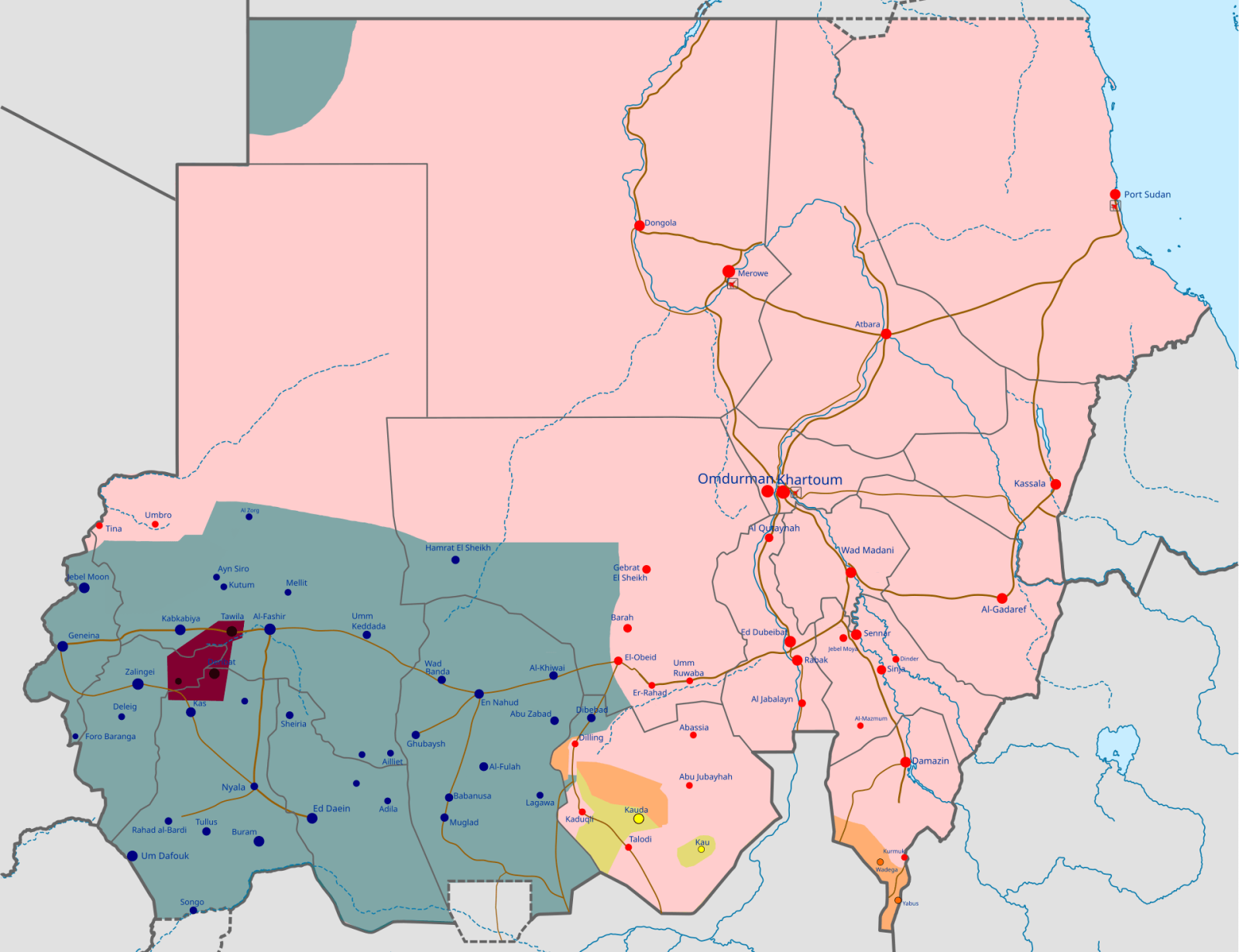
Image Source: ElijahPepe – Own work, derivate of Template:2023 Sudanese Clashes detailed map This is a retouched picture, which means that it has been digitally altered from its original version. The original can be viewed here: Sudan adm location map.svg – CC BY-SA 4.0
There is now strong evidence of closer ties between the Sudanese Armed Forces (SAF) and Iran. Yet almost every aspect of it is still disputed. Some of the wilder claims such as Iran wanting a permanent naval base on Sudan’s Red Sea coast remain unconfirmed.
Claims of chemical-weapons use by the SAF in its war against the Rapid Support Forces (RSF) show something similar in a different way. In 2025, the United States said that it had identified the use of chemical weapons by the Sudanese government in 2024 and announced sanctions in response. Yet Washington did not publish any of the evidence behind its decision, Sudan denied the accusation, and the allegations have not been put to a full independent international investigation, though lonely voices are still calling for one.
There is definitely a pattern here. Claims and allegations emerge, attract attention for a while, and then fade into bitterness, secrecy and a kind of geopolitical distraction. The problem is not that nothing is known. Rather, access, accounts and interests make it hard to separate the established from the uncertain.
Most days I try to read something on Sudan. Yesterday a friend sent me a line that he believed may have been used about MI6’s struggle to accept Philby was a Soviet spy: “Where simple but unpalatable truths are washed away.” It seemed to capture perfectly Sudan. The country has a habit of frustrating simple explanations.
Yet even that is only part of it. Beneath the military narratives, Sudan has a robust alternative civilian movement. Somoud, one of its principal political coalitions, campaigns regularly for human rights, democratic reform and an inclusive political settlement. It recently described itself as “one legitimate strand within a genuinely inclusive political process.”
I know Sudan only from the margins, but well enough to recognise names whenever another crisis unfolds. I’ve been fortunate enough to meet some of the civilian leaders while travelling across East Africa. I have attended memorable and vigorous discussions at Chatham House and SOAS, University of London. I have even had a documentary on Sudan fully funded—until, suddenly, it wasn’t.
I remember sitting through one discussion in Nairobi where there was broad agreement as to why Sudan had collapsed. By the end, however, there was no consensus on what, if anything, could be done to stop the fighting. It struck me, there and then, that Sudan had this unique ability to produce agreement on the diagnosis but only paralysis over the treatment.
The same pattern has shaped international reactions to its rapprochement with Iran. Diplomatic ties between Tehran and the SAF-led authorities were restored in October 2023 after a gap of nearly eight years. Coming only months after the civil war began, the move represented a major shift in foreign policy. Yet it remains unclear whether this was the start of a deeper strategic partnership or simply a wartime necessity.
For some Sudan observers, these renewed ties with Iran matter far beyond Sudan. Dr. Dan Diker, writing with two former Sudanese ministers, argued recently that Iran was seeking to create “a continuous Iranian operational corridor across the Red Sea.” Whether or not people accept such an evaluation, it does show how Sudan is viewed through the wider rivalry in the region.
The reversal has surprised a few diplomats across the region. Less than a decade earlier, Sudan had shut Iranian cultural centres, shown the door to Iranian personnel and joined the Saudi-led coalition fighting the Houthis in Yemen. Khartoum saw itself as firmly within the Gulf camp, where Sudan was often described admiringly as a future breadbasket.
To be fair, while the conflict across in the entire Gulf reaches “seismic” proportions, the renewed ties with Tehran reflect a familiar feature of Sudanese foreign policy. Alliances there have often been shaped by circumstance more than ideology.
The effects soon became clear on the battlefield. By late 2023 and early 2024, open-source researchers and a small number of news organisations had identified Iranian-made drones in SAF service, most notably the Mohajer-6. This was alongside reports of Ababil-family systems. Reuters concluded that the drones improved the army’s ability to strike RSF positions around Khartoum and Omdurman while helping it recover from initial setbacks.
Residents and fighters interviewed by Reuters described unfamiliar drones flying over the Khartoum-Omdurman area before SAF strikes and advances. For many in the capital region, Iran’s return didn’t come with diplomatic announcement. It came with the low, unfamiliar sound of drones overhead.
The evidence stretched beyond eyewitness accounts. Researchers at the US State Department-funded Sudan Conflict Observatory tracked repeated cargo flights from Iran to Port Sudan using aircraft linked to Qeshm Fars Air. This was an airline sanctioned for its ties to Iran’s Islamic Revolutionary Guard Corps. They concluded “with near certainty” that Iranian weapons shipments to the SAF were continuing.
As Khartoum descended into fighting, Port Sudan was transformed into Sudan’s wartime capital. Diplomats, aid agencies and military planners moved there, while foreign military cargo, even the Church of England, flowed through its airport and port. Reporting by Bloomberg, The Washington Post and the Observatory suggested that Iranian military support for the SAF was more visible now, although Iran remained one of several outsiders investing in the conflict.
As Port Sudan became more key, it also became more vulnerable. In early May 2025, the war reached the city. Beginning on 4 May, a series of long-range drone attacks—said to be RSF—hit the airport, military sites, fuel depots and other infrastructure, bringing to an end any dreamy assumption of eastern Sudan somehow being beyond the conflict. The distinction between the front line and the rear had effectively disappeared. The SAF-aligned government would eventually go back to Khartoum in January 2026, but Port Sudan kept much of its importance acquired during those earlier stages of the war.
At one Chatham House discussion, there featured as I recall important civilian perspectives on the war, but the conversation did at one point return to the question of who was supplying arms and why this was unchallenged. It was a reminder of the horror of war depending as much on supply chains as ideology.
By 2026, foreign support for the SAF extended well beyond Iran. Egypt was widely accepted as its main regional sponsor, Turkey supplied military equipment, Saudi Arabia, presently showing a more muscular approach against Iran in the Gulf, maintained relations with the authorities in Port Sudan while presenting itself as a mediator, and Eritrea stayed closely aligned with the Sudanese military. More recently, Pakistan appears to be another supplier, with reports and imagery in August 2026 suggesting Pakistani-made armoured vehicles had reached SAF forces.
Russia’s role was more complicated. Wagner and other Russian networks had built close ties with Hemedti and the RSF, particularly through Sudan’s gold trade, while Moscow also kept relations with the SAF. As the war continued, Russia moved closer to the SAF. Confusingly, Ukrainian operatives were also reported to have assisted SAF forces against Wagner-linked elements earlier in the conflict, adding yet another international layer. All this certainly helped encourage claims that Sudan had become another proxy war. But that would be specious. As we have seen, alliances jump about repeatedly.
Reports also suggested at one stage that Tehran wanted a more lasting foothold on Sudan’s Red Sea coast. In March 2024, The Wall Street Journal, citing a senior Sudanese intelligence official, reported that Sudan had said no to an Iranian request to establish a permanent naval base in exchange for advanced weapons and military assistance, including a helicopter-carrying warship. Something similar had been mooted with the Russians. Sudanese and Iranian officials denied any such discussions, leaving the episode disputed like so many others. Even if the report was accurate, it highlighted an important distinction. The SAF appeared willing to accept Iranian military assistance while resisting a permanent Iranian military presence, preserving room to manoeuvre between competing powers. Not to mention the Iran, Russia, China, and North Korea “global authoritaruan axis”—historian Niall Ferguson’s words—developing elsewhere.
There is still little evidence, however, that the SAF has taken on board Iran’s wider project. Although not in itself an Islamist movement, the army was closely connected with Sudan’s Islamist state for much of Omar al-Bashir’s rule. That system famously came from an Islamist movement with roots in the Muslim Brotherhood, though Sudanese Islamism grew its own factions and organisations in the end. Since the outbreak of war in 2023, Bashir-era Islamists have reportedly popped up within parts of the SAF-aligned state and have readied armed groups in support of the army. Even so, the SAF’s relationship with Iran appears to be driven more by practical needs than shared ideology.
The momentum of the war in Sudan began to shift. During 2024, the SAF made steady gains in Omdurman and elsewhere around the capital. Those gains began to speed up in early 2025, leading to the army’s capture of the presidential palace in a violent combat operation in March and recovery of much of Khartoum afterwards. Many analysts point to the arrival of Iranian drones as one of the things that made this possible. In other words, the SAF did not win this phase of the war on their own, but it did show how outside support can shape events on the battlefield without ever fully explaining them.
The recovery of Khartoum didn’t bring the war to an end. By 2026, much of its military focus had gone westwards towards Kordofan and Darfur. During the middle of the year, fighting around El Obeid and across North Kordofan heated up, although significant SAF gains in late July and early August changed the battlefield again. The advances showed both the army’s growing ability to challenge the RSF along important supply routes and how quickly momentum can change. For civilians, however, the impacts remained utterly devastating, with drone attacks, displacement and worsening food insecurity continuing right across Kordofan and Darfur. Across Sudan, around 34 million people were estimated to be in need of humanitarian assistance in 2026.
There is no denying the war has pushed the Sudanese Armed Forces into their closest relationship with Iran in years. Those restored ties, Iranian drones on the battlefield and repeated evidence of arms shipments through Port Sudan all point in the same direction—a partnership quietly reshaping Sudan’s place in Red Sea geopolitics.
Official US assessments generally place Iranian assistance within a broader pattern of foreign intervention rather than by painting Sudan as an Iranian client. Such hesitation can probably be justified. Iran became one of the SAF’s most important wartime partners, particularly during a critical phase of the army’s recovery, while also adding a new dimension to the balance of power in the Red Sea. Yet Sudan is not an Iranian proxy. Egypt, Turkey, Saudi Arabia, Eritrea, Pakistan and Russia all continue to shape the conflict for the SAF in different ways, reflecting that long-standing tendency to balance outside relationships with circumstance.
That is perhaps Sudan’s chief characteristic. External powers may gain considerable influence, sometimes dramatically, but not exclusive control. Without the military, financial and political back-up from abroad, Sudan’s war would likely not have taken the course it has, and might not even have been sustainable. Wartime alliances matter and Iran’s renewed presence is likely to stay an important one. But helping a war is not quite the same as defining a country’s course. No single external relationship can explain Sudan’s trajectory. Domestic interests, regional rivalries and the choices of Sudanese leaders continue to shape the country’s future alongside the ambitions of outside powers. Sudan, and its terrible war, still defy simple explanations.
