
[ad_1]

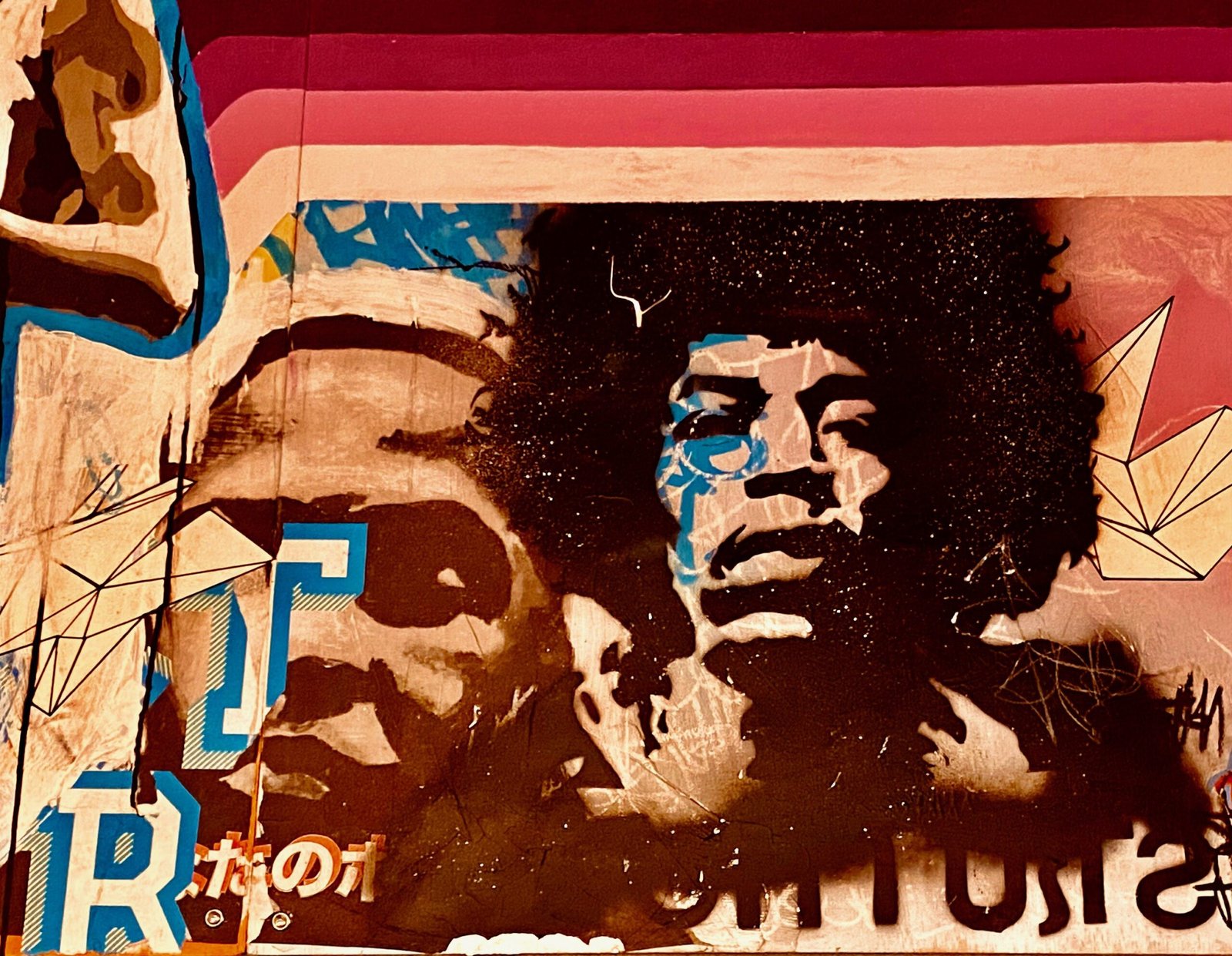
George Floyd and Jimi Hendrix Mural, Milwaukie, Oregon. Photo: Jeffrey St. Clair
If I don’t meet you no more in this world then
I’ll meet you on the next one
And don’t be late, don’t be late…–Jimi Hendrix, “Voodoo Child (Slight Return)”
On a spring night in 1967, the manager of the Savoy Theatre told the young guitar phenom Jimi Hendrix that Paul McCartney and George Harrison would be in the audience for the band’s final show in London. About an hour before going on stage Hendrix, Noel Redding, and Mitch Mitchell hastily rehearsed “Sgt. Pepper’s Lonely Heart’s Club Band.” They opened their set with a blistering version of the song, which had only been released by The Beatles three days earlier. By his own account, McCartney was so blown away by the performance that he began incessantly talking up Hendrix to other musicians and producers, including the organizers of the Monterey Pop Festival, who soon invited the new band to perform at the big concert on the California coast three weeks later. Hendrix closed the Monterey performance, vividly recorded by DA Pennebaker’s cameras, with a vicious cover of Chip Taylor’s rave-up “Wild Thing,” where 90,000 heads were blown, when he lit his crackling Stratocaster on fire and tossed the shrieking guitar into the crowd. Music was never the same.
Three completed studio albums: Are You Experienced? (1967), Axis: Bold as Love(1968), Electric Ladyland (1969). That’s all we have from Jimi Hendrix. Each distinctive. Each meticulously crafted. Each musically innovative and thematically coherent. There’s nothing else like them in the canon of rock music. And then he was gone. Dead in a London flat at the age of 27 and, as a consequence, forever linked to the ghosts of two infinitely lesser talents: the Texas screecher Janis Joplin and the messianic drug-fiend Jim Morrison.
The studio sessions are one thing; Jimi Hendrix playing live was something else altogether. On stage Hendrix was an untethered anarchic force. Here was Hendrix the explorer, the innovator, the unrivaled improviser, assaulting the boundaries of popular music and challenging the audience (and his bandmates) to keep up. Not many could—not even the great Little Richard, who kicked an 18-year-old Hendrix out his band for upstaging him in concert.
One of the most tantalizing documents we have of Hendrix performing live is the posthumous 1972 release on the Reprise label titled Hendrix in the West, a collection of stunning performances in San Francisco, Berkeley, and San Diego. Unfortunately, this record was soon deleted from the Reprise catalogue by the meddlesome producer Alan Douglas, who mangled many of the releases that surged into stores in the 1970s under Hendrix’s name. Fortunately, Hendrix in the West was finally reissued from remastered tapes engineered by Eddie Kramer and released by the Hendrix estate on the Legacy label.
Here we find a Hendrix for our time: raw, explosive, angry. It opens with a growling, distortion-fueled interpretation of “God Save the Queen” leading into brief almost punkish thrashing of “Sgt. Pepper’s,” both recorded at the miserable Isle of Wight Festival gig a few weeks before Hendrix’s death. After this oddity, we are transported back to San Francisco’s Winterland Ballroom in 1968 for a mesmerizing, oceanic version of “Little Wing,” which, enriched by Mitch Mitchell’s dramatic drumming, builds in concussive waves toward the swelling, trippy solo that climaxes the song and undermines every previous convention of popular music. (Eric Clapton’s “Layla” is merely a quaint and mannered imitation of the wrenching improvisational coda that Hendrix seemed to invent on the fly.)
This was back when psychedelia seemed to offer the promise of cultural metamorphosis. Or perhaps it was just Hendrix’s magical gifts that made it seem so. In any event, the playing on “Fire,” “I Don’t Live Today,” “Voodoo Child (Slight Return)” and “Lover Man” is cosmic rock at its most transcendental, the speedy passages roaring by, the riffs throwing off sparks, the notes bending and mutating in a kind of aural alchemy.
But for all his improvisational-jam mojo, Hendrix was at heart a blues-driven rocker, as he demonstrates with devastating force in his shattering cover of “Johnny B. Goode” and, more slyly, in a funked-out version of “Blue Suede Shoes,” recorded during a sound check at the Berkeley Community Center in 1970. “Spanish Castle Magic,” Hendrix’s scorching tribute the great Seattle R&B venue that hosted the Northwest’s signature bands, including the Wailers, the Kingsmen, the Raiders and, yes, the teenage Hendrix, is rendered as a proto-type of hippy-heavy metal, with knee-buckling power chords and growling feedback, which, in an acid-like transition, suddenly slips into a long passage from “Sunshine of Your Love” and then flashes back again.
In a live setting, you get brief glimpses into Hendrix’s restless consciousness, his darker, more mercurial moods. There are moments in these songs, especially during the prolonged jams, when it almost seems as though Hendrix is momentarily frustrated, not with his own playing, but with the limitations of his Stratocaster or perhaps the confines of rock music, as if he was in pursuit of an ever-elusive montage of sounds.
It’s not surprising that the most energetic and experimental playing on Hendrix in the West occurs during the band’s 12-minute reworking of “Red House”, that scorching blues from the early days of the Experience, revivified here into a menacing epic of longing, loss, and jealousy, as if Othello had erupted into an electric rage. Or, as John Lee Hooker said, “That ‘Red House’ that’ll make you grab your mother and choke her! Man, that’s really hard, that tears you apart.”
This is the tectonic sound of Hendrix in transition, of sonic plates shifting. But transition to what? Toward the long-anticipated fusion collaboration with Miles Davis? Toward throbbing funk in the manner of Sly Stone? Toward something beyond description, like John Coltrane’s Ascension? I don’t even think he knew. When he died in that Notting Hill hotel room, Hendrix left us at the crossroads, on the verge of a revolution we can imagine but never hear.
[ad_2]
Source link
